Término del glosario: Lente gravitacional
Descripción: Los objetos con masa pueden desviar la trayectoria de la luz que pasa cerca de su campo gravitatorio. Este efecto, predicho por la teoría de la relatividad general de Einstein, se observó por primera vez durante el eclipse solar de 1919, cuando se midió la desviación de la luz de varias estrellas cercanas al Sol. El efecto de lente gravitacional es más evidente en objetos muy masivos, como las galaxias o los cúmulos de galaxias. Si los observadores en la Tierra miran un objeto lejano cuya luz se ve desviada (por «la lente»), el objeto aparecerá distorsionado. Esta distorsión siempre implica una (des)magnificación de la luz, lo que normalmente nos permite ver mejor objetos de fondo que, de otro modo, serían tenues. Cuando la lente tiene suficiente masa concentrada en un área angular pequeña, se producen múltiples imágenes del mismo objeto de fondo, y la luz de cada una de ellas llega al observador en momentos diferentes. Medir estos denominados «retrasos temporales» es una de las mejores formas de determinar el valor de la constante de Hubble a escalas extragalácticas. Las imágenes múltiples de una lente, por otro lado, nos permiten determinar con precisión su masa (mediante modelización); este es un método muy útil para calcular la masa de las galaxias y, especialmente, de los cúmulos de galaxias.
Términos relacionados:
Ver este término en otros idiomas
Estado del término y la definición: La definición original de este término en inglés ha sido aprobada por unastrónomo o astrónoma investigadora y un docente La traducción de este término y su definición aún están pendientes de aprobación
El Glosario multilingüe de la OAE es un proyecto de la Oficina de Astronomía para la Educación de la UAI (OAE) en colaboración con la Oficina de Divulgación de Astronomía de la UAI (OAO). Los términos y definiciones fueron seleccionados, redactados y revisados gracias al esfuerzo colectivo de la OAE, los Centros y Nodos de la OAE, los Coordinadores Nacionales de Educación Astronómica (NAECs) y otros voluntarios. Puedes encontrar una lista completa de créditos aquí. Todos los términos del glosario y sus definiciones se publican bajo la licencia Creative Commons CC BY-4.0 y deben atribuirse a la "IAU OAE".
Si detectas algún error de contenido o de traducción en este término del glosario o en ladefinición, ponte en contacto con nosotros.
En otros idiomas
- Árabe: عدسة الجاذبية
- Alemán: Gravitationslinse
- Inglés: Gravitational Lens
- Francés: Lentille gravitationnelle
- Hindi: गुरुत्वाकर्षण लेंस
- Italiano: Lente gravitazionale
- Japonés: 重力レンズ (enlace externo)
- Maratí: गुरुत्वीय भिंग (ग्रॅव्हिटेशनल लेन्सिंग)
- Portugués de Brasil: Lente gravitacional
- Chino simplificado: 引力透镜
- Chino tradicional: 引力透鏡
Contenidos relacionados
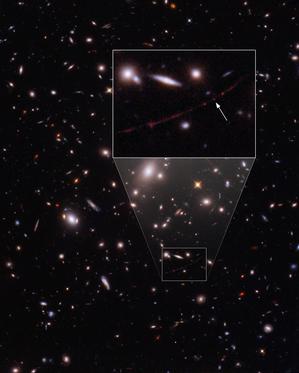
A gravitational lens magnifies one of the first stars
Pie de foto: This image zooms in on a star formed within the first billion years after the birth of the Universe (at a redshift of 6.2). The Hubble Space Telescope detected this light using a technique called gravitational lensing. A massive galaxy cluster between the observer and the imaged star creates a distorted and warped image of the parent galaxy and reveals its features.
Crédito: NASA, ESA, B. Welch (JHU), D. Coe (STScI), A. Pagan (STScI)
enlace de crédito
License: CC-BY-4.0 Creative Commons Reconocimiento 4.0 Internacional (CC BY 4.0) íconos

The Happy Face of Gravitational Lensing
Pie de foto: Captured by the NASA/ESA Hubble Space Telescope, this image showcases the galaxy cluster SDSS J1038+4849, affectionately dubbed the "happy face" cluster due to its striking resemblance to a smiling face. The two bright galaxies at the center resemble orange eyes, while the arcs surrounding them form the illusion of a smile. These arcs are actually a result of strong gravitational lensing, a phenomenon where the cluster's immense gravitational pull distorts and magnifies light from background objects. This particular case of gravitational lensing has produced an Einstein Ring, a ring-like structure formed by the precise alignment of the source, lens, and observer. By studying these gravitational lenses, astronomers gain insights into the properties of massive galaxies, allowing for a deeper understanding of the early Universe.
Crédito: NASA/ESA
enlace de crédito
License: PD Dominio público íconos
Actividades relacionadas

Dark matter & dark energy (Part 2) – Understanding the nature of dark matter and dark energy
astroEDU educational activity (links to astroEDU website) Description: Let's investigate the nature of dark matter and energy with gravitational lensing!
License: CC-BY-4.0 Creative Commons Reconocimiento 4.0 Internacional (CC BY 4.0) íconos
Etiquetas:
Experiment
, Invisible
Rango de edades:
12-14
, 14-16
, 16-19
, 19+
Nivel educativo:
Educación no forma
, Educación secundaria
Áreas de aprendizaje:
Aprendizaje por descubrimiento guiado
, Clase interactiva
, Modelización
, Resolución de problemas
Costos:
Coste medio
Duración:
45 minutos
Tamaño del grupo:
Grupo
Competencias:
Elaborar explicaciones
, Desarrollar y utilizar modelos
, Participar en debates basados en pruebas