Término del glosario: Neptuno
Descripción: Neptuno es el octavo planeta y el más lejano del Sol. Al igual que su vecino Urano, Neptuno es un gigante de hielo. El radio de Neptuno es de poco menos de 25 000 kilómetros (km), algo menos de cuatro veces el radio de la Tierra. Neptuno tiene un núcleo de roca sólida rodeado por una capa a alta presión de agua, metano y amoníaco. En el Sistema Solar exterior temprano, estas sustancias químicas se congelaron y se acumularon sobre el joven Neptuno, de ahí el nombre de «gigante helado». La atmósfera exterior de Neptuno es una capa densa y esponjosa de hidrógeno y helio.
Su distancia típica al Sol es de unos 4 500 millones de km, alrededor de 30 unidades astronómicas (distancias Tierra-Sol). Neptuno tiene al menos 14 lunas y un tenue sistema de anillos. Como el planeta mayor más externo, la gravedad de Neptuno desempeña un papel fundamental en la configuración de las órbitas de los cuerpos más pequeños del cinturón de Kuiper.
Neptuno no es visible a simple vista. Se identificó por primera vez debido al efecto que su gravedad tiene sobre la órbita de Urano. Los matemáticos John Couch Adams y Urbain Le Verrier predijeron la existencia y la ubicación de Neptuno a principios de la década de 1840. Basándose en los cálculos de Le Verrier, Johann Gottfried Galle identificó por primera vez a Neptuno en 1846. Neptuno recibe su nombre del dios romano del mar.
Términos relacionados:
- Unidad Astronómica
- Planeta gigante
- Gigante de hielo
- Cinturón de Kuiper
- Planetas exteriores
- Sistema Solar
- Urano
Ver este término en otros idiomas
Estado del término y la definición: La definición original de este término en inglés ha sido aprobada por unastrónomo o astrónoma investigadora y un docente La traducción de este término y su definición aún están pendientes de aprobación
El Glosario multilingüe de la OAE es un proyecto de la Oficina de Astronomía para la Educación de la UAI (OAE) en colaboración con la Oficina de Divulgación de Astronomía de la UAI (OAO). Los términos y definiciones fueron seleccionados, redactados y revisados gracias al esfuerzo colectivo de la OAE, los Centros y Nodos de la OAE, los Coordinadores Nacionales de Educación Astronómica (NAECs) y otros voluntarios. Puedes encontrar una lista completa de créditos aquí. Todos los términos del glosario y sus definiciones se publican bajo la licencia Creative Commons CC BY-4.0 y deben atribuirse a la "IAU OAE".
Si detectas algún error de contenido o de traducción en este término del glosario o en ladefinición, ponte en contacto con nosotros.
Contenidos relacionados
Neptune
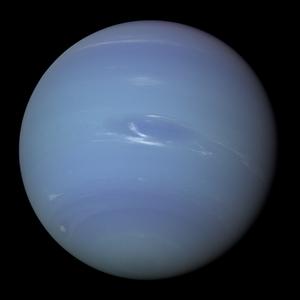
Pie de foto: Voyager 2 Narrow Angle Camera image of Neptune taken in August 1989. The Great Dark Spot, flanked by cirrus clouds, is at center. A smaller dark storm, Dark Spot Jr., is rotating into view at bottom left. Additionally, a patch of white cirrus clouds to its north, named "Scooter" for its rapid motion relative to other features, is visible.
Crédito: NASA / JPL / Voyager-ISS / Justin Cowart
enlace de crédito
License: PD Dominio público íconos

Neptune’s Moon Triton Fosters Rare Icy Union
Pie de foto: An image of Neptune's moon Triton taken by NASA's Voyager 2 spacecraft. This image covers the south pole region of Triton. Triton's surface is covered by an icy mix of frozen nitrogen, water and carbon dioxide. Below the surface some of these compounds are thought to be in a liquid state. These liquids can burst out of the surface through geysers. These geysers produce the dark streaks seen in this image.
Crédito: NASA/JPL
enlace de crédito
License: CC-BY-4.0 Creative Commons Reconocimiento 4.0 Internacional (CC BY 4.0) íconos