Término del glosario: Polaris
Descripción: Polaris es la estrella brillante más cercana (a menos de un grado) al polo norte celeste. Su designación oficial es α Ursae Minoris, pero se la conoce comúnmente como Polaris, la Estrella del Norte o la Estrella Polar. Todas las estrellas del hemisferio norte parecen girar a su alrededor, por lo que constituye un excelente punto fijo desde el que realizar mediciones para la navegación y la astrometría. Su elevación sobre el horizonte indica la latitud aproximada del lugar de observación. Sin embargo, su posición en la esfera celeste está cambiando lentamente debido a la precesión del eje de rotación de la Tierra, por lo que, dentro de varios siglos, Polaris ya no indicará la ubicación del polo norte celeste.
Polaris es un sistema estelar triple, compuesto por la estrella principal —una supergigante amarilla denominada Polaris Aa— que orbita alrededor de una compañera más pequeña, Polaris Ab, una estrella de secuencia principal muy cercana; el par tiene una compañera más lejana, Polaris B, una estrella de secuencia principal que orbita a una distancia de 2 400 unidades astronómicas. Polaris B puede observarse con un telescopio modesto. El Telescopio Espacial Hubble fue capaz de distinguir los tres miembros del sistema ternario de Polaris. La magnitud visual aparente de Polaris fluctúa porque Polaris Aa es una variable cefeida. El sistema de Polaris se encuentra a unos 447 años luz de la Tierra.
Estado del término y la definición: La definición original de este término en inglés ha sido aprobada por unastrónomo o astrónoma investigadora y un docente La traducción de este término y su definición aún están pendientes de aprobación
El Glosario multilingüe de la OAE es un proyecto de la Oficina de Astronomía para la Educación de la UAI (OAE) en colaboración con la Oficina de Divulgación de Astronomía de la UAI (OAO). Los términos y definiciones fueron seleccionados, redactados y revisados gracias al esfuerzo colectivo de la OAE, los Centros y Nodos de la OAE, los Coordinadores Nacionales de Educación Astronómica (NAECs) y otros voluntarios. Puedes encontrar una lista completa de créditos aquí. Todos los términos del glosario y sus definiciones se publican bajo la licencia Creative Commons CC BY-4.0 y deben atribuirse a la "IAU OAE".
Si detectas algún error de contenido o de traducción en este término del glosario o en ladefinición, ponte en contacto con nosotros.
En otros idiomas
- Árabe: النجم القطبي
- Alemán: Polarstern
- Inglés: Polaris
- Francés: Polaris
- Italiano: Polaris
- Japonés: 北極星 (enlace externo)
- Coreano: 북극성
- Portugués de Brasil: Polaris
- Chino simplificado: 北极星
- Chino tradicional: 北極星
Contenidos relacionados

Dreamlike Starry Sky and Airglow
Pie de foto: Winner in the 2022 IAU OAE Astrophotography Contest, category Still images of celestial patterns.
This spectacular image shows a range of prominent constellations visible in the night sky over the desert of inner Mongolia, taken in August 2019. The yellowish star in the bottom left side is Arcturus, one of the brightest stars in the night sky, and the brightest in the constellation Boötes. The handle of the Big Dipper points towards this bright star and the Dipper is also visible above Boötes. The Northern Dipper (Bei Dou) is a traditional Chinese constellation. It is considered a chariot in which the Judges for Nobility are sitting. Arcturus is considered a single-star asterism, named the Horn, which forms part of the Chinese super-constellation for the spring, the Azure Dragon of the East. The front of the Northern Dipper points towards the star at the top of the photograph which is now called Polaris, the northern Pole Star. In ancient China, there was no bright star at the pole, so the stars in the nearest vicinity of the pole were considered to belong to the emperor and his family in the constellation the Purple Forbidden Palace. At least as early as mediaeval times, Polaris was considered part of the constellation of the Great Emperor of Heaven.
Corona Borealis is also visible in the top right corner of this image, although not in its completeness. It is called the Coiled Thong in China. With its characteristic semi-circular shape, this is one of the smaller constellations of the 88 modern ones, but also can be traced back at least three or four millennia through the Roman “Crown”, the Greek wedding “Wreath”, and the Babylonian “Asterism of Dignity”. The modern name literally means “Northern Crown” in Latin.
At the upper-right edge of the image, we find the part of the modern constellation Cassiopeia that is considered the Flying Corridor and an Auxiliary Road in ancient China. The W-shape of Cassiopeia is cut off by the edge of the photograph but the constellations to its south and southeast, Andromeda and Perseus, are clearly recognisable. Prominently we see the Andromeda galaxy, the most distant object that is visible to the unaided eye. It is located at the outermost outliers of the band of the Milky Way, which could explain why it has not been mentioned explicitly in ancient star catalogues, as it was mistakenly thought to be part of the Milky Way. The photograph also shows clearly reddish parts of the Milky Way that don’t appear bright to the naked eye, and also open clusters that are formed from the same molecular cloud, i.e., groups of stars with similar ages. This region is part of many big and small asterisms in traditional Chinese uranology.
Crédito: Likai Lin/IAU OAE
License: CC-BY-4.0 Creative Commons Reconocimiento 4.0 Internacional (CC BY 4.0) íconos

Big Dipper in Four Seasons
Pie de foto: Winner in the 2022 IAU OAE Astrophotography Contest, category Still images of celestial patterns.
As Earth moves around the Sun, the positions of the stars in the night sky appear to change over the course of the year. This is well exemplified in this mosaic, with images taken in all four seasons throughout 2020 in the region of Veneto, Italy, showing the apparent motion of the Ursa Minor and Ursa Major constellations.
Ursa Minor, the Little Bear, is a constellation of the northern hemisphere, and it contains the northern celestial pole, in our current epoch marked by a bright star called Polaris or the Pole Star. For centuries Polaris has been used for navigation in the northern hemisphere, as it has been almost at the exact pole position for roughly 200 years. In the Middle Ages and antiquity, there was no pole star; the celestial north pole lay in a dark region and the Greeks considered the “Little She-Bear” as a companion of the “Great She-Bear”, which is more easily recognizable. The brightest stars of these constellations were alternatively also considered as chariots by the Greeks, as written in Aratus’s famous didactic poem from the 3rd century before the common era. The most famous asterism in Ursa Major, composed of seven stars, has different names across the (northern) world. While considered as a chariot by the Greeks, it is “The Northern Dipper” in China, and “The Seven Oxen” for the ancient Romans.
It was also the navigational purpose that led to the name The Great She-Bear, Ursa Major; for the Greeks, travelling towards the direction of the horizon above which Ursa Major appears meant moving towards the land of the bears (northern Europe). An animal is clearly recognizable when taking into account all the fainter stars in the vicinity of the seven bright ones. They considered it a female bear because Greek mythology connects this animal with the nymph Callisto, whose story describes the initiation rituals for women.
In the top left, we see an image taken on a spring evening, while the image below shows the same portion of the sky on a summer evening. Going counterclockwise, we see the sky during autumn in the bottom right image, while the top right finally shows this portion of the sky in the winter. Note that the relative positions of Ursa Minor and the Big Dipper don’t change, but all stars appear to be moved in a circle around Polaris. This star pointing due north lies at the point where Earth’s rotational axis intersects the celestial sphere.
The shift of constellations throughout the year is therefore a globe-clock or a globe-calendar, used by ancient civilizations to measure the year, and to predict the changes of seasons. It helps to establish, for instance, the best time for sowing and sailing as winds change with the seasons.
Crédito: Giorgia Hofer/IAU OAE
License: CC-BY-4.0 Creative Commons Reconocimiento 4.0 Internacional (CC BY 4.0) íconos

Big Dipper and Comet Neowise C2020 F3
Pie de foto: Honorable mention in the 2023 IAU OAE Astrophotography Contest, category of Time-lapses of rotation of Big Dipper or Southern Cross.
This time-lapse documents the trajectory of the iconic Big Dipper across three frames taken in July 2020. Captured from three locations in Italy, Tre Cime di Lavaredo Auronzo di Cadore, Monte Rite, Cibiana di Cadore, and Casera Razzo, Vigo di Cadore, this visual odyssey showcases the captivating journey of the Big Dipper with the addition of trails of stars painting a celestial canvas. It not only traces the path of this renowned asterism but also features the rare appearance of comet Neowise C/2020 F3, an extraordinary event that graced our skies during July 2020.
Crédito: Giorgia Hofer/IAU OAE (CC BY 4.0)
License: CC-BY-4.0 Creative Commons Reconocimiento 4.0 Internacional (CC BY 4.0) íconos
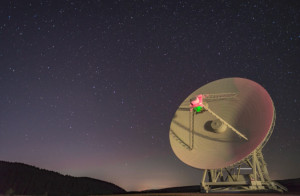
The Big Dipper with the Sardinia Radio Telescope SRT
Pie de foto: Honorable mention in the 2023 IAU OAE Astrophotography Contest, category of Time-lapses of rotation of Big Dipper or Southern Cross.
This time-lapse captures the movement of the stars alongside the majestic 64-metre Sardinia Radio Telescope (SRT) from the National Institute of Astrophysics (INAF), with special attention to the renowned Big Dipper against the backdrop of the celestial sphere. The camera pans as the famous asterism sinks in the sky while planes fly past and the radio telescope rotates. The harmonious interplay between the stellar pathways and the colossal dish of the radio telescope creates a mesmerising visual ode to the cosmic ballet taken in September 2019.
Crédito: Antonio Finazzi/IAU OAE (CC BY 4.0)
License: CC-BY-4.0 Creative Commons Reconocimiento 4.0 Internacional (CC BY 4.0) íconos

Big Dipper Over the Mono Lake
Pie de foto: Honorable mention in the 2023 IAU OAE Astrophotography Contest, category of Time-lapses of rotation of Big Dipper or Southern Cross.
The Big Dipper asterism gracefully moves above the otherworldly tufa formations of Mono Lake, California. The time-lapse captures the Big Dipper’s movement across the northern horizon until its inferior conjunction. At Mono Lake’s latitude (+38°), the stars of the Big Dipper remain circumpolar, except for Alkaid. The North Star sits 38° above the horizon, just outside the field of view in the top right. The lunar illumination bathes the landscape in a soft glow, gradually fading as the Moon sets, cloaking the scene in darkness.
Crédito: Fabrizio Melandri/IAU OAE (CC BY 4.0)
License: CC-BY-4.0 Creative Commons Reconocimiento 4.0 Internacional (CC BY 4.0) íconos
Diagramas relacionados
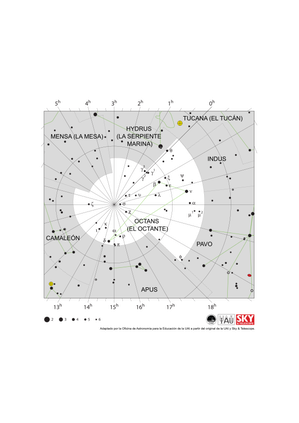
Mapa de la Constelación de Octans
Pie de foto: La constelación de Octans junto con sus estrellas brillantes y las constelaciones que la rodean. Octans está rodeada por (en el sentido de las agujas del reloj desde arriba): Hydrus, Indus, Pavo, Apus, Camaleón y Mensa. Octans es una constelación relativamente débil que destaca por encontrarse en el polo sur celeste. Mientras que la estrella del polo norte es la relativamente brillante Polaris, sigma Octans, la estrella del polo sur, apenas es visible a simple vista.
Octans se encuentra en el polo sur celeste, por lo que es visible desde todo el hemisferio sur y parte de la constelación desde las regiones ecuatoriales del hemisferio norte. La constelación es circumpolar en la mayor parte del hemisferio sur. Se observa mejor al atardecer en otoño en el hemisferio norte y en primavera en el hemisferio sur.
Este diagrama muestra una zona alrededor del polo sur celeste. Aquí convergen líneas de ascensión recta constante. Los valores de ascensión recta de estas líneas (en horas) están marcados en el eje-x por encima y por debajo del diagrama. El círculo sólido alrededor del polo marca una línea de -80° de declinación y el círculo más grande e incompleto a la derecha marca -70° de declinación. El tamaño de las estrellas marcadas aquí está relacionado con la magnitud aparente de la estrella, una medida de su brillo aparente. Los puntos más grandes representan las estrellas más brillantes. Las letras griegas indican las estrellas más brillantes de la constelación. Están ordenadas según su brillo: la estrella más brillante se denomina alfa, la segunda más brillante beta, etc., aunque este orden no siempre se sigue con exactitud. Las líneas punteadas marcan los límites de las constelaciones según la UAI y las líneas verdes continuas marcan una de las formas habituales utilizadas para representar las figuras de las constelaciones. Ni los límites de las constelaciones ni las líneas que unen las estrellas aparecen en el cielo.
Crédito: Adaptado por la Oficina de Astronomía para la Educación de la UAI a partir del original de UAI/Sky & Telescope
License: CC-BY-4.0 Creative Commons Reconocimiento 4.0 Internacional (CC BY 4.0) íconos
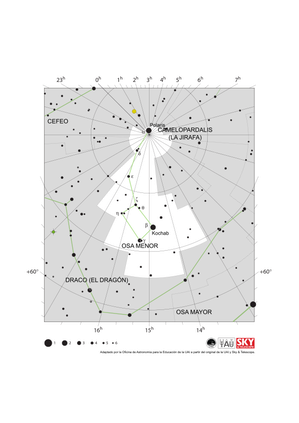
Mapa de la Constelación de la Osa Menor
Pie de foto: La constelación de la Osa Menor junto con sus estrellas brillantes y las constelaciones que la rodean. La Osa Menor está rodeada por (en el sentido de las agujas del reloj desde arriba): Cefeo, Camelopardalis y Draco. La Osa Menor destaca por su estrella más brillante, Polaris, que es la estrella del polo norte.
La Osa Menor es visible desde todo el hemisferio norte y algunas partes de la constelación desde las regiones ecuatoriales del hemisferio sur. También es circumpolar para las regiones templadas y árticas del hemisferio norte. Polaris, situada muy cerca del polo norte celeste, es circumpolar para todo el hemisferio norte. La constelación es más visible por la noche en verano en el hemisferio norte y en invierno en el hemisferio sur.
Este diagrama muestra una zona alrededor del polo norte celeste. Aquí convergen las líneas de ascensión recta constante. Los valores de ascensión recta (en horas) de estas líneas están marcados en el eje-x encima y debajo del diagrama. Algunas de las líneas de declinación constante (en grados) están marcadas en el eje-y. El tamaño de las estrellas marcadas aquí está relacionado con la magnitud aparente de la estrella, una medida de su brillo aparente. Los puntos más grandes representan estrellas más brillantes. Las letras griegas indican las estrellas más brillantes de la constelación. Están ordenadas según su brillo: la estrella más brillante se denomina alfa, la segunda más brillante beta, etc., aunque este orden no siempre se sigue con exactitud. Las líneas punteadas marcan los límites de las constelaciones según la UAI y las líneas verdes continuas marcan una de las formas habituales utilizadas para representar las figuras de las constelaciones. Ni los límites de las constelaciones ni las líneas que unen las estrellas aparecen en el cielo.
Crédito: Adaptado por la Oficina de Astronomía para la Educación de la UAI a partir del original de UAI/Sky & Telescope
License: CC-BY-4.0 Creative Commons Reconocimiento 4.0 Internacional (CC BY 4.0) íconos
Actividades relacionadas

Navigating with the Kamal – Northern Hemisphere
astroEDU educational activity (links to astroEDU website) Description: How did Arabian sailors navigate at sea?
License: CC-BY-4.0 Creative Commons Reconocimiento 4.0 Internacional (CC BY 4.0) íconos
Etiquetas:
History
, Geography
, Coordinates
, Celestial navigation
, Arabia
, Kamal
Rango de edades:
14-16
, 16-19
Nivel educativo:
Educación secundaria
, Secondary
Áreas de aprendizaje:
Modelización
, Aprendizaje basado en la investigación estructurada
Costos:
Bajo coste
Duración:
1 hora y 30 minutos
Tamaño del grupo:
Grupo
Competencias:
Analizar e interpretar datos
, Plantear preguntas
, Comunicar información
, Desarrollar y utilizar modelos
, Planificar y llevar a cabo investigaciones