Término del glosario: Anillo
Descripción: Los cuatro planetas gigantes de nuestro Sistema Solar (Júpiter, Saturno, Urano y Neptuno) —en el caso de los exoplanetas, aún no lo sabemos— están rodeados por numerosos fragmentos pequeños de hielo o roca, de un tamaño que va desde los micrómetros hasta los metros, en forma de grandes anillos. Los anillos más espectaculares son los que rodean a Saturno: un intrincado sistema de anillos separados por huecos. Parte de esa estructura se debe a la interacción con las lunas más grandes de Saturno, y dos huecos se abren por la presencia de lunas diminutas que orbitan en su interior. Existen varias hipótesis sobre cómo se formaron los anillos, la mayoría de ellas relacionadas con una luna desintegrada o destruida por la gravedad de Saturno. Se estima que los anillos de Saturno se habrán disuelto en unos pocos cientos de millones de años, lo que no es mucho tiempo en términos astronómicos. Júpiter, Urano y Neptuno tienen sistemas de anillos menos pronunciados.
Términos relacionados:
Ver este término en otros idiomas
Estado del término y la definición: La definición original de este término en inglés ha sido aprobada por unastrónomo o astrónoma investigadora y un docente La traducción de este término y su definición aún están pendientes de aprobación
El Glosario multilingüe de la OAE es un proyecto de la Oficina de Astronomía para la Educación de la UAI (OAE) en colaboración con la Oficina de Divulgación de Astronomía de la UAI (OAO). Los términos y definiciones fueron seleccionados, redactados y revisados gracias al esfuerzo colectivo de la OAE, los Centros y Nodos de la OAE, los Coordinadores Nacionales de Educación Astronómica (NAECs) y otros voluntarios. Puedes encontrar una lista completa de créditos aquí. Todos los términos del glosario y sus definiciones se publican bajo la licencia Creative Commons CC BY-4.0 y deben atribuirse a la "IAU OAE".
Si detectas algún error de contenido o de traducción en este término del glosario o en ladefinición, ponte en contacto con nosotros.
Contenidos relacionados
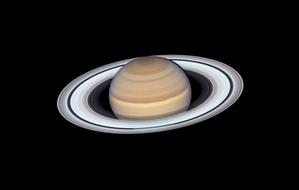
Saturn
Pie de foto: The NASA/ESA Hubble Space Telescope’s Wide Field Camera 3 observed Saturn on 20 June 2019 as the planet made its closest approach to Earth this year, at approximately 1.36 billion kilometres away. The image shows coloured bands of gas on the planet's surface as well as its prominent rings made of ice and rocky material.
Crédito: NASA, ESA, A. Simon (Goddard Space Flight Center), and M.H. Wong (University of California, Berkeley)
enlace de crédito
License: CC-BY-4.0 Creative Commons Reconocimiento 4.0 Internacional (CC BY 4.0) íconos
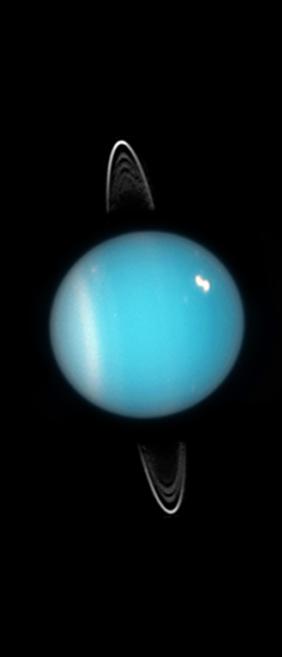
Urano con anillos
Pie de foto: La cámara ACS/HRC del telescopio espacial Hubble de la NASA y la ESA observó Urano en agosto de 2005. En la superficie se aprecian nubes blancas y una región polar brillante. Los anillos que rodean a Urano son estrechos y contienen material rocoso que va desde diminutas partículas de polvo hasta rocas de un metro de tamaño.
Crédito: NASA, ESA y M. Showalter (Instituto SETI)
enlace de crédito
License: PD Dominio público íconos