Glossary term: 고리
Description: 우리 태양계의 네 개의 거대 행성(목성, 토성, 천왕성, 해왕성)은 모두 고리를 가지고 있습니다. 이 고리는 마이크로미터에서 미터 크기까지 되는 수많은 작은 얼음이나 암석 조각들이 모여 큰 띠처럼 둘러싸여 있는 것입니다. 외계행성의 고리는 아직 알 수 없지만, 태양계에서는 네 개의 행성에서 모두 발견됩니다. 그 중에도 가장 멋진 고리는 토성의 고리입니다. 토성의 고리는 여러개의 고리로 이루어져 있고, 사이에 틈도 있어 매우 복잡한 구조를 이룹니다. 이런 구조 중 일부는 토성의 큰 위성과 상호 작용하면서 생겨났습니다. 또 어떤 틈은 그 안을 도는 작은 위성이 열어 놓은 것입니다. 토성의 고리가 어떻게 생겨났는지는 아직 확실하지 않지만, 가장 널리 받아들여지는 생각은 토성의 중력에 의해 토성의 달(위성)이 찢기거나 부서져서 고리가 되었다는 것입니다. 토성의 고리는 몇 억 년 안에 사라질 것으로 보이는데, 천문학에서 볼 때는 그렇게 긴 시간이 아닙니다. 목성, 천왕성, 해왕성도 고리를 가지고 있지만, 토성처럼 눈에 띄거나 화려하지는 않습니다.
Related Terms:
See this term in other languages
Term and definition status: The original definition of this term in English have been approved by a research astronomer and a teacher The translation of this term and its definition is still awaiting approval
The OAE Multilingual Glossary is a project of the IAU Office of Astronomy for Education (OAE) in collaboration with the IAU Office of Astronomy Outreach (OAO). The terms and definitions were chosen, written and reviewed by a collective effort from the OAE, the OAE Centers and Nodes, the OAE National Astronomy Education Coordinators (NAECs) and other volunteers. You can find a full list of credits here. All glossary terms and their definitions are released under a Creative Commons CC BY-4.0 license and should be credited to "IAU OAE".
If you notice a factual or translation error in this glossary term or definition then please get in touch.
Related Media
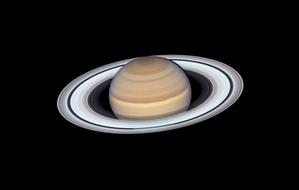
Saturn
Caption: The NASA/ESA Hubble Space Telescope’s Wide Field Camera 3 observed Saturn on 20 June 2019 as the planet made its closest approach to Earth this year, at approximately 1.36 billion kilometres away. The image shows coloured bands of gas on the planet's surface as well as its prominent rings made of ice and rocky material.
Credit: NASA, ESA, A. Simon (Goddard Space Flight Center), and M.H. Wong (University of California, Berkeley)
credit link
License: CC-BY-4.0 Creative Commons 저작자표시 4.0 국제 (CC BY 4.0) icons
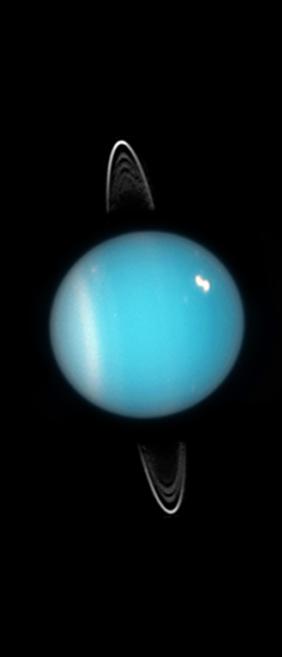
Uranus with rings
Caption: The NASA/ESA Hubble Space Telescope’s ACS/HRC camera observed Uranus in August 2005. The surface depicts white clouds and a bright polar region. The rings around Uranus are narrow and contain rocky material from tiny dust particles up to metre-sized boulders.
Credit: NASA, ESA, and M. Showalter (SETI Institute)
credit link
License: PD Public Domain icons