Término del glosario: Galaxia espiral
Descripción: Las galaxias espirales son galaxias que tienen brazos espirales: regiones de mayor densidad que se forman a medida que gira una galaxia, donde el gas y el polvo se comprimen y nacen nuevas estrellas. La mayoría de las galaxias espirales son galaxias de disco, por lo que a veces se utilizan ambos nombres indistintamente. La mayoría de las galaxias espirales tienen un bulbo central de estrellas, y muchas (incluida la Vía Láctea) tienen una barra central. Las galaxias espirales se diferencian de las galaxias elípticas, lenticulares, irregulares y enanas (aunque también existen galaxias espirales enanas).
Términos relacionados:
- Galaxia de disco
- Polvo
- Galaxia enana
- Galaxia elíptica
- Galaxia
- Gas
- Vía Láctea
- Barra galáctica
- Galaxia lenticular
Ver este término en otros idiomas
Estado del término y la definición: La definición original de este término en inglés ha sido aprobada por unastrónomo o astrónoma investigadora y un docente La traducción de este término y su definición aún están pendientes de aprobación
El Glosario multilingüe de la OAE es un proyecto de la Oficina de Astronomía para la Educación de la UAI (OAE) en colaboración con la Oficina de Divulgación de Astronomía de la UAI (OAO). Los términos y definiciones fueron seleccionados, redactados y revisados gracias al esfuerzo colectivo de la OAE, los Centros y Nodos de la OAE, los Coordinadores Nacionales de Educación Astronómica (NAECs) y otros voluntarios. Puedes encontrar una lista completa de créditos aquí. Todos los términos del glosario y sus definiciones se publican bajo la licencia Creative Commons CC BY-4.0 y deben atribuirse a la "IAU OAE".
Si detectas algún error de contenido o de traducción en este término del glosario o en ladefinición, ponte en contacto con nosotros.
En otros idiomas
- Árabe: المجرة الحلزونية
- Alemán: Spiralgalaxie
- Inglés: Spiral Galaxy
- Francés: Galaxie spirale
- Italiano: Galassia a spirale
- Japonés: 渦巻銀河 (enlace externo)
- Coreano: 나선은하
- Portugués de Brasil: Galáxia espiral
- Chino simplificado: 漩涡星系
- Chino tradicional: 漩渦星系
Contenidos relacionados
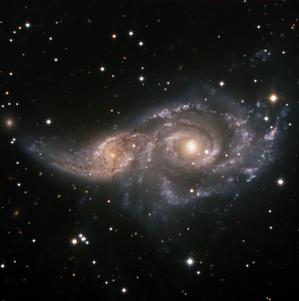
Spiral Galaxy Merger
Pie de foto: This image shows two interacting spiral galaxies located approximately 150 million light-years away. Two spiral galaxies are involved in this dance, creating visible distortions in their spiral arms due to the gravitational pull. What is starting as an embrace in this picture, will end in the merger of those two galaxies into one, most likely elliptical, galaxy.
Crédito: ESO
enlace de crédito
License: CC-BY-4.0 Creative Commons Reconocimiento 4.0 Internacional (CC BY 4.0) íconos

A visible light image of the Andromeda Galaxy
Pie de foto: The Andromeda Galaxy viewed in visible light. Like our Milky Way, Andromeda is a barred spiral galaxy. Here we can see its bright core and spiral disk. The glow from the stars in the disk is interrupted by lanes of dust that form part of its spiral structure.
Andromeda is the largest galaxy in the Local Group of galaxies that includes the Milky Way.
To the left of the core and just above the disk we see the dwarf galaxy M32 and to the right and below the disk we see the dwarf galaxy M110. These are both satellite galaxies of the Andromeda Galaxy.
Crédito: Torben Hansen
enlace de crédito
License: CC-BY-2.0 Creative Commons Atribución 2.0 Genérica íconos

Spiral Galaxy UGC 2885
Pie de foto: This image shows UGC 2885, a spiral galaxy located in the constellation Perseus, about 230 million light-years from Earth. Spiral galaxies have rotating disks of stars, gas, and dust, with spiral arms extending outward from the central region. In UGC 2885, these arms are very broad and faint, revealing the galaxy’s large size. This galaxy is tilted at an angle to the observer on Earth, meaning it does not appear as the circular "grand design" spiral it would look like if viewed face-on, nor as the thin line with a central bulge it would appear as if viewed edge-on.
UGC 2885 is remarkable because it is roughly twice the diameter of the Milky Way. It was studied by astronomer Vera Rubin, whose observations of how galaxies rotate — including systems like this one — played a key role in the search for dark matter.
The bright star which appears to the left of the galaxy's center is a foreground object not related to the galaxy.
Crédito: NASA, ESA, Benne Holwerda (University of Louisville)
enlace de crédito
License: PD Dominio público íconos
Diagramas relacionados
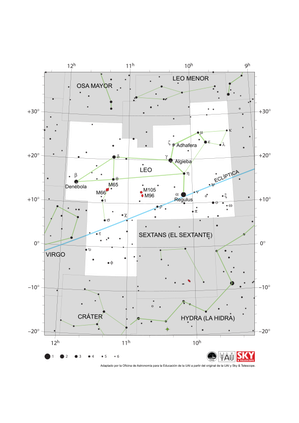
Mapa de la constelación de Leo
Pie de foto: La constelación zodiacal de Leo y las constelaciones que la rodean. Empezando por la parte superior del diagrama y siguiendo el sentido de las agujas del reloj, son Leo Menor, Cáncer, Sextante, Hidra, Cráter, Virgo y Osa Mayor. La estrella más brillante de Leo, Regulus, se encuentra casi exactamente en la eclíptica (mostrada aquí como una línea azul): la trayectoria que el Sol parece seguir a través del cielo en el transcurso de un año. El Sol se encuentra en Leo desde mediados de agosto hasta mediados de septiembre. Los demás planetas del Sistema Solar se encuentran a menudo en Leo.
Leo abarca el ecuador celeste y, por tanto, parte de ella es visible en algún momento del año desde todo el planeta Tierra, con parte de la constelación oscurecida para las regiones más árticas y antárticas del mundo. Leo es más visible por la noche en primavera en el hemisferio norte y en otoño en el hemisferio sur.
Varios objetos pueden verse en Leo, incluyendo M65 y M66 - dos galaxias en el Triplete de Leo, un trío de galaxias incluyendo NGC 3628, no listada aquí. Además, M96, una galaxia espiral, puede verse como un objeto borroso utilizando un telescopio pequeño, y Messier 105, una galaxia elíptica. Cada uno de estos objetos está marcado en el mapa como elipses rojas.
El eje-y de este diagrama está en grados de declinación con el norte hacia arriba y el eje-x está en horas de ascensión recta con el este a la izquierda. El tamaño de las estrellas marcadas aquí está relacionado con la magnitud aparente de la estrella, una medida de su brillo aparente. Los puntos más grandes representan estrellas más brillantes. Las letras griegas indican las estrellas más brillantes de la constelación. Están ordenadas según su brillo: la estrella más brillante se denomina alfa, la segunda más brillante beta, etc., aunque este orden no siempre se sigue con exactitud. Las líneas punteadas marcan los límites de las constelaciones según la UAI y las líneas verdes continuas marcan una de las formas habituales utilizadas para representar las figuras de las constelaciones. Ni los límites de las constelaciones, ni la línea que marca la eclíptica, ni las líneas que unen las estrellas aparecen en el cielo.
Crédito: Adaptado por la Oficina de Astronomía para la Educación de la UAI a partir del original de UAI/Sky & Telescope
License: CC-BY-4.0 Creative Commons Reconocimiento 4.0 Internacional (CC BY 4.0) íconos

Mapa de la constelación de Virgo
Pie de foto: La constelación zodiacal de Virgo y las constelaciones que la rodean. Comenzando por la parte superior del diagrama y siguiendo el sentido de las agujas del reloj, son Coma Berenices, Leo, Cráter, Corvus, Libra y Bootes. La estrella más brillante de Virgo, Espiga, se encuentra justo debajo de la eclíptica (mostrada aquí como una línea azul) en el centro del mapa. Una forma de localizar esta estrella en el cielo nocturno es seguir el asa de la Osa Mayor hasta la estrella Arcturus en Bootes y seguir una línea recta hasta Espiga ("arco a Arcturus y espiga a Spica"). Esta estrella se encuentra justo debajo de la eclíptica. La eclíptica es la trayectoria que el Sol parece seguir a través del cielo en el transcurso de un año. El Sol se encuentra en Virgo desde mediados de septiembre hasta finales de octubre. Los demás planetas del Sistema Solar se encuentran a menudo en Virgo.
Virgo abarca el ecuador celeste y, por tanto, parte de ella es visible en algún momento del año desde todo el planeta Tierra, con parte de la constelación oscurecida para las regiones más árticas y antárticas del mundo. Virgo es más visible por las tardes en primavera en el hemisferio norte y en otoño en el hemisferio sur.
La constelación de Virgo aparece como una persona tumbada con la espalda casi pegada a la eclíptica, los brazos extendidos y los pies apuntando hacia el este. En Virgo son visibles varios objetos de cielo profundo, como NGC4697, M49, M87, M86, M84 y M60, todos ellos mostrados con elipses rojas en el mapa. Todas ellas son galaxias espirales y elípticas situadas a varios millones de años luz de la Tierra. Más notablemente, M87 alberga el agujero negro supermasivo (Pōwehi) que fue fotografiado por el Event Horizon Telescope en 2019. Todas estas galaxias son miembros del Cúmulo de Virgo, el cúmulo de galaxias más cercano a la Vía Láctea.
El eje-y de este diagrama está en grados de declinación con el norte hacia arriba y el eje-x está en horas de ascensión recta con el este a la izquierda. El tamaño de las estrellas mostradas aquí está relacionado con la magnitud aparente de la estrella, una medida de su brillo aparente. Los puntos más grandes representan estrellas más brillantes. Las letras griegas indican las estrellas más brillantes de la constelación. Están ordenadas según su brillo: la estrella más brillante se denomina alfa, la segunda más brillante beta, etc., aunque este orden no siempre se sigue con exactitud. Las líneas punteadas marcan los límites de las constelaciones según la UAI y las líneas verdes continuas marcan una de las formas habituales utilizadas para representar las figuras de las constelaciones. Ni los límites de las constelaciones, ni la línea que marca la eclíptica, ni las líneas que unen las estrellas aparecen en el cielo.
Crédito: Adaptado por la Oficina de Astronomía para la Educación de la UAI a partir del original de UAI/Sky & Telescope
License: CC-BY-4.0 Creative Commons Reconocimiento 4.0 Internacional (CC BY 4.0) íconos

Mapa de la Constelación de la Osa Mayor
Pie de foto: La constelación de la Osa Mayor junto con sus estrellas brillantes y las constelaciones que la rodean. La Osa Mayor está rodeada por (en el sentido de las agujas del reloj desde arriba): Draco, Camelopardalis, Lynx, Leo Menor, Leo, Coma Berenices, Canes Venatici y Bootes. La Osa Mayor es famosa por su distintivo asterismo, a menudo conocido en inglés como Big Dipper (Osa Mayor) o Plough (Arado). Este distintivo asterismo septentrional recibe una gran variedad de nombres de culturas de todo el mundo. Mientras que la mayoría de las constelaciones y asterismos están formados por estrellas no relacionadas que aparecen juntas en el cielo de forma aleatoria, cinco de las estrellas de la Osa Mayor forman parte de la Asociación Estelar de la Osa Mayor, un grupo de estrellas que se mueven juntas por el espacio y que probablemente se formaron en el mismo lugar hace 300 millones de años. Las dos estrellas del extremo derecho de la Osa Mayor en este diagrama forman un par de estrellas puntero que pueden utilizarse para localizar a Polaris, la estrella polar del norte que se encuentra en la constelación de la Osa Menor.
La Osa Mayor es una constelación boreal y es visible desde las regiones septentrionales y ecuatoriales. Algunas partes de la constelación son visibles desde todas las regiones del hemisferio sur, excepto las más antárticas, pero no todas las regiones templadas del hemisferio sur pueden ver toda la Osa Mayor. Por el contrario, la Osa Mayor y gran parte del resto de la constelación son circumpolares en las regiones árticas y en muchas regiones templadas del hemisferio norte. La Osa Mayor es más visible al atardecer en primavera en el hemisferio norte y en otoño en el hemisferio sur.
En la parte norte de esta constelación aparecen dos galaxias destacadas, la galaxia espiral M81, y M82, una posible galaxia espiral cuya estructura es difícil de observar desde la Tierra, ya que aparece de canto. Ambas se muestran aquí como elipses rojas. La nebulosa planetaria M97 (la nebulosa del Búho) se encuentra en el centro de la constelación y está marcada con un círculo verde superpuesto a un signo de más.
El eje-y de este diagrama está en grados de declinación con el norte hacia arriba y el eje-x está en horas de ascensión recta con el este a la izquierda. El tamaño de las estrellas marcadas aquí está relacionado con la magnitud aparente de la estrella, una medida de su brillo aparente. Los puntos más grandes representan estrellas más brillantes. Las letras griegas indican las estrellas más brillantes de la constelación. Están ordenadas según su brillo: la estrella más brillante se denomina alfa, la segunda más brillante beta, etc., aunque este orden no siempre se sigue con exactitud. Las líneas punteadas marcan los límites de las constelaciones según la UAI y las líneas verdes continuas marcan una de las formas habituales utilizadas para representar las figuras de las constelaciones. Ni los límites de las constelaciones ni las líneas que unen las estrellas aparecen en el cielo.
Crédito: Adaptado por la Oficina de Astronomía para la Educación de la UAI a partir del original de UAI/Sky & Telescope
License: CC-BY-4.0 Creative Commons Reconocimiento 4.0 Internacional (CC BY 4.0) íconos
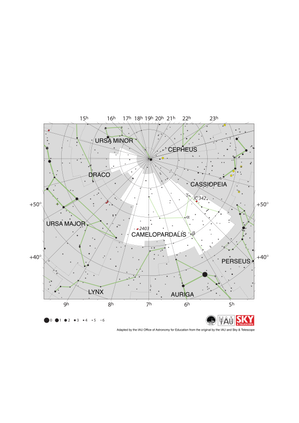
Camelopardalis Constellation Map
Pie de foto: The constellation Camelopardalis with its bright stars and surrounding constellations. Camelopardalis is surrounded by (going clockwise from the top): Cepheus, Cassiopea, Perseus, Auriga, Lynx, Ursa Major, Draco and Ursa Minor. Camelopardalis is a large constellation but contains relatively few bright stars.
Camelopardalis is a northern constellation and as such the whole constellation is visible for the whole northern hemisphere at some point in the year. It is also visible from equatorial parts of the southern hemisphere with some parts visible to temperate southern regions. The whole constellation is circumpolar for all arctic and more northerly temperate regions of the northern hemisphere. Camelopardalis is best viewed in the evening in the late northern hemisphere winter and late southern hemisphere summer.
The spiral galaxies NGC 2403 and IC 342 lie in Camelopardalis and are marked here with red ellipses.
This diagram maps an area around the north celestial pole. Here lines of constant right ascension converge. The right ascension values of these lines are marked on the x-axis above and below the diagram. Some of the lines of constant declination are marked on the y-axis. The sizes of the stars marked here relate to the star's apparent magnitude, a measure of its apparent brightness. The larger dots represent brighter stars. The Greek letters mark the brightest stars in the constellation. These are ranked by brightness with the brightest star being labeled alpha, the second brightest beta, etc., although this ordering is not always followed exactly. The dotted boundary lines mark the IAU's boundaries of the constellations and the solid green lines mark one of the common forms used to represent the figures of the constellations. Neither the constellation boundaries, nor the lines joining the stars appear on the sky.
Crédito: Adapted by the IAU Office of Astronomy for Education from the original by the IAU and Sky & Telescope
License: CC-BY-4.0 Creative Commons Reconocimiento 4.0 Internacional (CC BY 4.0) íconos
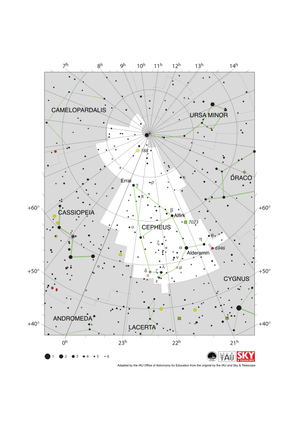
Cepheus Constellation Map
Pie de foto: The constellation Cepheus along with its bright stars and surrounding constellations. Cepheus is surrounded by (going clockwise from the top): Camelopardalis, Ursa Minor, Draco, Cygnus, Lacerta and Cassiopeia. Cepheus is a large constellation. Its most notable star is Delta Cephei, the prototype for the class of variable stars known as Cepheid variables. These are variable stars which can be used to estimate distances both within our galaxy and to nearby galaxies.
Cepheus lies close to the north celestial pole. As such it is circumpolar for arctic and temperate regions of the northern hemisphere. The whole of the constellation is also visible at some point in the year in equatorial regions of the northern hemisphere with parts of it visible in equatorial regions of the southern hemisphere. It is best viewed in the evening in the northern hemisphere late autumn and southern hemisphere late spring.
The open cluster NGC 188 lies in Cepheus and is marked here with a yellow circle. The nebula NGC 7023 also lies in the constellation and is marked with a green square. The red ellipse in the lower right marks the position of the spiral galaxy NGC 6946.
This diagram maps an area around the north celestial pole. Here lines of constant right ascension converge. The right ascension values of these lines are marked on the x-axis above and below the diagram. Some of the lines of constant declination are marked on the y-axis. The sizes of the stars marked here relate to the star's apparent magnitude, a measure of its apparent brightness. The larger dots represent brighter stars. The Greek letters mark the brightest stars in the constellation. Delta Cephei is marked with a circle around a dot as it is a variable star. Mu Cephei is also a variable star marked here as an open circle. These are ranked by brightness with the brightest star being labeled alpha, the second brightest beta, etc., although this ordering is not always followed exactly. The dotted boundary lines mark the IAU's boundaries of the constellations and the solid green lines mark one of the common forms used to represent the figures of the constellations. Neither the constellation boundaries, nor the lines joining the stars appear on the sky.
Crédito: Adapted by the IAU Office of Astronomy for Education from the original by the IAU and Sky & Telescope
License: CC-BY-4.0 Creative Commons Reconocimiento 4.0 Internacional (CC BY 4.0) íconos








.jpg)
