Término del glosario: Galaxia de disco
Descripción: Una galaxia de disco es un tipo de galaxia que presenta una estructura plana formada por estrellas, gas y polvo, todos ellos en movimiento circular coplanar alrededor del centro de la galaxia. En estos discos suelen encontrarse brazos espirales y la actividad de formación estelar asociada a ellos. En la mayoría de los esquemas de clasificación de galaxias, las galaxias de disco se distinguen de las galaxias elípticas, irregulares y enanas.
Términos relacionados:
Ver este término en otros idiomas
Estado del término y la definición: La definición original de este término en inglés ha sido aprobada por unastrónomo o astrónoma investigadora y un docente La traducción de este término y su definición aún están pendientes de aprobación
El Glosario multilingüe de la OAE es un proyecto de la Oficina de Astronomía para la Educación de la UAI (OAE) en colaboración con la Oficina de Divulgación de Astronomía de la UAI (OAO). Los términos y definiciones fueron seleccionados, redactados y revisados gracias al esfuerzo colectivo de la OAE, los Centros y Nodos de la OAE, los Coordinadores Nacionales de Educación Astronómica (NAECs) y otros voluntarios. Puedes encontrar una lista completa de créditos aquí. Todos los términos del glosario y sus definiciones se publican bajo la licencia Creative Commons CC BY-4.0 y deben atribuirse a la "IAU OAE".
Si detectas algún error de contenido o de traducción en este término del glosario o en ladefinición, ponte en contacto con nosotros.
En otros idiomas
- Árabe: المجرة القرصية
- Alemán: Scheibengalaxie
- Inglés: Disk Galaxy
- Francés: Galaxie à disque
- Italiano: Galassia a disco
- Japonés: 円盤銀河 (enlace externo)
- Coreano: 원반은하
- Portugués de Brasil: Disco Galaxy
- Chino simplificado: 盘状星系
- Chino tradicional: 盤狀星系
Contenidos relacionados
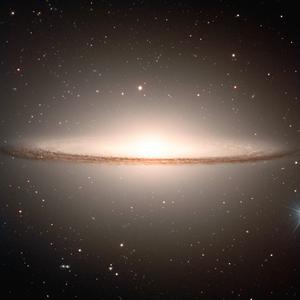
Sombrero galaxy
Pie de foto: This prominent galaxy M 104 is often called the Sombrero galaxy due to its resemblance to the Mexican hat. This look is created by the thin disk oriented nearly edge-on, which appears illuminated by the dominant bulge. Both, the disk and bulge contain stars, but the stars in the bulge tend to be older, while the disk also harbors large amounts of dust and gas creating shadows. M 104 is located in the constellation Virgo approximately 50 light-years away. While some of the dots visible in the picture are foreground stars and others background galaxies, the majority are actually globular clusters, dense massive clusters of stars, associated with the Sombrero Galaxy.
Crédito: ESO/P. Barthel
enlace de crédito
License: CC-BY-4.0 Creative Commons Reconocimiento 4.0 Internacional (CC BY 4.0) íconos

A visible light image of the Andromeda Galaxy
Pie de foto: The Andromeda Galaxy viewed in visible light. Like our Milky Way, Andromeda is a barred spiral galaxy. Here we can see its bright core and spiral disk. The glow from the stars in the disk is interrupted by lanes of dust that form part of its spiral structure.
Andromeda is the largest galaxy in the Local Group of galaxies that includes the Milky Way.
To the left of the core and just above the disk we see the dwarf galaxy M32 and to the right and below the disk we see the dwarf galaxy M110. These are both satellite galaxies of the Andromeda Galaxy.
Crédito: Torben Hansen
enlace de crédito
License: CC-BY-2.0 Creative Commons Atribución 2.0 Genérica íconos

La galaxia lenticular NGC 2787
Pie de foto: La galaxia lenticular NGC 2787. Esta galaxia es una galaxia de disco, pero carece de la estructura dominante de grandes brazos espirales que se observa en los discos de las galaxias espirales. Su núcleo es muy brillante en comparación con el núcleo de una galaxia espiral. En el disco de la galaxia se pueden observar anillos delgados de polvo.
Crédito: NASA/ESA y The Hubble Heritage Team
enlace de crédito
License: CC-BY-4.0 Creative Commons Reconocimiento 4.0 Internacional (CC BY 4.0) íconos

Spiral Galaxy UGC 2885
Pie de foto: This image shows UGC 2885, a spiral galaxy located in the constellation Perseus, about 230 million light-years from Earth. Spiral galaxies have rotating disks of stars, gas, and dust, with spiral arms extending outward from the central region. In UGC 2885, these arms are very broad and faint, revealing the galaxy’s large size. This galaxy is tilted at an angle to the observer on Earth, meaning it does not appear as the circular "grand design" spiral it would look like if viewed face-on, nor as the thin line with a central bulge it would appear as if viewed edge-on.
UGC 2885 is remarkable because it is roughly twice the diameter of the Milky Way. It was studied by astronomer Vera Rubin, whose observations of how galaxies rotate — including systems like this one — played a key role in the search for dark matter.
The bright star which appears to the left of the galaxy's center is a foreground object not related to the galaxy.
Crédito: NASA, ESA, Benne Holwerda (University of Louisville)
enlace de crédito
License: PD Dominio público íconos








.jpg)
