Término del glosario: Límite de Roche
Descripción: Las fuerzas de marea deforman los objetos astronómicos, dándoles formas alargadas. Por ejemplo, la Luna deforma el agua que rodea la Tierra formando dos protuberancias; esto provoca las mareas en la Tierra.
Cualquier par de objetos masivos ejercen fuerzas de marea entre sí. Los objetos más masivos ejercen fuerzas de marea mayores, mientras que estas son más intensas cuanto más cerca se encuentran los objetos. Estas fuerzas de marea pueden llegar a ser tan fuertes que el estiramiento puede hacer que uno de los objetos se desgarre en pedazos.
Para un objeto (por ejemplo, un asteroide o una luna) de una masa y un tamaño determinados que se encuentre cerca de otro objeto masivo, existe una distancia dentro de la cual será destrozado por las fuerzas de marea del otro objeto. Esta distancia se conoce como el «límite de Roche».
Un ejemplo habitual del límite de Roche son las lunas rocosas y heladas que orbitan alrededor de los planetas gigantes. Si una luna se encuentra más cerca del planeta gigante que el límite de Roche, se desintegrará, formando un anillo de material alrededor del planeta gigante.
Las cadenas de cráteres denominadas «catenae», visibles en la Luna y en otros cuerpos rocosos del Sistema Solar, son prueba de que los asteroides entrantes se fragmentan al atravesar el límite de Roche, lo que hace que impacten como una sucesión de objetos más pequeños, en lugar de como un único cuerpo de gran tamaño.
Estado del término y la definición: La definición original de este término en inglés ha sido aprobada por unastrónomo o astrónoma investigadora y un docente La traducción de este término y su definición aún están pendientes de aprobación
El Glosario multilingüe de la OAE es un proyecto de la Oficina de Astronomía para la Educación de la UAI (OAE) en colaboración con la Oficina de Divulgación de Astronomía de la UAI (OAO). Los términos y definiciones fueron seleccionados, redactados y revisados gracias al esfuerzo colectivo de la OAE, los Centros y Nodos de la OAE, los Coordinadores Nacionales de Educación Astronómica (NAECs) y otros voluntarios. Puedes encontrar una lista completa de créditos aquí. Todos los términos del glosario y sus definiciones se publican bajo la licencia Creative Commons CC BY-4.0 y deben atribuirse a la "IAU OAE".
Si detectas algún error de contenido o de traducción en este término del glosario o en ladefinición, ponte en contacto con nosotros.
En otros idiomas
- Árabe: حد روش
- Alemán: Roche-Grenze
- Inglés: Roche Limit
- Francés: Limite de Roche
- Italiano: Limite di Roche
- Japonés: ロッシュ限界 (enlace externo)
- Coreano: 로시한계
- Portugués de Brasil: Limite de Roche
- Chino simplificado: 洛希极限
- Chino tradicional: 洛希極限
Contenidos relacionados
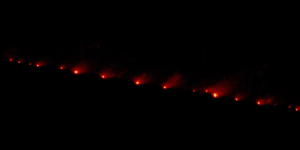
Comet Shoemaker-Levy After Crossing Jupiter's Roche Limit
Pie de foto: This panoramic image captured by the Hubble Space Telescope shows fragments of Comet Shoemaker–Levy 9. This comet was discovered in 1993 as the series of fragments you see here. These fragments were orbiting Jupiter. It is thought that at some point in the previous few decades the whole, unfragmented comet had been gravitationally captured by Jupiter. Then in 1992 the comet passed within Jupiter’s Roche limit.
Astronomical objects exert gravitational forces on each other. The closer one is to an object, the larger the force. Astronomical objects have a real physical size and thus the gravitational force exerted on the object will vary across the object, the side of an object closer to another object will feel a stronger gravitational force from that other object than the more distant side. The gravitational stretching distorts the object. This gravitational stretching force is known as the tidal force. When an object is close enough to a large body like Jupiter, the object will feel such a large tidal stretching force that it will overcome the internal gravitational force holding the object together, ripping it to shreds. The distance from the larger body within which this occurs is known as the Roche limit.
When Shoemaker–Levy 9 crossed Jupiter's Roche limit in 1992, the tidal force pulled the comet into separate fragments. Here we see these fragments in a chain as they orbited Jupiter in May 1994. Later in July 1994 the comet fragment plunged into Jupiter’s atmosphere over the course of a week in a spectacular series of impacts. This event provided scientists with a rare opportunity to witness an impact unfolding in real time.
Crédito: NASA, ESA, and H. Weaver and E. Smith (STScI)
enlace de crédito
License: PD Dominio público íconos