Término del glosario: Ocultación
Descripción: Una ocultación se produce cuando un objeto oculta por completo a otro detrás de sí. Visto desde la Tierra, la Luna pasa con frecuencia por delante de las estrellas. Se dice que estas estrellas son ocultadas por la Luna. Otros objetos del Sistema Solar ocultan ocasionalmente estrellas brillantes.
Las ocultaciones son útiles para estudiar las atmósferas de objetos lejanos del cinturón de Kuiper. Cuando estos cuerpos helados ocultan estrellas, la luz de la estrella atraviesa brevemente la atmósfera del objeto del cinturón de Kuiper. Esta luz queda marcada con las firmas espectrales de la atmósfera del objeto del cinturón de Kuiper cuando llega a la Tierra.
Cuando un objeto pasa por delante de otro pero no lo oculta por completo, se dice que transita por delante del otro objeto.
Términos relacionados:
Ver este término en otros idiomas
Estado del término y la definición: La definición original de este término en inglés ha sido aprobada por unastrónomo o astrónoma investigadora y un docente La traducción de este término y su definición aún están pendientes de aprobación
El Glosario multilingüe de la OAE es un proyecto de la Oficina de Astronomía para la Educación de la UAI (OAE) en colaboración con la Oficina de Divulgación de Astronomía de la UAI (OAO). Los términos y definiciones fueron seleccionados, redactados y revisados gracias al esfuerzo colectivo de la OAE, los Centros y Nodos de la OAE, los Coordinadores Nacionales de Educación Astronómica (NAECs) y otros voluntarios. Puedes encontrar una lista completa de créditos aquí. Todos los términos del glosario y sus definiciones se publican bajo la licencia Creative Commons CC BY-4.0 y deben atribuirse a la "IAU OAE".
Si detectas algún error de contenido o de traducción en este término del glosario o en ladefinición, ponte en contacto con nosotros.
En otros idiomas
- Árabe: الاحتجاب
- Alemán: Bedeckung
- Inglés: Occultation
- Francés: Occultation
- Italiano: occultazione
- Portugués de Brasil: Ocultação
- Chino simplificado: 掩星
- Chino tradicional: 掩星
Contenidos relacionados
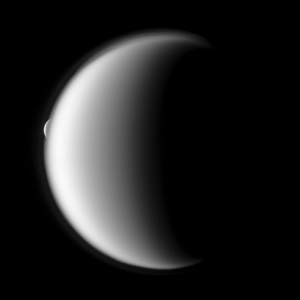
Rhea reappearing after occultation by Titan
Pie de foto: On October 27, 2009, NASA’s Cassini spacecraft orbiting around Saturn captured this view of Saturn's moon Rhea as it began to emerge after being hidden by Saturn's largest moon Titan during an occultation. An occultation is a celestial event in which one object moves in front of another and temporarily blocks the first object from view.
In this image, Titan — about 5,150 km across — was closer to the spacecraft at about 1 million km, while Rhea — roughly 1,528 km in diameter — was farther away at about 2.3 million km. Titan’s high-altitude atmospheric haze is visible as a faint glow around its limb, showing the difference in surface and atmospheric properties between these two moons.
Scientists study occultations like this because watching how one moon disappears behind or reappears from another helps refine our understanding of their orbits and physical characteristics.
Crédito: NASA/JPL/Space Science Institute
enlace de crédito
License: PD Dominio público íconos