Término del glosario: Tránsito
Descripción: Un tránsito se produce cuando un cuerpo celeste pasa entre otro cuerpo celeste de mayor tamaño angular y el observador. Desde el punto de vista del observador, el cuerpo celeste que oculta se desplaza por delante del cuerpo ocultado, bloqueando la visión de una fracción de la superficie del objeto ocultado. Si el cuerpo que oculta, al pasar entre el observador y el objeto ocultado, tiene un tamaño angular mayor que este último, el fenómeno se denomina «ocultación» en lugar de «tránsito». Un tránsito visto por un observador puede no ser visible para otro observador que contemple el mismo sistema desde un ángulo diferente.
En el Sistema Solar, tanto Mercurio como Venus pueden, en ocasiones, transitar por delante del Sol cuando se observan desde la Tierra. Es habitual ver cómo las lunas que orbitan alrededor de los planetas del Sistema Solar transitan por delante de su planeta anfitrión cuando se observan desde la Tierra.
Los planetas que orbitan alrededor de otras estrellas (exoplanetas) suelen descubrirse cuando transitan por delante de su estrella anfitriona, bloqueando una pequeña parte de la luz de esta y haciendo que parezca que se atenúa ligeramente cuando se observa desde la ubicación del observador. Un planeta que orbita alrededor de una estrella solo transitará, visto desde la Tierra, si el plano de su órbita se cruza con la línea de visión desde la Tierra. Por ello, la búsqueda de planetas mediante el método de tránsito solo permite detectar una fracción de los planetas de la Galaxia. Los tránsitos también pueden utilizarse para estimar el tamaño de un exoplaneta.
Términos relacionados:
Ver este término en otros idiomas
Estado del término y la definición: La definición original de este término en inglés ha sido aprobada por unastrónomo o astrónoma investigadora y un docente La traducción de este término y su definición aún están pendientes de aprobación
El Glosario multilingüe de la OAE es un proyecto de la Oficina de Astronomía para la Educación de la UAI (OAE) en colaboración con la Oficina de Divulgación de Astronomía de la UAI (OAO). Los términos y definiciones fueron seleccionados, redactados y revisados gracias al esfuerzo colectivo de la OAE, los Centros y Nodos de la OAE, los Coordinadores Nacionales de Educación Astronómica (NAECs) y otros voluntarios. Puedes encontrar una lista completa de créditos aquí. Todos los términos del glosario y sus definiciones se publican bajo la licencia Creative Commons CC BY-4.0 y deben atribuirse a la "IAU OAE".
Si detectas algún error de contenido o de traducción en este término del glosario o en ladefinición, ponte en contacto con nosotros.
Contenidos relacionados
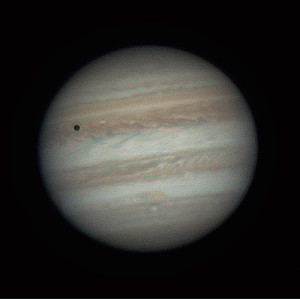
Jupiter, Io and its shadow, by Ralf Burkart, Germany
Pie de foto: First place in the 2021 IAU OAE Astrophotography Contest, category Galilean moons.
This time-lapse of Jupiter taken in 2017 from Germany beautifully illustrates the transit of one of the Galilean moons, Io, in front of Jupiter. As this is simply a moon casting a shadow on a planet it is equivalent to a lunar eclipse on Earth observed from further away. While the shadow of the moon is clearly visible from the beginning, it might be difficult to spot the moon itself against the background of the beautiful atmospheric bands of Jupiter the first time the video is seen. Watching it repeatedly allows appreciating the rapid motion and rotation in this fantastic observation.
Crédito: Ralf Burkart/IAU OAE
License: CC-BY-4.0 Creative Commons Reconocimiento 4.0 Internacional (CC BY 4.0) íconos

Venus Transit from Tempe, AZ, USA , June 5, 2012
Pie de foto: While the planet Venus regularly passes between the Sun and the Earth, most of the time it passes above or below the Sun when observed from Earth. On rare occasions, the planet Venus passes directly in front of the Sun for observers on Earth. The last such Venus transits were in 2004 and 2012, respectively. The next such transit will be in 2117. The picture was taken at 18:54 PDT on June 5, 2012, from Tempe, Arizona, US. The telescope used was an 8" Schmidt-Cassegrain with ND5 filter; the camera was a Sony NEX5N with the APS sensor placed at prime focus. Clearly visible are the disk of the Sun, Venus as a prominent round spot. Several sun spots also appear on the solar disk.
Crédito: Stephen Rector
enlace de crédito
License: CC-BY-SA-3.0 Creative Commons Atribución-CompartirIgual 3.0 No portada íconos

Tránsito de Fobos desde Marte
Pie de foto: Este vídeo muestra el Sol visto desde Marte mientras su luna, Fobos, transita por el disco solar. Este vídeo está compuesto por imágenes tomadas desde la superficie marciana el 30 de septiembre de 2024 por la cámara Mastcam-Z del vehículo explorador Perseverance Mars de la NASA. Mientras que nuestra Luna tiene el tamaño perfecto para eclipsar al Sol vista desde la superficie terrestre, el tamaño y la órbita de Fobos hacen que no pueda cubrir completamente el disco solar. Esto significa que se trata de un tránsito y no de un eclipse.
Este vídeo es en tiempo real, y el tránsito completo dura sólo 32 segundos. Esto contrasta con las horas que dura un eclipse solar en la Tierra desde que la Luna oscurece parte del Sol hasta que este vuelve a ser completamente visible. Esto se debe a que el período orbital de Fobos es mucho más corto, de poco más de siete horas y media, que el de la Luna, de 27 días, y a que el disco solar parece ligeramente más pequeño desde Marte que desde la Tierra. Nótese la forma no esférica de Fobos al cruzar el disco solar.
Crédito: NASA/JPL-Caltech/ASU/MSSS
enlace de crédito
License: PD Dominio público íconos
Actividades relacionadas

Hunting for exoplanets with Arduino
astroEDU educational activity (links to astroEDU website) Description: Become a planet hunter with an Arduino kit and some simple components
License: CC-BY-4.0 Creative Commons Reconocimiento 4.0 Internacional (CC BY 4.0) íconos
Rango de edades:
14-16
, 16-19
, 19+
Nivel educativo:
Secondary
, Universitario
Áreas de aprendizaje:
Modelización
, Basado en la observación
, Centrado en la simulación
, Aprendizaje basado en la investigación estructurada
, Basado en la tecnología
Costos:
Coste medio
Duración:
3 horas
Tamaño del grupo:
Grupo
Competencias:
Analizar e interpretar datos
, Plantear preguntas
, Desarrollar y utilizar modelos