Término del glosario: Orión
Descripción: Orión es una constelación fácilmente reconocible situada cerca del ecuador celeste. En el hemisferio norte, es una constelación destacada del invierno; en el hemisferio sur, una constelación destacada del verano. En la mitología griega, Orión era un cazador, y las estrellas principales de la constelación suelen interpretarse como los hombros de Orión, su cinturón, la espada que cuelga de su cinturón y sus dos pies. La mayoría de esas estrellas son gigantes azules o supergigantes, es decir, estrellas azuladas especialmente brillantes que se encuentran en las últimas etapas de su vida estelar. La estrella del hombro izquierdo, Betelgeuse, es una supergigante roja, es decir, una estrella roja muy brillante en la etapa final de su vida. Su color rojizo se puede ver fácilmente en el cielo nocturno. La espada de Orión contiene la nebulosa de Orión. Vista a simple vista, es una mancha blanquecina. Los telescopios astronómicos han revelado que se trata de una nube roja brillante de gas hidrógeno donde actualmente están naciendo nuevas estrellas.
Términos relacionados:
Ver este término en otros idiomas
Estado del término y la definición: La definición original de este término en inglés ha sido aprobada por unastrónomo o astrónoma investigadora y un docente La traducción de este término y su definición aún están pendientes de aprobación
El Glosario multilingüe de la OAE es un proyecto de la Oficina de Astronomía para la Educación de la UAI (OAE) en colaboración con la Oficina de Divulgación de Astronomía de la UAI (OAO). Los términos y definiciones fueron seleccionados, redactados y revisados gracias al esfuerzo colectivo de la OAE, los Centros y Nodos de la OAE, los Coordinadores Nacionales de Educación Astronómica (NAECs) y otros voluntarios. Puedes encontrar una lista completa de créditos aquí. Todos los términos del glosario y sus definiciones se publican bajo la licencia Creative Commons CC BY-4.0 y deben atribuirse a la "IAU OAE".
Si detectas algún error de contenido o de traducción en este término del glosario o en ladefinición, ponte en contacto con nosotros.
Contenidos relacionados
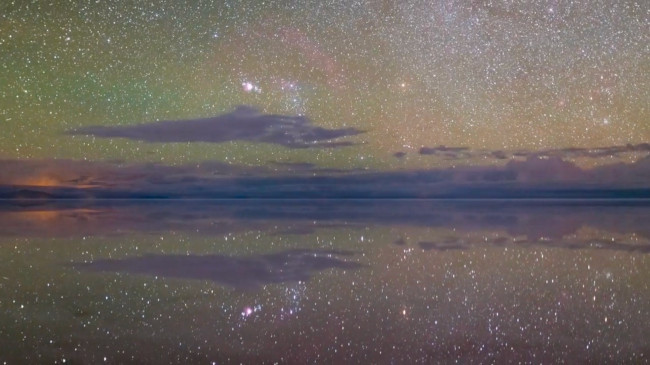
Constellations from the World
Pie de foto: Third place in the 2022 IAU OAE Astrophotography Contest, category Time lapses of celestial patterns.
This video tries to cover a huge variety of phenomena in the night sky from different locations — Iceland and China — and is designed like a theatre play, starring mother nature herself.
It starts with a blue twilight sky that dims and unveils the starry night sky on the stage with terrestrial clouds on a beautiful landscape. The impressive parts of the southern Milky Way between Scorpius and Crux, with the pointer stars Alpha and Beta Centaurus, are shown passing by majestically. The terrestrial clouds blur the stars and allow us to recognise their colours even more clearly.
The first act presents the starry sky in human culture. One scene shows the Pleiades rising over the top of a hill, while a human moves hastily with a flashlight below. At the very moment that the Pleiades rises behind the hill, the beam of the flashlight hits the camera. There is some humour in this remarkable scene referencing the human relationship to the rise of the Pleiades in cultural history.
The next scene shows The Big Dipper, Ursa Major, as a typical northern constellation, with an arch of aurora below it. The aurora evolves and moves but does not change much fundamentally. In northern human cultures, aurorae were often interpreted as the ghosts of ancestors, but this play does not spend any time on human beliefs, instead moving the view southwards in the subsequent scenes. First we see some stars rising shortly before sunrise. The lightcone of Zodiacal light appears in Gemini/Taurus and the horizon gets brighter. In the next scene, at about 1 minute and 13 seconds, we see Orion setting over water, so that the water surface mirrors the celestial scene. Some clouds crossing the image prove that the videos were really taken on our beautiful planet, and, since Orion’s shoulder and foot are seen to set almost simultaneously, this sequence must have been captured almost at the equator. In this area, the bright stars of Orion look like a huge butterfly, with Orion’s Belt forming the body, and the quadrilateral of four bright stars interpreted as the wings.
As in a real theatre, we now see a curtain before the next act of the heavenly play, an aurora curtain. The next act presents several bright stars in original scenes: the Chinese asterisms of The Tail (of the Azure Dragon), the Winnowing Basket and the Southern Dipper, which are seen in the modern constellations Scorpius and Sagittarius. The striking shape of Corona Borealis that has been recognised as an asterism in many cultures all over the globe, is also shown, as are some planets, the stars Vega and Deneb with adjacent areas, Altair, the Milky Way, and the characteristic W shape of Cassiopeia that has also been an asterism for many cultures on Earth.
The outro presents two more scenes with a smooth and silent night sky.
Crédito: Stephanie Ye Ziyi/IAU OAE
License: CC-BY-4.0 Creative Commons Reconocimiento 4.0 Internacional (CC BY 4.0) íconos
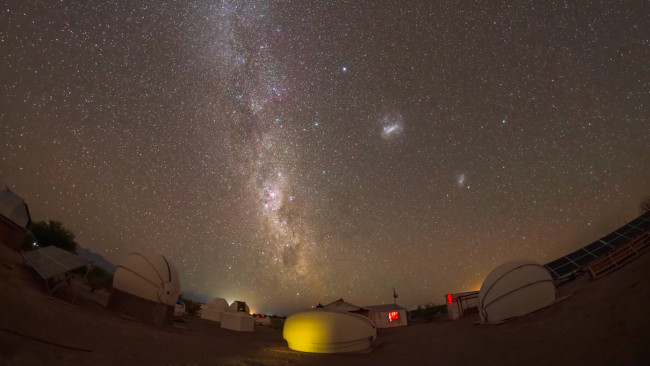
Chilean Nights
Pie de foto: Honourable mention in the 2022 IAU OAE Astrophotography Contest, category Time lapses of celestial patterns.
Shot in December 2020, this time-lapse shows the sky from San Pedro de Atacama, Chile, in the southern hemisphere.
Right in the first frame we can see our home galaxy, the Milky Way, as well as both the Large and Small Magellanic clouds, two satellite galaxies orbiting the Milky Way. In the bottom of the image the bright stars Rigil Kentaurus and Hadar (also known as Alpha and Beta Centauri) are visible, both in the constellation Centaurus. Just above, we can also see the small constellation Crux, visible from the northern tropical circles southwards. It is important for navigation purposes because its longer axis indicates the direction of the celestial south pole. The bright whitish star in the top of the image and to the right of the Galaxy is Canopus, one of the brightest stars in the night sky, located in the constellation Carina. Canopus is the second brightest star in the sky, while Rigil Kentaurus is the third brightest.
In some of the next frames, Orion, the great hunter, appears clearly with its bright stars and its characteristic asterism, the belt, composed of three aligned bright stars. Since this video was taken from the southern hemisphere, the Greek hero from the northern hemisphere seems to be performing a headstand.
We can also see the planets Jupiter and Saturn in a close conjunction, even finding themselves in the significant beam of Zodiacal light setting down below the horizon. There are also a few meteors blinking in some of the frames, one of them with a long-lasting and developing trail. The very bright object rising from behind the volcanoes of the Andes, creating spectacular shadows and crepuscular rays, is the Moon. In the last frame we see the Moon next to Saturn and Jupiter.
Crédito: Robert Barsa/IAU OAE
License: CC-BY-4.0 Creative Commons Reconocimiento 4.0 Internacional (CC BY 4.0) íconos
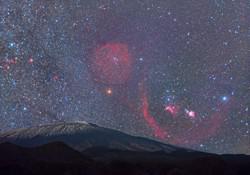
Orion Rises Over Mount Etna
Pie de foto: Honourable mention in the 2022 IAU OAE Astrophotography Contest, category Still images of celestial patterns.
Taken in February 2021, this image is a composite of an astronomy picture in the background and Mount Etna, the famous volcano in Sicily, Italy, in the foreground. Prominently, we see the red hydrogen clouds in space in the area of Orion. Barnard’s Loop is the gigantic bow with the Great Orion Nebula and the Horsehead Nebula in its centre. The deeper-coloured Horse Head is below the southernmost stars in Orion’s Belt, which is the line of white stars above the red nebula. Clearly visible is also the division between the Small and the Great Orion Nebula, the circular and the trapezium-shaped structure in light pink within which one of the nearest star-forming regions is located. The nebula is only a bit more than a thousand light-years away.
In the middle-left, close to the edge of the image, the small red structure is the Monkey Head Nebula still in the constellation Orion. It hosts a young star cluster and the deep red colour of this hydrogen cloud indicates its potential to build new stars in the future if the material is compressed again. All these reddish objects are strongly processed in this image, as they are not visible to the unaided eye.
Still, this image provides an interesting feature; the red supergiant star Betelgeuse lies in the middle of the image and it seems to be directly above the active volcano Mount Etna. At the foot of this volcano is an ancient settlement, the city of Catania. We consider both Betelgeuse and Mount Etna somehow dangerous — but which of them will erupt first?
Ok, we know that Etna occasionally erupts. Normally it exhibits only small eruptions, but the bigger ones happen every few centuries. We also know that Betelgeuse as a giant star will become a supernova in the future. Astronomers call the timescale for the potential supernova short, implying that it will be only 10 000 or maybe 100 000 years until this star explodes. This is “soon” for astronomers, meaning that on Earth, two to four precession cycles will pass by (with the consequence that the Sahara will turn green and dry again two to four times), continental drift will take Africa further north and cause the Alps to grow in height, the Niagara falls in America will wash the rock completely away and only after all this (and much more) happening on Earth will Betelgeuse explode as a supernova. Mount Etna is much more dangerous for the people in Sicily, and Catania in particular, because it will erupt sooner.
Crédito: Dario Giannobile/IAU OAE
License: CC-BY-4.0 Creative Commons Reconocimiento 4.0 Internacional (CC BY 4.0) íconos

Winter Constellations
Pie de foto: Second place in the 2022 IAU OAE Astrophotography Contest, category Time lapses of celestial patterns.
Sirius, the brightest star in the night sky, is shown rising, setting and passing by. Sometimes constellations and asterisms are also visible, including Orion, Taurus and the Pleiades. In the first scene, the aforementioned constellations are covered by a semi-transparent golden veil. The next scenes show it rising in a dark blue night sky. In one of the scenes, a planet brightly decorates the faint constellation Pisces.
The videos were taken above various landscapes and places of cultural heritage on Earth. Some of them simply show monuments in the desert, while others show palm trees with waving leaves.
Crédito: Amirreza Kamkar/IAU OAE
License: CC-BY-4.0 Creative Commons Reconocimiento 4.0 Internacional (CC BY 4.0) íconos
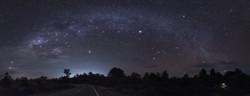
Most Brightest Stars of the Sky
Pie de foto: Honourable mention in the 2022 IAU OAE Astrophotography Contest, category Still images of celestial patterns.
Taken in March 2016 in Bromo-Tengger-Semeru National Park, Java Island, Indonesia, this image shows the arch of the Milky Way and many prominent constellations, including many of the brightest stars in the night sky.
In the lower-left corner, we see Rigil Kentaurus and Hadar, the first one lower and the other higher up, both located in the large constellation Centaurus. As pointers they point towards Crux, the Southern Cross, whose long axis points towards the southern pole, which is located roughly at the horizon because the Island of Java is almost at the equator. Crux is almost entirely obscured by clouds, with only the four bright stars visible in the photograph. Confusingly, the asterism of the False Cross (consisting of stars in Argo, The Ship) is clearly prominent a bit further up the Milky Way.
The pinkish spot between the true and the False Cross is the Carina Nebula, located about 8500 light-years from Earth, in the constellation Carina, and invisible to the unaided eye. In Carina we can also find Canopus, the second-brightest star in the night sky, seen just below the Galaxy and above the road on the ground.
Even brighter is Sirius, the brightest star in the night sky. Sirius lies in the constellation Canis Major, The Great Dog, one of the dogs that follow Orion, the Hunter, who is depicted in the right half of this image, just above the clouds at the horizon. Orion’s Belt of three bright stars points to Sirius in the upper left and to Aldebaran in the lower right, just above the horizon.
Orion contains some of the brightest stars in the sky, making it the most colourful constellation as it hosts Rigel, the bright bluish star below the Galaxy toward the right, and Betelgeuse, the reddish bright star higher up and to the right of Rigel. Between them we find the three stars that comprise the belt of Orion, a famous asterism. Just next to the belt we find the Great Orion Nebula, a star-forming region whose bright centre is visible to the unaided eye and also in this image.
Above Betelgeuse but on the opposite side of the Galaxy, we see the bright star Procyon, whose name means literally “Before the Dog”. It is mythologically often considered a tiny one-star dog asterism accompanying Orion, and transformed into the modern constellation of Canis Minor.
In the upper-right corner, the Beehive Star Cluster in the constellation Cancer is easily recognisable. Below it, we find the constellation Gemini with the stars Pollux and Castor, which are not prominent in this image. In contrast, the bright white star Capella in the constellation Auriga, the Charioteer, shines through the clouds at the middle-right edge of the image.
Some light pollution is visible along the road.
Crédito: Giorgia Hofer/IAU OAE
License: CC-BY-4.0 Creative Commons Reconocimiento 4.0 Internacional (CC BY 4.0) íconos
Diagramas relacionados
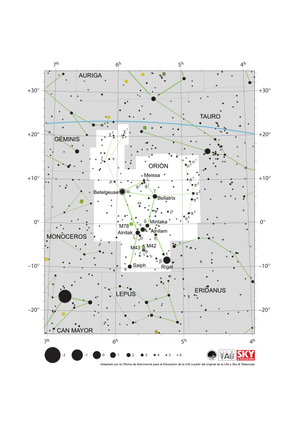
Mapa de la constelación de Orión
Pie de foto: La constelación de Orión junto con sus estrellas brillantes y las constelaciones circundantes. Orión está rodeada (en el sentido de las agujas del reloj desde arriba) por Tauro, Eridanus, Lepus, Monoceros y Géminis. Las estrellas más brillantes de Orión, Betelgeuse y Rígel, aparecen en los extremos norte (arriba en este diagrama) y sur (abajo) de la constelación, respectivamente, con el famoso "cinturón" de tres estrellas en el centro.
Orión atraviesa el ecuador celeste y, por tanto, es visible en algún momento del año desde todo el planeta Tierra. En las regiones más árticas o antárticas del mundo, algunas partes de la constelación pueden no ser visibles. Orión es más visible por las tardes en el invierno del hemisferio norte y en el verano del hemisferio sur. La línea azul sobre Orión marca la eclíptica, el camino que el Sol parece recorrer a través del cielo en el transcurso de un año. El Sol nunca pasa por Orión, pero ocasionalmente se pueden encontrar los demás planetas del Sistema Solar y la Luna en Orión.
Justo al sur del cinturón de Orión se encuentran dos objetos Messier, M42 (la nebulosa de Orión) y M43, marcados con cuadrados verdes. Estas nebulosas, junto con M78 (aquí el cuadrado verde a la izquierda del cinturón), forman parte del enorme Complejo de Nubes Moleculares de Orión. Éste cubre la mayor parte de la constelación e incluye regiones donde estas nubes moleculares están colapsando para formar estrellas jóvenes.
El eje-y de este diagrama está en grados de declinación con el norte hacia arriba y el eje-x está en horas de ascensión recta con el este a la izquierda. El tamaño de las estrellas marcadas aquí está relacionado con la magnitud aparente de la estrella, una medida de su brillo aparente. Los puntos más grandes representan estrellas más brillantes. Las letras griegas indican las estrellas más brillantes de la constelación. Están ordenadas según su brillo: la estrella más brillante se denomina alfa, la segunda más brillante beta, etc., aunque este orden no siempre se sigue con exactitud. El círculo alrededor de Betelgeuse indica que se trata de una estrella variable. Las líneas punteadas marcan los límites de las constelaciones de la UAI y las líneas verdes sólidas marcan una de las formas comunes utilizadas para representar las figuras de las constelaciones. Ni los límites de las constelaciones, ni la línea que marca la eclíptica, ni las líneas que unen las estrellas aparecen en el cielo.
Crédito: Adaptado por la Oficina de Astronomía para la Educación de la UAI a partir del original de UAI/Sky & Telescope
License: CC-BY-4.0 Creative Commons Reconocimiento 4.0 Internacional (CC BY 4.0) íconos
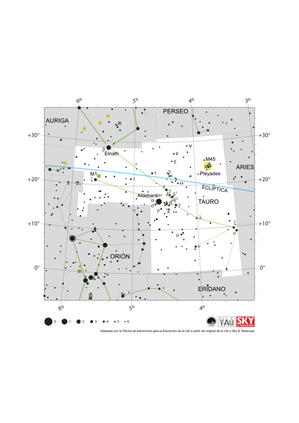
Mapa de la constelación de Tauro
Pie de foto: La constelación de Tauro junto con sus estrellas brillantes y las constelaciones circundantes. Tauro está rodeada por (en el sentido de las agujas del reloj desde arriba) Perseo, Aries, Cetus, Erídano, Orión, Géminis y Auriga. La estrella más brillante de Tauro, Aldebarán, aparece en el centro de la constelación. Tauro se encuentra en la eclíptica (mostrada aquí como una línea azul), que es la trayectoria que el Sol parece seguir a través del cielo en el transcurso de un año. El Sol está en Tauro desde mediados de mayo hasta finales de junio. Los demás planetas del Sistema Solar se encuentran a menudo en Tauro.
Tauro se encuentra principalmente al norte del ecuador celeste, con una pequeña parte en el hemisferio sur celeste. Toda la constelación es visible en algún momento del año para todo el planeta excepto la Antártida y una pequeña región alrededor del Polo Norte. Tauro es más visible por las tardes en invierno en el hemisferio norte y en verano en el hemisferio sur.
En la parte oriental de Tauro podemos encontrar el remanente de supernova M1 (comúnmente conocido como la Nebulosa del Cangrejo), marcado aquí con un cuadrado verde. En el noreste de Tauro se encuentra uno de los cúmulos abiertos de estrellas más famosos del cielo, M45 (las Pléyades), marcado aquí con un círculo amarillo. Muchas de las estrellas cercanas a Aldebarán (pero no Aldebarán) son miembros de otro cúmulo estelar, las Híades. Sin embargo, este cúmulo se encuentra cerca del Sistema Solar, por lo que está demasiado disperso en el cielo como para tener una designación de objeto Messier como la que tienen las Pléyades.
El eje-y de este diagrama está en grados de declinación con el norte hacia arriba y el eje-x está en horas de ascensión recta con el este a la izquierda. El tamaño de las estrellas marcadas aquí está relacionado con la magnitud aparente de la estrella, una medida de su brillo aparente. Los puntos más grandes representan estrellas más brillantes. Las letras griegas indican las estrellas más brillantes de la constelación. Están ordenadas según su brillo: la estrella más brillante se denomina alfa, la segunda más brillante beta, etc., aunque este orden no siempre se sigue con exactitud. Las líneas punteadas marcan los límites de las constelaciones según la UAI y las líneas verdes continuas marcan una de las formas habituales utilizadas para representar las figuras de las constelaciones. Ni los límites de las constelaciones, ni la línea que marca la eclíptica, ni las líneas que unen las estrellas aparecen en el cielo.
Crédito: Adaptado por la Oficina de Astronomía para la Educación de la UAI a partir del original de UAI/Sky & Telescope
License: CC-BY-4.0 Creative Commons Reconocimiento 4.0 Internacional (CC BY 4.0) íconos
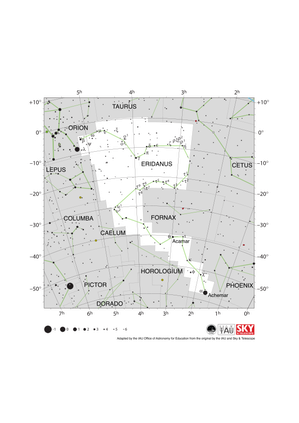
Eridanus Constellation Map
Pie de foto: The constellation Eridanus with its bright stars and surrounding constellations. Eridanus is surrounded by (going clockwise from the top): Taurus, Cetus, Fornax, Phoenix, Tucana, Hydrus, Horologium, Caelum, Lepus and Orion.
Eridanus is a large constellation that spans a wide range in declination. A small portion of the constellation is in the northern hemisphere with the southern-most point lying at a declination of almost -60°. As it spans the celestial equator, parts of the constellation are visible to the whole Earth at some point in the year. The whole constellation can be observed from northern and southern equatorial regions, southern temperate regions and most of Antarctica. Eridanus is best viewed in the evening in the northern hemisphere winter and southern hemisphere summer.
The y-axis of this diagram is in degrees of declination with north as up and the x-axis is in hours of right ascension with east to the left. The sizes of the stars marked here relate to the star's apparent magnitude, a measure of its apparent brightness. The larger dots represent brighter stars. The Greek letters mark the brightest stars in the constellation. These are ranked by brightness with the brightest star being labeled alpha, the second brightest beta, etc., although this ordering is not always followed exactly. The dotted boundary lines mark the IAU's boundaries of the constellations and the solid green lines mark one of the common forms used to represent the figures of the constellations. Neither the constellation boundaries, nor the lines joining the stars appear on the sky.
Crédito: Adapted by the IAU Office of Astronomy for Education from the original by the IAU and Sky & Telescope
License: CC-BY-4.0 Creative Commons Reconocimiento 4.0 Internacional (CC BY 4.0) íconos
Actividades relacionadas
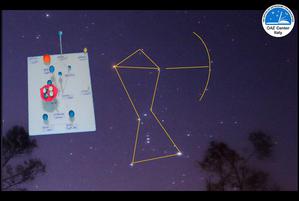
Orion constellation in 3D
astroEDU educational activity (links to astroEDU website) Description: Let's make a simple model of the Orion constellation
License: CC-BY-4.0 Creative Commons Reconocimiento 4.0 Internacional (CC BY 4.0) íconos
Rango de edades:
8-10
, 10-12
Nivel educativo:
Primaria
Áreas de aprendizaje:
Aprendizaje por descubrimiento guiado
, Modelización
, Aprendizaje basado en la investigación estructurada
Costos:
Bajo coste
Duración:
2 horas
Tamaño del grupo:
Grupo
Competencias:
Analizar e interpretar datos
, Plantear preguntas
, Desarrollar y utilizar modelos