Terme du glossaire : Leo
Description : Le Lion est une constellation du Zodiaque, c'est-à-dire que les étoiles qui la composent se trouvent dans la partie du ciel qui coupe l'écliptique, c'est-à-dire le plan défini par les orbites des planètes de notre système solaire. Ainsi, de notre point de vue, ici sur Terre, nous pouvons régulièrement trouver les planètes, ainsi que le Soleil, dans cette constellation - dans le cas du Soleil, du 11 août au 17 septembre. (Dans le ciel nocturne, c'est au printemps que le Lion est le plus facile à observer. Le Lion est l'une des 88 constellations modernes définies par l'Union astronomique internationale et l'une des 48 constellations classiques nommées par l'astronome Claudius Ptolemy au IIe siècle. La plus brillante des nombreuses étoiles du Lion s'appelle Regulus.
Termes associés :
Voir ce terme dans d'autres langues
Statut du terme et de sa définition : La définition initiale de ce terme en anglais a été aprouvée par un·e spécialiste de la recherche en astronomie et un·e spécialiste de l’éducation La traduction de ce terme et de sa définition n'ont pas encore été aprouvées
Le glossaire multilangue de l'OAE est un projet du Bureau de l'IAU de l'Astronomie pour l'Education (OAE) en collaboration avec le Bureau de l'IAU de diffusion de l'Astronomie (OAO). Les termes et définitions ont été choisis, écrits et relues grâce à un effort collectif de l'OAE, les Centres et les Noeuds de l'OAE, les Coordinateurs Nationaux de l'Astronomie pour l'Education de l'OAE(NAECs) et d'autres volontaires. La liste complète des crédits pour ce projet est disponible ici . Tous les termes du glossaire et leur définition sont déposés sous licence Creative Commons CC BY-4.0 et doivent être créditées au nom de "IAU OAE".
Si vous constatez une erreur dans ce terme ou sa définition, veuillez nous contacter .
Diagrammes associés
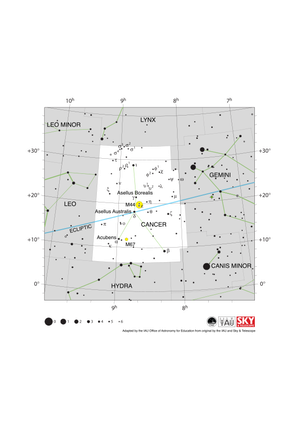
Cancer Constellation Map
Légende : The zodiac constellation Cancer and its surrounding constellations. Starting from the top of the diagram and going clockwise, these are Lynx, Gemini, Canis Minor, Hydra, Leo and Leo Minor. The ecliptic (shown here as a blue line) passes almost exactly through the middle of the constellation, this is the path the Sun appears to take across the sky over the course of a year. The Sun is in Cancer from late July to mid August. The other planets of the Solar System can often be found in Cancer.
Cancer lies just north of the celestial equator and is thus visible at some time in the year from all of planet Earth except for the most antarctic regions of the world. Cancer is most visible in the evenings in the northern hemisphere spring and southern hemisphere autumn.
Two star clusters are visible in Cancer: M44, an open cluster often called the Beehive Cluster, and M67, a denser open cluster with about four times more stars than M44. These clusters are indicated by yellow circles with a dotted border on the map.
The y-axis of this diagram is in degrees of declination with north as up and the x-axis is in hours of right ascension with east to the left. The sizes of the stars marked here relate to the star's apparent magnitude, a measure of its apparent brightness. The larger dots represent brighter stars. The Greek letters mark the brightest stars in the constellation. These are ranked by brightness with the brightest star being labelled alpha, the second brightest beta, etc., although this ordering is not always followed exactly. The dotted boundary lines mark the IAU's boundaries of the constellations and the solid green lines mark one of the common forms used to represent the figures of the constellations. Neither the constellation boundaries, nor the line marking the ecliptic, nor the lines joining the stars appear on the sky.
Crédit : Adapted by the IAU Office of Astronomy for Education from the original by IAU/Sky & Telescope
License: CC-BY-4.0 Creative Commons (CC) Attribution 4.0 International (CC BY 4.0) Icônes
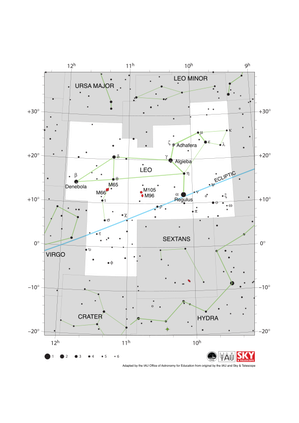
Leo Constellation Map
Légende : The zodiac constellation Leo and its surrounding constellations. Starting from the top of the diagram and going clockwise, these are Leo Minor, Cancer, Sextans, Hydra, Crater, Virgo and Ursa Major. The brightest star in Leo, Regulus, lies almost exactly on the ecliptic (shown here as a blue line): the path the Sun appears to take across the sky over the course of a year. The Sun spends the period from mid August to mid September in Leo. The other planets in the Solar System can often be found in Leo.
Leo spans the celestial equator and is thus part of it is visible at some time in the year from all of planet Earth with some of the constellation obscured for the most arctic and antarctic regions of the world. Leo is most visible in the evenings in the northern hemisphere spring and southern hemisphere autumn.
Several objects can be seen in Leo, including M65 and M66 – two galaxies in the Leo Triplet, a trio of galaxies including NGC 3628, not listed here. In addition, M96, a spiral galaxy, can be seen as a fuzzy object using a small telescope, and Messier 105, an elliptical galaxy. Each of these objects are labelled on the map as red ellipses.
The y-axis of this diagram is in degrees of declination with north as up and the x-axis is in hours of right ascension with east to the left. The sizes of the stars marked here relate to the star's apparent magnitude, a measure of its apparent brightness. The larger dots represent brighter stars. The Greek letters mark the brightest stars in the constellation. These are ranked by brightness with the brightest star being labelled alpha, the second brightest beta, etc., although this ordering is not always followed exactly. The dotted boundary lines mark the IAU's boundaries of the constellations and the solid green lines mark one of the common forms used to represent the figures of the constellations. Neither the constellation boundaries, nor the line marking the ecliptic, nor the lines joining the stars appear on the sky.
Crédit : Adapted by the IAU Office of Astronomy for Education from the original by IAU/Sky & Telescope
License: CC-BY-4.0 Creative Commons (CC) Attribution 4.0 International (CC BY 4.0) Icônes
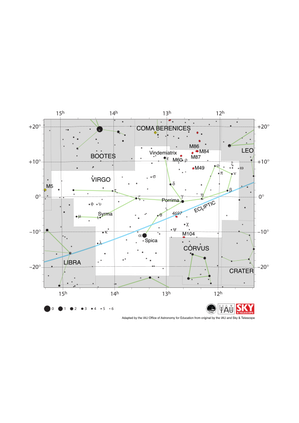
Virgo Constellation Map
Légende : The zodiac constellation Virgo and its surrounding constellations. Starting from the top of the diagram and going clockwise, these are Coma Berenices, Leo, Crater, Corvus, Libra, and Bootes. The brightest star in Virgo, Spica, lies just below the ecliptic (shown here as a blue line) in the middle of the map. One way of locating this star in the night sky is to follow the handle of the Big Dipper to the star Arcturus in Bootes and go along a line straight down to Spica (“arc to Arcturus and spike to Spica”). This star lies just below the ecliptic. The ecliptic is the path the Sun appears to take across the sky over the course of a year. The Sun is in Virgo from mid September to late October. The other planets of the Solar System can often be found in Virgo.
Virgo spans the celestial equator and is thus part of it is visible at some time in the year from all of planet Earth with some of the constellation obscured for the most arctic and antarctic regions of the world. Virgo is most visible in the evenings in the northern hemisphere spring and southern hemisphere autumn.
The constellation Virgo appears as a person lying with their back roughly against the ecliptic, arms outstretched, and feet pointed east. Several deep-sky objects are visible in Virgo, including NGC4697, M49, M87, M86, M84, and M60, all of which are labelled as red ellipses on the map. These are all spiral and elliptical galaxies located several millions of lightyears from Earth. Most notably, M87 is host to the supermassive black hole (Pōwehi) that was imaged by the Event Horizon Telescope in 2019. All of these galaxies are members of the Virgo Cluster, the nearest cluster of galaxies to the Milky Way.
The y-axis of this diagram is in degrees of declination with north as up and the x-axis is in hours of right ascension with east to the left. The sizes of the stars marked here relate to the star's apparent magnitude, a measure of its apparent brightness. The larger dots represent brighter stars. The Greek letters mark the brightest stars in the constellation. These are ranked by brightness with the brightest star being labelled alpha, the second brightest beta, etc., although this ordering is not always followed exactly. The dotted boundary lines mark the IAU's boundaries of the constellations and the solid green lines mark one of the common forms used to represent the figures of the constellations. Neither the constellation boundaries, nor the line marking the ecliptic, nor the lines joining the stars appear on the sky.
Crédit : Adapted by the IAU Office of Astronomy for Education from the original by IAU/Sky & Telescope
License: CC-BY-4.0 Creative Commons (CC) Attribution 4.0 International (CC BY 4.0) Icônes

Carte de la constellation LA GRANDE OURSE
Légende : La constellation de la Grande Ourse avec ses étoiles brillantes et les constellations qui l'entourent. La Grande Ourse ou Ursa Major est entourée de (dans le sens des aiguilles d'une montre à partir du haut) : Dragon, Caméléon, Lynx, Petit Lion, Lion, Chevelure de Bérénice, Chiens de Chasse et Bouvier. La Grande Ourse est célèbre pour son astérisme proéminent, souvent connu en anglais sous le nom de Big Dipper ou the Plough (la Grande Ourse ou la Charrue). Cet astérisme nordique proéminent porte une grande variété de noms dans les cultures du monde entier. Alors que la plupart des constellations et des astérismes sont constitués d'étoiles sans rapport les unes avec les autres qui apparaissent au hasard dans le ciel, cinq des étoiles de la Grande Ourse font partie du groupe mobile de la Grande Ourse, un groupe d'étoiles qui se déplacent ensemble dans l'espace et qui se sont probablement formées au même endroit il y a 300 millions d'années. Les deux étoiles situées à l'extrémité droite de la Grande Ourse sur ce diagramme forment une paire d'étoiles indicatrices qui peuvent être utilisées pour localiser Polaris, l'étoile du pôle nord qui se trouve dans la constellation de la Petite Ourse.
La Grande Ourse est une constellation septentrionale, visible depuis les régions septentrionales et équatoriales. Certaines parties de la constellation sont visibles depuis toutes les régions de l'hémisphère sud, à l'exception des régions les plus antarctiques, mais toutes les régions tempérées de l'hémisphère sud ne peuvent pas voir l'intégralité de la Grande Ourse. Inversement, la Grande Ourse et une grande partie du reste de la constellation sont circumpolaires dans les régions arctiques et dans de nombreuses régions tempérées de l'hémisphère nord. La Grande Ourse est surtout visible le soir au printemps dans l'hémisphère nord et en automne dans l'hémisphère sud.
Deux galaxies importantes apparaissent dans la partie nord de cette constellation, la galaxie spirale M81 et M82, une galaxie spirale possible dont la structure est difficile à observer depuis la Terre car elle apparaît sur le bord. Ces deux galaxies sont représentées ici par des ellipses rouges. La nébuleuse planétaire M97 (la nébuleuse du Hibou) se trouve au milieu de la constellation et est marquée par un cercle vert superposé à un symbole plus.
L'axe des y de ce diagramme est en degrés de déclinaison avec le nord en haut et l'axe des x est en heures d'ascension droite avec l'est à gauche. La taille des étoiles marquées ici correspond à la magnitude apparente de l'étoile, une mesure de sa luminosité apparente. Les points les plus gros représentent les étoiles les plus brillantes. Les lettres grecques indiquent les étoiles les plus brillantes de la constellation. Elles sont classées par ordre de luminosité, l'étoile la plus brillante étant étiquetée alpha, la deuxième plus brillante bêta, etc., bien que cet ordre ne soit pas toujours respecté à la lettre. Les lignes pointillées marquent les limites des constellations selon l'UAI et les lignes vertes pleines marquent l'une des formes couramment utilisées pour représenter les figures des constellations. Ni les limites des constellations, ni les lignes reliant les étoiles n'apparaissent sur le ciel.
Crédit : Adapté par le Bureau de l'astronomie pour l'éducation de l'AIU à partir de l'original de l'AIU/Sky & Telescope
License: CC-BY-4.0 Creative Commons (CC) Attribution 4.0 International (CC BY 4.0) Icônes

Carte de la constellation Chevelure de Bérénice
Légende : La constellation Chevelure de Bérénice avec ses étoiles les plus brillantes et les constellations environnantes. La Chevelure de Bérénice est entourée de (dans le sens des aiguilles d'une montre à partir du haut) : les Chiens de chasse, La Grande Ourse, le Lion, la Vierge et le Bouvier. Cette constellation contient relativement peu d'étoiles brillantes.
La Chevelure de Bérénice est une constellation septentrionale proche de l'équateur céleste. En tant que telle, la constellation entière est visible à un moment ou à un autre de l'année partout sur Terre, à l'exception des régions les plus antarctiques. La constellation est plus facile à observer le soir à la fin du printemps dans l'hémisphère nord et à la fin de l'automne dans l'hémisphère sud.
La Chevelure de Bérénice abrite un grand amas de galaxies connu sous le nom de Super amas de la Chevelure de Bérénice. Cependant, aucune des galaxies de cet amas n'est indiquée sur ce diagramme car elles sont trop peu lumineuses pour être observées avec la plupart des télescopes amateurs. La galaxie elliptique M85 et la galaxie spirale M100 font partie de l'amas de galaxies de la Vierge, plus proche. Elles sont marquées par des ellipses rouges, tout comme les galaxies encore plus proches M64 et NGC 4565, qui sont toutes deux des galaxies spirales. L'amas globulaire M53, marqué ici d'un cercle jaune avec un signe plus superposé, se trouve également dans la Chevelure de Bérénice.
L'axe des y de ce diagramme est en degrés de déclinaison avec le nord en haut et l'axe des x est en heures d'ascension droite avec l'est à gauche. La taille des étoiles marquées ici correspond à la magnitude apparente de l'étoile, une mesure de sa luminosité apparente. Les points les plus gros représentent les étoiles les plus brillantes. Les lettres grecques indiquent les étoiles les plus brillantes de la constellation. Elles sont classées par ordre de luminosité, l'étoile la plus brillante étant étiquetée alpha, la deuxième plus brillante bêta, etc., bien que cet ordre ne soit pas toujours respecté à la lettre. Les lignes pointillées délimitent les frontières des constellations selon l'UAI et les lignes vertes pleines représentent l'une des formes couramment utilisées pour représenter les figures des constellations. La ligne bleue en bas à droite du diagramme marque l'écliptique. Ni les limites des constellations, ni la ligne marquant l'écliptique, ni les lignes reliant les étoiles n'apparaissent dans le ciel.
Crédit : Adapté par le Bureau de l'astronomie pour l'éducation de l'AIU à partir de l'original de l'AIU et de Sky & Telescope.
License: CC-BY-4.0 Creative Commons (CC) Attribution 4.0 International (CC BY 4.0) Icônes









- Ressources
- Moteur de recherche des ressources pédagogiques
- Parcourir les ressources pédagogiques par Sujet
- Parcourir les images
- AstroEdu - Activités en classe
- Grandes Idées - Littéracie en astronomie
- Glossaire
- Rapports de l'OAE
- L'astronomie pour l'Education à travers le monde
- Sélection de ressources externes