Terme du glossaire : Queue cométaire
Description : Lorsqu'une comète est proche du Soleil, le rayonnement solaire chauffe la surface de la comète. La glace à la surface se transforme en gaz (elle se "sublime"), entraînant avec elle des matériaux rocheux et poussiéreux. Le mélange résultant forme un nuage autour du noyau de la comète, appelé coma. En général, une comète a deux queues.
Les particules de poussière éjectées forment la première queue de la comète, qui a une forme courbe caractéristique. Elle est constituée de particules de poussière libérées de la surface, qui suivent la comète le long de son orbite autour du Soleil. Les queues de poussière peuvent mesurer des millions de kilomètres ou plus. Elles réfléchissent la lumière du Soleil et, si les conditions sont réunies, leur forme blanchâtre et diffuse explique la majeure partie de ce que l'on peut observer lorsqu'une comète est visible à l'œil nu.
Une partie importante du gaz est emportée et ionisée par le vent solaire, c'est-à-dire les particules chargées électriquement émises par le Soleil. Ces ions forment la seconde queue, ionique, de la comète, qui a généralement une couleur bleuâtre. La queue ionique est toujours orientée dans la direction opposée au Soleil. Si la comète elle-même s'éloigne du Soleil, la queue ionique la précède.
Termes associés :
Voir ce terme dans d'autres langues
Statut du terme et de sa définition : La définition initiale de ce terme en anglais a été aprouvée par un·e spécialiste de la recherche en astronomie et un·e spécialiste de l’éducation La traduction de ce terme et de sa définition n'ont pas encore été aprouvées
Le glossaire multilangue de l'OAE est un projet du Bureau de l'IAU de l'Astronomie pour l'Education (OAE) en collaboration avec le Bureau de l'IAU de diffusion de l'Astronomie (OAO). Les termes et définitions ont été choisis, écrits et relues grâce à un effort collectif de l'OAE, les Centres et les Noeuds de l'OAE, les Coordinateurs Nationaux de l'Astronomie pour l'Education de l'OAE(NAECs) et d'autres volontaires. La liste complète des crédits pour ce projet est disponible ici . Tous les termes du glossaire et leur définition sont déposés sous licence Creative Commons CC BY-4.0 et doivent être créditées au nom de "IAU OAE".
Si vous constatez une erreur dans ce terme ou sa définition, veuillez nous contacter .
Dans d'autres langues
- Arabe: ذيل المذنب
- Allemand: Kometenschweif
- Anglais: Cometary Tail
- Espagnol: Cola de un cometa
- Italien: Coda cometaria
- Japonais: 尾(彗星の) (Liens externes)
- Portugais brésilien: Cauda de cometa
- Chinois simplifié: 彗尾
- Chinois traditionnel: 彗尾
Media associé
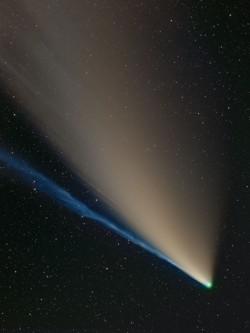
Comet C/2020F3 (Neowise) with separate dust and ion gas tails and a green glowing coma, by Dietmar Gutermuth, Germany
Légende : Second place in the 2021 IAU OAE Astrophotography Contest, category Comets.
Comets have a very interesting structure comprising of four main parts: the nucleus, composed of rock, dust and frozen gases, typically spanning a few kilometres, although bigger ones have been observed; a small atmosphere of gas surrounding the nucleus (only present when the comet approaches its closest point to the Sun), called coma; and the two distinctive cometary tails (there is at times third tail). The green colour of the coma is due to carbon and nitrogen present in the coma reacting with the Sun’s ultraviolet radiation. The tail that we are mostly used to observing – dust tail and is composed of micron sized dust particles, the second tail composed of charged particles – ion or gas tail. The tails are released only when the comet approaches the Sun at a distance where the heat and radiation emanating from our star is intense enough to vaporize the frozen gases. The dust tail is curved, while the gas tail is straight and always points away from the Sun as this is carried by the solar wind - flow of charged particles emitted by the Sun. As comets are formed by leftover material, they carry with them important information about the early stages of the Solar System’s formation. This beautiful image shows the comet C/2020 F3 (Neowise), as seen from Germany in July 2020, with three of the four structures clearly visible – coma, gas, and dust tail.
Crédit : Dietmar Gutermuth/IAU OAE
License: CC-BY-4.0 Creative Commons (CC) Attribution 4.0 International (CC BY 4.0) Icônes
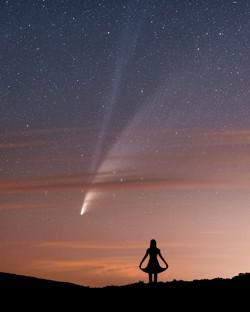
Hello Comet, shall we dance?, by Robert Barsa, Slovakia
Légende : Third place in the 2021 IAU OAE Astrophotography Contest, category Comets.
This beautiful and poetic image taken from Slovakia in July 2020 captures the comet C/2020 F3 (Neowise). The direction of the tails of the comet provides a clue as to the position of the Sun. In the past, the appearance of a comet in the skies could be accompanied by apprehension and even fear from those who did not know what these objects really are. Through careful observations and the applications of knowledge from physics, chemistry and geology, we now understand that comets are objects left over from the earliest days when the Solar System formed. The most distinctive features of a comet are the bluish ion (gas) tail, and whitish dust tail, which can extend for tens of millions of kilometres. These distinctive features, easily observable with the unaided eye together with an understanding of the science, are no longer cause for fear, rather they help us understand the history of our Solar System, and bring awe, joy and contemplation, as portrayed in this image.
Crédit : Robert Barsa/IAU OAE
License: CC-BY-4.0 Creative Commons (CC) Attribution 4.0 International (CC BY 4.0) Icônes
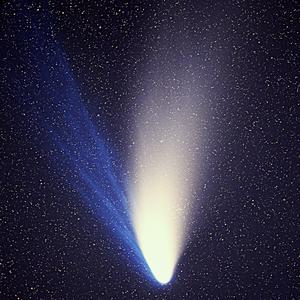
Comète Hale-Bopp
Légende : Image de la comète C/1995 O1 (Hale-Bopp), prise le 4 avril 1997, avec un temps d'exposition de 10 minutes. Le champ représenté est d'environ 6,5°x6,5°. Deux queues s'étendent à partir de la chevelure brillante : une queue de poussière blanche-jaunâtre, orientée à l'opposé du déplacement de la comète et une queue de gaz bleuâtre, orientée à l'opposé du Soleil.
Crédit : E. Kolmhofer, H. Raab ; Observatoire Johannes Kepler, Linz, Autriche
Lien vers les crédits
License: CC-BY-SA-3.0 Creative Commons (CC) Attribution - Partage dans les Mêmes Conditions 3.0 non transposé Icônes

Halley's Comet
Légende : Halley’s Comet, is a well-known periodic comet, named after the English astronomer Edmond Halley. It has an orbital period of approximately 75 years and is visible from Earth with the naked eye when it passes through the inner solar system.
The image shows Halley’s Comet, officially designated 1P/Halley, with a tail of gas and dust streaming away from the Sun. It was taken from the La-Silla-Observatory in Chile in 1986 during Halley's Comet's last visit to the inner solar system. The stars in this image appear elongated or as lines of three different colored dots as image was created from three separate observations in different colors of light and the telescope was tracking the comet, which was moving very slightly compared to the background stars. Note that the comets tail does not point in exactly the same direction as the elongation of the stars. This shows us that the comet tail is not always behind the comet, but instead pointing away from the Sun.
The comet passes its perihelion (closest distance to the Sun) at a distance of around 0.59 astronomical units, right between the orbits of Mercury and Venus. Beyond Neptune, it reaches its aphelion (furthest distance from the Sun) at a distance of approximately 35 astronomical units. Halley's Comet reached aphelion in December 2023 and is now moving inwards again. It is expected to be seen with the naked eye from Earth again in mid-2061.
Crédit : ESO
Lien vers les crédits
License: CC-BY-4.0 Creative Commons (CC) Attribution 4.0 International (CC BY 4.0) Icônes
Ceci pourrait vous intéresser également







- Ressources
- Moteur de recherche des ressources pédagogiques
- Parcourir les ressources pédagogiques par Sujet
- Parcourir les images
- AstroEdu - Activités en classe
- Grandes Idées - Littéracie en astronomie
- Glossaire
- Rapports de l'OAE
- L'astronomie pour l'Education à travers le monde
- Sélection de ressources externes