Glossary term: 彗尾
Description: 當彗星靠近太陽時,太陽輻射會加熱彗星表面。表面的冰變成氣體("升華"),同時帶走岩石和塵埃物質。由此產生的混合物在彗核周圍形成一團雲,這就是彗發。一般來說,彗星會有兩條尾巴:噴射出的塵埃粒子形成彗尾,彗尾呈典型的彎曲狀。它由從表面釋放出來的塵埃粒子組成,這些塵埃粒子沿著彗星的軌道繞太陽運行。塵埃尾的長度可達數百萬公里或更長。它們反射太陽光,如果條件合適,肉眼能觀測到的彗星大部分都是由它們的白色漫射形狀組成的。
相當一部分氣體被太陽風--太陽發出的帶電粒子--吹走並電離。這些離子形成了彗星的離子尾,通常呈藍色。離子尾總是直指太陽。如果彗星本身正在遠離太陽,離子尾就會在彗星之前。
Related Terms:
See this term in other languages
Term and definition status: The original definition of this term in English have been approved by a research astronomer and a teacher The translation of this term and its definition is still awaiting approval
This is an automated transliteration of the simplified Chinese translation of this term
The OAE Multilingual Glossary is a project of the IAU Office of Astronomy for Education (OAE) in collaboration with the IAU Office of Astronomy Outreach (OAO). The terms and definitions were chosen, written and reviewed by a collective effort from the OAE, the OAE Centers and Nodes, the OAE National Astronomy Education Coordinators (NAECs) and other volunteers. You can find a full list of credits here. All glossary terms and their definitions are released under a Creative Commons CC BY-4.0 license and should be credited to "IAU OAE".
If you notice a factual or translation error in this glossary term or definition then please get in touch.
In Other Languages
- 阿拉伯語: ذيل المذنب
- 德語: Kometenschweif
- 英語: Cometary Tail
- 西班牙語: Cola de un cometa
- 法語: Queue cométaire
- 義大利語: Coda cometaria
- 日語: 尾(彗星の) (external link)
- 巴西葡萄牙語: Cauda de cometa
- 簡體中文: 彗尾
Related Media
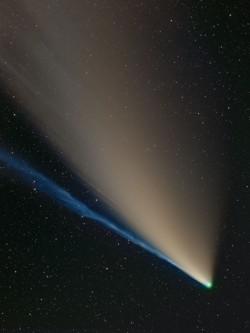
彗星 C/2020F3 (Neowise),有分開的塵埃尾和離子氣體尾,以及發出綠色光芒的彗發,作者 Dietmar Gutermuth,德國
Caption: 2021 年國際天文學聯合會 OAE 天體攝影比賽彗星類第二名。
彗星的結構非常有趣,主要由四個部分組成:由岩石、塵埃和冰凍氣體組成的彗核,大小通常為幾公里,但也觀測到過更大的彗星;彗核周圍的一小團氣體(只有在彗星最接近太陽時才會出現),稱為彗發;以及兩條獨特的彗尾(有時還有第三條尾)。彗發的綠色是由於其中的碳和氮與太陽的紫外輻射發生反應。我們通常觀測到的尾跡是塵埃尾,由微米級的塵埃粒子組成;第二條尾跡由帶電粒子組成--即離子尾或氣體尾。只有當彗星在一定距離內接近太陽,來自恆星的熱量和輻射強到足以使冰凍氣體氣化時,彗尾才會出現。塵埃尾是彎曲的,而氣體尾則是筆直的,並且始終指向遠離太陽的方向,因為這是由太陽風攜帶的--太陽發出的帶電粒子流。由於彗星是由殘留物質形成的,它們攜帶著太陽系形成早期的重要信息。這幅美麗的圖片顯示的是 2020 年 7 月從德國看到的彗星 C/2020 F3(Neowise),四個結構中的三個:彗尾、氣體尾和塵埃尾清晰可見。
Credit: Dietmar Gutermuth/IAU OAE
License: CC-BY-4.0 Creative Commons 姓名標示 4.0 國際 (CC BY 4.0) icons

你好,彗星,我們跳舞好嗎?作者羅伯特·巴爾薩,斯洛伐克
Caption: 2021年國際天文學聯合會教育辦公室天文攝影大賽彗星類別季軍作品。
這張優美而富有詩意的照片拍攝於2020年7月來自斯洛伐克,記錄了彗星C/2020 F3(NEOWISE)的身影。彗星尾巴的方向為太陽的位置提供了線索。在過去,對於不了解這些天體本質的人來說,天空中彗星的出現常常會讓他們感到憂慮甚至恐懼。然而,通過細緻的觀測以及物理學、化學和地質學知識,我們如今了解到,彗星是太陽系形成早期殘留的天體。彗星最顯著的特徵是藍色的離子(氣體)尾和白色的塵埃尾,這些尾巴可以延伸數千萬公里。這些獨特的特徵,即便肉眼也能輕鬆觀測到,再加上科學的理解,不再會引起恐懼,而是幫助我們探索太陽系的歷史,帶來敬畏、喜悅和思索,正如這幅影像中所呈現的那樣。
Credit: 羅伯特·巴爾薩/國際天文學聯合會教育辦公室
License: CC-BY-4.0 Creative Commons 姓名標示 4.0 國際 (CC BY 4.0) icons
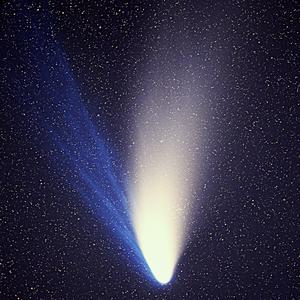
海爾-波普彗星
Caption: 彗星 C/1995 O1(海爾-波譜)的圖像,拍攝於 1997 年 4 月 4 日,曝光時間為 10 分鐘。顯示的視場約為 6.5°x6.5°。明亮的彗尾上延伸出兩條尾巴:一條白黃色的塵埃尾巴和一條始終指向遠離太陽的方向藍色的氣體尾巴。
Credit: E.Kolmhofer, H. Raab; Johannes Kepler Observatory, Linz, Austria
credit link
License: CC-BY-SA-3.0 Creative Commons Attribution-ShareAlike 3.0 Unported icons

Halley's Comet
Caption: Halley’s Comet, is a well-known periodic comet, named after the English astronomer Edmond Halley. It has an orbital period of approximately 75 years and is visible from Earth with the naked eye when it passes through the inner solar system.
The image shows Halley’s Comet, officially designated 1P/Halley, with a tail of gas and dust streaming away from the Sun. It was taken from the La-Silla-Observatory in Chile in 1986 during Halley's Comet's last visit to the inner solar system. The stars in this image appear elongated or as lines of three different colored dots as image was created from three separate observations in different colors of light and the telescope was tracking the comet, which was moving very slightly compared to the background stars. Note that the comets tail does not point in exactly the same direction as the elongation of the stars. This shows us that the comet tail is not always behind the comet, but instead pointing away from the Sun.
The comet passes its perihelion (closest distance to the Sun) at a distance of around 0.59 astronomical units, right between the orbits of Mercury and Venus. Beyond Neptune, it reaches its aphelion (furthest distance from the Sun) at a distance of approximately 35 astronomical units. Halley's Comet reached aphelion in December 2023 and is now moving inwards again. It is expected to be seen with the naked eye from Earth again in mid-2061.
Credit: ESO
credit link
License: CC-BY-4.0 Creative Commons 姓名標示 4.0 國際 (CC BY 4.0) icons