Glossary term: 궁수자리에이*
Description: 은하수 중심부의 별과 가스의 움직임을 관측한 결과, 지구에서 약 27,000광년 떨어진 곳에 태양 질량의 약 450만 배에 해당하는 초대질량 블랙홀이 존재한다는 간접적인 증거가 발견되었습니다. 이 블랙홀의 크기는 약 4천만 킬로미터 정도로 추정됩니다. 이 블랙홀과 연관된 콤팩트 전파원(compact radio source)이 바로 궁수자리 A* (Sagittarius A*)입니다. 궁수자리(Sagittarius)라는 이름은 이 전파원이 지구에서 보았을 때 궁수자리 별자리 방향에 위치하기 때문이며, “A”는 이 별자리에서 발견된 가장 밝고 첫 번째 전파원임을 의미합니다. 이름 뒤의 * 표시는 물리학에서 들뜬 상태(excited state)를 나타내는 기호로, 발견 당시 이 전파원이 특히 흥미로운 천체로 간주되었음을 반영합니다.
2022년, 이벤트 호라이즌 망원경(Event Horizon Telescope, EHT) 공동 연구팀은 궁수자리 A*와 연관된 블랙홀의 ‘그림자(shadow)’ 이미지를 처음으로 공개했습니다.
Related Terms:
See this term in other languages
Term and definition status: The original definition of this term in English have been approved by a research astronomer and a teacher The translation of this term and its definition is still awaiting approval
The OAE Multilingual Glossary is a project of the IAU Office of Astronomy for Education (OAE) in collaboration with the IAU Office of Astronomy Outreach (OAO). The terms and definitions were chosen, written and reviewed by a collective effort from the OAE, the OAE Centers and Nodes, the OAE National Astronomy Education Coordinators (NAECs) and other volunteers. You can find a full list of credits here. All glossary terms and their definitions are released under a Creative Commons CC BY-4.0 license and should be credited to "IAU OAE".
If you notice a factual or translation error in this glossary term or definition then please get in touch.
In Other Languages
- 아랍어: القوس أ*
- 독일어: Sagittarius A*
- 영어: Sagittarius A*
- 스페인어: Sagitario A*
- 프랑스어: Sagittarius A*
- 힌두어: सॅजीटेरीअस ए*
- 이탈리아어: Sagittario A*
- 일본어: いて座A* (external link)
- 마라티어: सॅजीटेरीअस A* (Sgr A*)
- 브라질 포르투갈어: Sagitário A*
- 중국어 간체: 人马座 A*
- 중국어 번체: 人馬座 A*
Related Diagrams
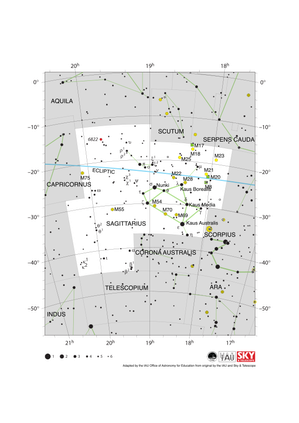
Sagittarius Constellation Map
Caption: The constellation Sagittarius along with its bright stars and surrounding constellations. Sagittarius is surrounded by (going clockwise from the top) Aquila, Scutum, Serpens Cauda, Ophiuchus, Scorpius, Corona Australis, Telescopium, Microscopium and Capricornus. The brighter stars in Sagittarius form a distinctive teapot shape. Sagittarius lies on the ecliptic (shown here as a blue line), this is the path the Sun appears to take across the sky over the course of a year. The Sun is in Sagittarius from mid December to mid January. The other planets of the Solar System can often be found in Sagittarius.
Sagittarius lies south of the celestial equator. The famous teapot asterism is visible for all but the most arctic regions of the world but the most southerly parts of the constellation are not visible in northern parts of Asia, Europe and North America. Sagittarius is most visible in the evenings in the northern hemisphere summer and southern hemisphere winter.
The supermassive black hole Sagittarius A* which lies at the center of our Milky Way Galaxy is sits on the western (here right-hand) edge of Sagittarius. Due to it covering an area at the center of our Galaxy, Sagittarius is home to many star clusters including open clusters (marked here with yellow circles) and globular clusters (marked here with yellow circles with + signs superimposed on them). Three nebulae are also marked here with green squares.
The y-axis of this diagram is in degrees of declination with north as up and the x-axis is in hours of right ascension with east to the left. The sizes of the stars marked here relate to the star's apparent magnitude, a measure of its apparent brightness. The larger dots represent brighter stars. The Greek letters mark the brightest stars in the constellation. These are ranked by brightness with the brightest star being labeled alpha, the second brightest beta, etc., although this ordering is not always followed exactly. The dotted boundary lines mark the IAU's boundaries of the constellations and the solid green lines mark one of the common forms used to represent the figures of the constellations. Neither the constellation boundaries, nor the line marking the ecliptic, nor the lines joining the stars appear on the sky.
Credit: Adapted by the IAU Office of Astronomy for Education from the original by IAU/Sky & Telescope
License: CC-BY-4.0 Creative Commons 저작자표시 4.0 국제 (CC BY 4.0) icons