Terme du glossaire : Sagittarius A*
Description : Les observations des mouvements des étoiles et du gaz autour du centre de la Voie lactée fournissent des preuves indirectes de l'existence d'un trou noir supermassif d'une masse d'environ 4,5 millions de fois celle du Soleil et d'un diamètre d'environ 40 millions de kilomètres, situé à quelque 27 000 années-lumière de la Terre. Sagittarius A* (étoile A du Sagittaire) est la source radio compacte associée au trou noir supermassif. Elle a été observée dans plusieurs longueurs d'onde, notamment en radio. Le nom Sagittarius est dû au fait qu'elle est située dans la constellation du Sagittaire telle qu'observée depuis la Terre ; la lettre A est due au fait qu'il s'agit de la source radio extrasolaire la plus brillante et la première découverte dans la constellation ; l'astérisque est dû au fait qu'en physique, les atomes dans des états excités sont désignés par *, et que Sagittarius A* a été une découverte passionnante.
En 2022, l'Event Horizon Telescope Collaboration a publié la première image de la silhouette ("ombre") du trou noir associé à Sagittarius A*.
Termes associés :
Voir ce terme dans d'autres langues
Statut du terme et de sa définition : La définition initiale de ce terme en anglais a été aprouvée par un·e spécialiste de la recherche en astronomie et un·e spécialiste de l’éducation La traduction de ce terme et de sa définition n'ont pas encore été aprouvées
Le glossaire multilangue de l'OAE est un projet du Bureau de l'IAU de l'Astronomie pour l'Education (OAE) en collaboration avec le Bureau de l'IAU de diffusion de l'Astronomie (OAO). Les termes et définitions ont été choisis, écrits et relues grâce à un effort collectif de l'OAE, les Centres et les Noeuds de l'OAE, les Coordinateurs Nationaux de l'Astronomie pour l'Education de l'OAE(NAECs) et d'autres volontaires. La liste complète des crédits pour ce projet est disponible ici . Tous les termes du glossaire et leur définition sont déposés sous licence Creative Commons CC BY-4.0 et doivent être créditées au nom de "IAU OAE".
Si vous constatez une erreur dans ce terme ou sa définition, veuillez nous contacter .
Dans d'autres langues
- Arabe: القوس أ*
- Allemand: Sagittarius A*
- Anglais: Sagittarius A*
- Espagnol: Sagitario A*
- Hindi: सॅजीटेरीअस ए*
- Italien: Sagittario A*
- Japonais: いて座A* (Liens externes)
- Coréen: 궁수자리에이*
- Marathi: सॅजीटेरीअस A* (Sgr A*)
- Portugais brésilien: Sagitário A*
- Chinois simplifié: 人马座 A*
- Chinois traditionnel: 人馬座 A*
Diagrammes associés
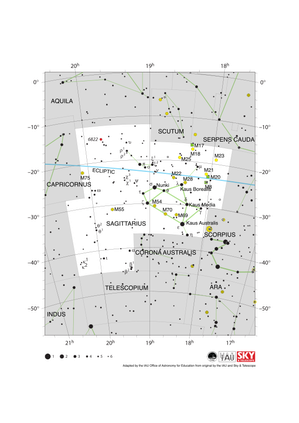
Sagittarius Constellation Map
Légende : The constellation Sagittarius along with its bright stars and surrounding constellations. Sagittarius is surrounded by (going clockwise from the top) Aquila, Scutum, Serpens Cauda, Ophiuchus, Scorpius, Corona Australis, Telescopium, Microscopium and Capricornus. The brighter stars in Sagittarius form a distinctive teapot shape. Sagittarius lies on the ecliptic (shown here as a blue line), this is the path the Sun appears to take across the sky over the course of a year. The Sun is in Sagittarius from mid December to mid January. The other planets of the Solar System can often be found in Sagittarius.
Sagittarius lies south of the celestial equator. The famous teapot asterism is visible for all but the most arctic regions of the world but the most southerly parts of the constellation are not visible in northern parts of Asia, Europe and North America. Sagittarius is most visible in the evenings in the northern hemisphere summer and southern hemisphere winter.
The supermassive black hole Sagittarius A* which lies at the center of our Milky Way Galaxy is sits on the western (here right-hand) edge of Sagittarius. Due to it covering an area at the center of our Galaxy, Sagittarius is home to many star clusters including open clusters (marked here with yellow circles) and globular clusters (marked here with yellow circles with + signs superimposed on them). Three nebulae are also marked here with green squares.
The y-axis of this diagram is in degrees of declination with north as up and the x-axis is in hours of right ascension with east to the left. The sizes of the stars marked here relate to the star's apparent magnitude, a measure of its apparent brightness. The larger dots represent brighter stars. The Greek letters mark the brightest stars in the constellation. These are ranked by brightness with the brightest star being labeled alpha, the second brightest beta, etc., although this ordering is not always followed exactly. The dotted boundary lines mark the IAU's boundaries of the constellations and the solid green lines mark one of the common forms used to represent the figures of the constellations. Neither the constellation boundaries, nor the line marking the ecliptic, nor the lines joining the stars appear on the sky.
Crédit : Adapted by the IAU Office of Astronomy for Education from the original by IAU/Sky & Telescope
License: CC-BY-4.0 Creative Commons (CC) Attribution 4.0 International (CC BY 4.0) Icônes
Ceci pourrait vous intéresser également









- Ressources
- Moteur de recherche des ressources pédagogiques
- Parcourir les ressources pédagogiques par Sujet
- Parcourir les images
- AstroEdu - Activités en classe
- Grandes Idées - Littéracie en astronomie
- Glossaire
- Rapports de l'OAE
- L'astronomie pour l'Education à travers le monde
- Sélection de ressources externes