Glossary term: 바다염소자리
Description: 바다염소자리는 황도대에서 가장 작은 별자리입니다. 이 별자리를 이루는 별들은 황도, 즉 태양 주위를 도는 지구의 궤도면과 교차하는 하늘의 일부에 있습니다. 사실 황도대를 구성하는 모든 별자리는 이 황도와 교차합니다. 지구에서는 염소자리 방향에서 태양과 행성을 정기적으로 볼 수 있습니다. 태양의 경우 1월 말부터 2월 중순 사이에 염소자리에 위치하게 됩니다. 물론 이 시기에는 태양빛 때문에 별자리의 별을 볼 수 없습니다. 염소자리는 국제천문연맹이 정한 88개의 현대 별자리 중 하나이지만, 이미 2세기 천문학자 클라우디우스 프톨레마이오스(Claudius Ptolemy)가 이름을 붙인 48개의 고대 별자리에도 포함되어 있습니다. 염소자리를 구성하는 별들은 비교적 희미합니다. 하지만 망원경으로 관측하면 염소자리 안에서 구상성단 M30을 찾을 수 있습니다.
Related Terms:
See this term in other languages
Term and definition status: The original definition of this term in English have been approved by a research astronomer and a teacher The translation of this term and its definition is still awaiting approval
The OAE Multilingual Glossary is a project of the IAU Office of Astronomy for Education (OAE) in collaboration with the IAU Office of Astronomy Outreach (OAO). The terms and definitions were chosen, written and reviewed by a collective effort from the OAE, the OAE Centers and Nodes, the OAE National Astronomy Education Coordinators (NAECs) and other volunteers. You can find a full list of credits here. All glossary terms and their definitions are released under a Creative Commons CC BY-4.0 license and should be credited to "IAU OAE".
If you notice a factual or translation error in this glossary term or definition then please get in touch.
In Other Languages
- 아랍어: كوكبة الجدي
- 독일어: Steinbock
- 영어: Capricornus
- 스페인어: Capricornio
- 프랑스어: Capricorne
- 이탈리아어: Capricorno
- 브라질 포르투갈어: Capricórnio
- 중국어 간체: 摩羯座
- 중국어 번체: 摩羯座
Related Media
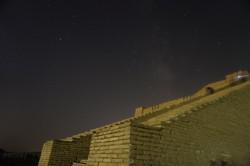
Galaxy Arm
Caption: Honourable mention in the 2022 IAU OAE Astrophotography Contest, category Still images of celestial patterns.
Taken from the south of Iraq in January 2022, this image shows a clear sky over one of the many ancient monuments in the region which looks like a Babylonian ziggurat. The Sumerians had invented these mountain-like buildings even before the invention of script; the earliest ziggurats appear around 4000 years before the common era. They look like the frustum of a pyramid and in Babylonian times often had temples on top. Next to the stairs of the ziggurat are the constellations of the southernmost part of the Zodiac, also invented in Babylon. Today, we call them Capricorn (left, with a planet in it) and Sagittarius, whose brightest stars form the asterism of the Teapot. For the Babylonians, Sagittarius was the god Pabilsang, the city god of Larak and a god of agriculture and war. He was also the husband of the mighty goddess of medicine, Gula, and his iconography is a hybrid creature holding a bow and arrow: a male human torso and head attached to the body of a horse with four legs, two gigantic wings and two tails — a horse tail and a scorpion tail. Such a creature did not exist in Greek mythology, so the Greeks reduced it to something they knew, a centaur holding a bow and arrow. This picture still did not make sense in Greek culture because centaurs were considered wild and cruel, and not intelligent enough to use a bow and arrow. Therefore, there was another Greek figure that existed simultaneously: a man with hooves instead of feet at the ends of his legs, a satyr, but this figure vanished in Roman times.
Capricornus is one of the most stable foreign creatures in the Zodiac and has been unchanged over millennia. It is depicted as a hybrid creature with the front part of a goat and the back part of a fish. This so-called Goat-Fish constellation has been recognised since the earliest writings of astronomy in Babylon. In Babylonian religion it is a good-natured, benevolent demon that protects humans, supports all healing processes and accompanies the god of wisdom and witchcraft. The Greeks simply adopted it and invented a saga for it. In Roman times, it became tremendously famous because emperor Augustus of Rome used it as his personal symbol, also imprinting it on coins and other political propaganda tools.
In Sagittarius, there is also the bright bulge of the Milky Way. That this is hardly visible in this photograph is a result of modern civilization; the huge number of artificial lights that we use on Earth also illuminates the night sky and makes it impossible to see the Milky Way in areas where humans live.
Credit: Ruqayah Mohammed/IAU OAE
License: CC-BY-4.0 Creative Commons 저작자표시 4.0 국제 (CC BY 4.0) icons

The Pillar of Creation
Caption: Winner in the 2022 IAU OAE Astrophotography Contest, category Still images of celestial patterns.
This image shows the night sky over Tre Cime di Lavaredo, (Dolomites Natural Park), in the region of Veneto, Italy, in October 2021.
The bright spot on the left-hand side is the planet Jupiter, appearing in the constellation Capricorn. To the right of Jupiter and below the two horn stars of Capricorn is the planet Saturn. Just above Jupiter we can see parts of Aquarius, one of the largest constellations and also part of the Zodiac. North of these constellations, left of the Milky Way, there are mostly faint stars. The brighter whitish one in the top left corner is Enif, a binary star in the constellation Pegasus.
The Milky Way seems to emerge from a rock like celestial vapour. Roughly centred in the image are two bright stars left and right of the Milky Way: Altair and Vega, respectively. They seem to be separated by the galactic stream, as told in a popular Chinese folk story where they represent a loving couple. Today, in popular astronomy, the fairly bright star at the upper edge of the photograph is added to form a huge triangle with them, the Summer Triangle in the northern hemisphere.
Altair is the brightest star of the Babylonian constellation Aquila, the Eagle. In ancient Babylon, it was said that the Eagle was carrying king Etana up in the air so that he could see Earth from above. Next to the Babylonian Eagle was the constellation of the Corpse, that returned only in Roman times when Ptolemy put it below the Eagle as the new sub-constellation “Antinous”. It is seen as the corpse (or soul) of the Roman emperor Hadrian’s favourite who had just died in the Nile.
Vega is the bright white star to the right of the Milky Way. It forms part of the small constellation Lyra, famous for hosting the Ring Nebula, which is an impressive planetary nebula — a dying star blowing its gas into space.
At the right edge of the image, three stars in a bent row appear rather prominently. This is the handle of the Big Dipper pointing downwards to a bright star close to the horizon: Arcturus, the bright star of the constellation Bootes (Greek: the Ploughman). This kite-like constellation is probably a pagan interpretation of the Babylonian god “Enlil” whose constellation also occupied that place in the sky. The Romans re-interpreted this figure as The Ox-Driver who controlled the Seven Oxen seen in the bright stars of Ursa Major.
Directly right of Vega, there is the huge constellation Hercules and below it, directly to the left of Bootes, we find a half-circle of stars comprising the small constellation Corona Borealis, associated with Ariadne, daughter of King Minos of Crete in Greek culture.
The lights seen in the bottom left side of the image are due to the reflection of artificial lights in the clouds.
Credit: Giorgia Hofer/IAU OAE
License: CC-BY-4.0 Creative Commons 저작자표시 4.0 국제 (CC BY 4.0) icons
Related Diagrams
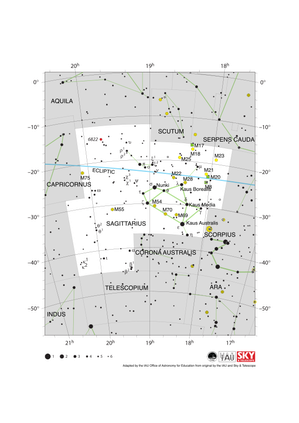
Sagittarius Constellation Map
Caption: The constellation Sagittarius along with its bright stars and surrounding constellations. Sagittarius is surrounded by (going clockwise from the top) Aquila, Scutum, Serpens Cauda, Ophiuchus, Scorpius, Corona Australis, Telescopium, Microscopium and Capricornus. The brighter stars in Sagittarius form a distinctive teapot shape. Sagittarius lies on the ecliptic (shown here as a blue line), this is the path the Sun appears to take across the sky over the course of a year. The Sun is in Sagittarius from mid December to mid January. The other planets of the Solar System can often be found in Sagittarius.
Sagittarius lies south of the celestial equator. The famous teapot asterism is visible for all but the most arctic regions of the world but the most southerly parts of the constellation are not visible in northern parts of Asia, Europe and North America. Sagittarius is most visible in the evenings in the northern hemisphere summer and southern hemisphere winter.
The supermassive black hole Sagittarius A* which lies at the center of our Milky Way Galaxy is sits on the western (here right-hand) edge of Sagittarius. Due to it covering an area at the center of our Galaxy, Sagittarius is home to many star clusters including open clusters (marked here with yellow circles) and globular clusters (marked here with yellow circles with + signs superimposed on them). Three nebulae are also marked here with green squares.
The y-axis of this diagram is in degrees of declination with north as up and the x-axis is in hours of right ascension with east to the left. The sizes of the stars marked here relate to the star's apparent magnitude, a measure of its apparent brightness. The larger dots represent brighter stars. The Greek letters mark the brightest stars in the constellation. These are ranked by brightness with the brightest star being labeled alpha, the second brightest beta, etc., although this ordering is not always followed exactly. The dotted boundary lines mark the IAU's boundaries of the constellations and the solid green lines mark one of the common forms used to represent the figures of the constellations. Neither the constellation boundaries, nor the line marking the ecliptic, nor the lines joining the stars appear on the sky.
Credit: Adapted by the IAU Office of Astronomy for Education from the original by IAU/Sky & Telescope
License: CC-BY-4.0 Creative Commons 저작자표시 4.0 국제 (CC BY 4.0) icons
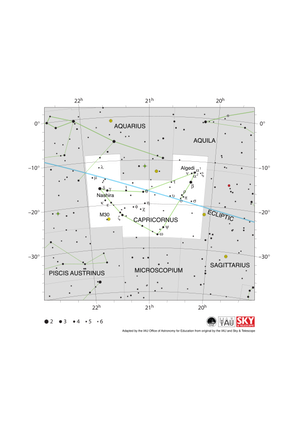
Capricornus Constellation Map
Caption: The constellation Capricornus (commonly called Capricorn) including its bright stars and surrounding constellations. Capricornus is surrounded by (going clockwise from the top) Aquarius, Aquila, Sagittarius, Microscopium and Piscis Austrinus. Capricornus lies on the ecliptic (shown here as a blue line), this is the path the Sun appears to take across the sky over the course of a year. The Sun is in Capricornus from mid January to mid February. The other planets of the Solar System can often be found in Capricornus.
Capricornus lies just south of the celestial equator and is visible to all observers south of the Arctic Circle. Capricornus is most visible in the evenings in the northern hemisphere autumn and southern hemisphere spring.
In the south east (lower left on this diagram) of the constellation one can find the globular cluster M30 (shown here as a yellow circle with a plus sign superimposed on it).
The y-axis of this diagram is in degrees of declination with north as up and the x-axis is in hours of right ascension with east to the left. The sizes of the stars marked here relate to the star's apparent magnitude, a measure of its apparent brightness. The larger dots represent brighter stars. The Greek letters mark the brightest stars in the constellation. These are ranked by brightness with the brightest star being labeled alpha, the second brightest beta, etc., although this ordering is not always followed exactly. The dotted boundary lines mark the IAU's boundaries of the constellations and the solid green lines mark one of the common forms used to represent the figures of the constellations. Neither the constellation boundaries, nor the line marking the ecliptic, nor the lines joining the stars appear on the sky.
Credit: Adapted by the IAU Office of Astronomy for Education from the original by IAU/Sky & Telescope
License: CC-BY-4.0 Creative Commons 저작자표시 4.0 국제 (CC BY 4.0) icons
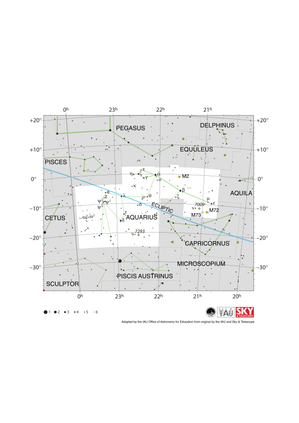
Aquarius Constellation Map
Caption: The constellation Aquarius along with its bright stars and surrounding constellations. Aquarius is surrounded by (going clockwise from the top) Pegasus, Equuleus, Aquila, Capricornus, Piscis Austrinus, Sculptor, Cetus and Pisces. Aquarius lies on the ecliptic (shown here as a blue line), this is the path the Sun appears to take across the sky over the course of a year. The Sun is in Aquarius from mid February to mid March. The other planets of the Solar System can often be found in Aquarius.
Aquarius spans the celestial equator and is thus visible at some time in the year from all of planet Earth. In the most arctic or antarctic regions of the world, some parts of the constellation may not be visible. Aquarius is most visible in the evenings in the northern hemisphere autumn and southern hemisphere spring.
The yellow circles with plus symbols superimposed on them mark the globular clusters M2 and M72. The green circles superimposed on plus symbols mark the planetary nebulae NGC 7293 (the Helix Nebula) and NGC 7002 (the Saturn Nebula). M73 (marked with an x symbol) is a coincident grouping of stars previously erroneously classified as an open cluster.
The y-axis of this diagram is in degrees of declination with north as up and the x-axis is in hours of right ascension with east to the left. The sizes of the stars marked here relate to the star's apparent magnitude, a measure of its apparent brightness. The larger dots represent brighter stars. The Greek letters mark the brightest stars in the constellation. These are ranked by brightness with the brightest star being labeled alpha, the second brightest beta, etc., although this ordering is not always followed exactly. The dotted boundary lines mark the IAU's boundaries of the constellations and the solid green lines mark one of the common forms used to represent the figures of the constellations. Neither the constellation boundaries, nor the line marking the ecliptic, nor the lines joining the stars appear on the sky.
Credit: Adapted by the IAU Office of Astronomy for Education from the original by IAU/Sky & Telescope
License: CC-BY-4.0 Creative Commons 저작자표시 4.0 국제 (CC BY 4.0) icons
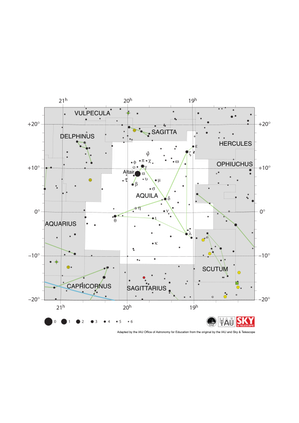
Aquila Constellation Map
Caption: The constellation Aquila with its bright stars and surrounding constellations. Aquila is surrounded by (going clockwise from the top): Sagitta, Hercules, Ophiuchus, Serpens Cauda, Scutum, Sagittarius, Capricornus, Aquarius and Delphinus. Aquila is most notable for its brightest star Altair. This forms one vertex of the prominent Summer Triangle asterism that is visible in northern hemisphere summer evenings.
Aquila spans the celestial equator and thus some part of it is visible from all of the Earth at some point in the year. It is most visible in the evenings in the late northern hemisphere summer and late southern hemisphere winter.
The y-axis of this diagram is in degrees of declination with north as up and the x-axis is in hours of right ascension with east to the left. The sizes of the stars marked here relate to the star's apparent magnitude, a measure of its apparent brightness. The larger dots represent brighter stars. The Greek letters mark the brightest stars in the constellation. These are ranked by brightness with the brightest star being labeled alpha, the second brightest beta, etc., although this ordering is not always followed exactly. The dotted boundary lines mark the IAU's boundaries of the constellations and the solid green lines mark one of the common forms used to represent the figures of the constellations. The blue line in the lower right of the diagram is the ecliptic. Neither the constellation boundaries, nor the line marking the ecliptic, nor the lines joining the stars appear on the sky.
Credit: Adapted by the IAU Office of Astronomy for Education from the original by IAU/Sky & Telescope
License: CC-BY-4.0 Creative Commons 저작자표시 4.0 국제 (CC BY 4.0) icons
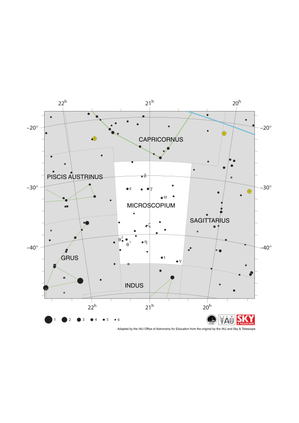
Microscopium Constellation Map
Caption: The constellation Microscopium with its brighter stars and surrounding constellations. Microscopium is surrounded by (going clockwise from the top): Capricornus, Sagittarius, Telescopium, Indus, Grus and Piscis Austrinus. Microscopium is a faint constellation with relatively few bright stars.
Microscopium is a southern constellation and thus the whole constellation is visible at some point in the year throughout the southern hemisphere. The whole constellation is also visible in equatorial and some temperate regions of the northern hemisphere with parts of the constellation visible from other northern temperate regions. Microscopium is best viewed in the evening in the northern hemisphere autumn and southern hemisphere spring.
The y-axis of this diagram is in degrees of declination with north as up and the x-axis is in hours of right ascension with east to the left. The sizes of the stars marked here relate to the star's apparent magnitude, a measure of its apparent brightness. The larger dots represent brighter stars. The Greek letters mark the brightest stars in the constellation. These are ranked by brightness with the brightest star being labeled alpha, the second brightest beta, etc., although this ordering is not always followed exactly. The dotted boundary lines mark the IAU's boundaries of the constellations and the solid green lines mark one of the common forms used to represent the figures of the constellations. Neither the constellation boundaries, nor the line marking the ecliptic, nor the lines joining the stars appear on the sky. The ecliptic is marked with a blue line in the top right.
Credit: Adapted by the IAU Office of Astronomy for Education from the original by the IAU and Sky & Telescope
License: CC-BY-4.0 Creative Commons 저작자표시 4.0 국제 (CC BY 4.0) icons