Término del glosario: Capricornio
Descripción: Capricornio es la constelación más pequeña del zodíaco. Las estrellas que componen esta constelación se encuentran en la parte del cielo que se cruza con la eclíptica (el plano definido por la trayectoria de la Tierra alrededor del Sol). De hecho, todas las constelaciones que componen el zodíaco se cruzan con la eclíptica. Desde la Tierra, podemos ver con frecuencia los planetas, y también el Sol, en la constelación de Capricornio. En el caso del Sol, esto ocurre desde finales de enero hasta mediados de febrero (en ese momento, por supuesto, no podemos ver las estrellas de la constelación). Capricornio es una de las 88 constelaciones modernas definidas por la Unión Astronómica Internacional, pero su origen se remonta mucho más atrás: ya era una de las 48 constelaciones nombradas por el astrónomo del siglo II Claudio Ptolomeo. Las estrellas que componen la constelación de Capricornio son relativamente tenues. Con un telescopio, se puede observar el cúmulo globular M30 en Capricornio.
Términos relacionados:
Ver este término en otros idiomas
Estado del término y la definición: La definición original de este término en inglés ha sido aprobada por unastrónomo o astrónoma investigadora y un docente La traducción de este término y su definición aún están pendientes de aprobación
El Glosario multilingüe de la OAE es un proyecto de la Oficina de Astronomía para la Educación de la UAI (OAE) en colaboración con la Oficina de Divulgación de Astronomía de la UAI (OAO). Los términos y definiciones fueron seleccionados, redactados y revisados gracias al esfuerzo colectivo de la OAE, los Centros y Nodos de la OAE, los Coordinadores Nacionales de Educación Astronómica (NAECs) y otros voluntarios. Puedes encontrar una lista completa de créditos aquí. Todos los términos del glosario y sus definiciones se publican bajo la licencia Creative Commons CC BY-4.0 y deben atribuirse a la "IAU OAE".
Si detectas algún error de contenido o de traducción en este término del glosario o en ladefinición, ponte en contacto con nosotros.
En otros idiomas
- Árabe: كوكبة الجدي
- Alemán: Steinbock
- Inglés: Capricornus
- Francés: Capricorne
- Italiano: Capricorno
- Coreano: 바다염소자리
- Portugués de Brasil: Capricórnio
- Chino simplificado: 摩羯座
- Chino tradicional: 摩羯座
Contenidos relacionados
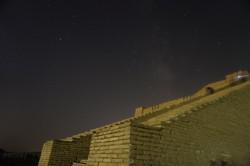
Galaxy Arm
Pie de foto: Honourable mention in the 2022 IAU OAE Astrophotography Contest, category Still images of celestial patterns.
Taken from the south of Iraq in January 2022, this image shows a clear sky over one of the many ancient monuments in the region which looks like a Babylonian ziggurat. The Sumerians had invented these mountain-like buildings even before the invention of script; the earliest ziggurats appear around 4000 years before the common era. They look like the frustum of a pyramid and in Babylonian times often had temples on top. Next to the stairs of the ziggurat are the constellations of the southernmost part of the Zodiac, also invented in Babylon. Today, we call them Capricorn (left, with a planet in it) and Sagittarius, whose brightest stars form the asterism of the Teapot. For the Babylonians, Sagittarius was the god Pabilsang, the city god of Larak and a god of agriculture and war. He was also the husband of the mighty goddess of medicine, Gula, and his iconography is a hybrid creature holding a bow and arrow: a male human torso and head attached to the body of a horse with four legs, two gigantic wings and two tails — a horse tail and a scorpion tail. Such a creature did not exist in Greek mythology, so the Greeks reduced it to something they knew, a centaur holding a bow and arrow. This picture still did not make sense in Greek culture because centaurs were considered wild and cruel, and not intelligent enough to use a bow and arrow. Therefore, there was another Greek figure that existed simultaneously: a man with hooves instead of feet at the ends of his legs, a satyr, but this figure vanished in Roman times.
Capricornus is one of the most stable foreign creatures in the Zodiac and has been unchanged over millennia. It is depicted as a hybrid creature with the front part of a goat and the back part of a fish. This so-called Goat-Fish constellation has been recognised since the earliest writings of astronomy in Babylon. In Babylonian religion it is a good-natured, benevolent demon that protects humans, supports all healing processes and accompanies the god of wisdom and witchcraft. The Greeks simply adopted it and invented a saga for it. In Roman times, it became tremendously famous because emperor Augustus of Rome used it as his personal symbol, also imprinting it on coins and other political propaganda tools.
In Sagittarius, there is also the bright bulge of the Milky Way. That this is hardly visible in this photograph is a result of modern civilization; the huge number of artificial lights that we use on Earth also illuminates the night sky and makes it impossible to see the Milky Way in areas where humans live.
Crédito: Ruqayah Mohammed/IAU OAE
License: CC-BY-4.0 Creative Commons Reconocimiento 4.0 Internacional (CC BY 4.0) íconos

The Pillar of Creation
Pie de foto: Winner in the 2022 IAU OAE Astrophotography Contest, category Still images of celestial patterns.
This image shows the night sky over Tre Cime di Lavaredo, (Dolomites Natural Park), in the region of Veneto, Italy, in October 2021.
The bright spot on the left-hand side is the planet Jupiter, appearing in the constellation Capricorn. To the right of Jupiter and below the two horn stars of Capricorn is the planet Saturn. Just above Jupiter we can see parts of Aquarius, one of the largest constellations and also part of the Zodiac. North of these constellations, left of the Milky Way, there are mostly faint stars. The brighter whitish one in the top left corner is Enif, a binary star in the constellation Pegasus.
The Milky Way seems to emerge from a rock like celestial vapour. Roughly centred in the image are two bright stars left and right of the Milky Way: Altair and Vega, respectively. They seem to be separated by the galactic stream, as told in a popular Chinese folk story where they represent a loving couple. Today, in popular astronomy, the fairly bright star at the upper edge of the photograph is added to form a huge triangle with them, the Summer Triangle in the northern hemisphere.
Altair is the brightest star of the Babylonian constellation Aquila, the Eagle. In ancient Babylon, it was said that the Eagle was carrying king Etana up in the air so that he could see Earth from above. Next to the Babylonian Eagle was the constellation of the Corpse, that returned only in Roman times when Ptolemy put it below the Eagle as the new sub-constellation “Antinous”. It is seen as the corpse (or soul) of the Roman emperor Hadrian’s favourite who had just died in the Nile.
Vega is the bright white star to the right of the Milky Way. It forms part of the small constellation Lyra, famous for hosting the Ring Nebula, which is an impressive planetary nebula — a dying star blowing its gas into space.
At the right edge of the image, three stars in a bent row appear rather prominently. This is the handle of the Big Dipper pointing downwards to a bright star close to the horizon: Arcturus, the bright star of the constellation Bootes (Greek: the Ploughman). This kite-like constellation is probably a pagan interpretation of the Babylonian god “Enlil” whose constellation also occupied that place in the sky. The Romans re-interpreted this figure as The Ox-Driver who controlled the Seven Oxen seen in the bright stars of Ursa Major.
Directly right of Vega, there is the huge constellation Hercules and below it, directly to the left of Bootes, we find a half-circle of stars comprising the small constellation Corona Borealis, associated with Ariadne, daughter of King Minos of Crete in Greek culture.
The lights seen in the bottom left side of the image are due to the reflection of artificial lights in the clouds.
Crédito: Giorgia Hofer/IAU OAE
License: CC-BY-4.0 Creative Commons Reconocimiento 4.0 Internacional (CC BY 4.0) íconos
Diagramas relacionados

Mapa de la constelación de Sagitario
Pie de foto: La constelación de Sagitario junto con sus estrellas brillantes y las constelaciones circundantes. Sagitario está rodeada por (en el sentido de las agujas del reloj desde arriba) Aquila, Scutum, Serpens Cauda, Ofiuco, Scorpius, Corona Australis, Telescopio, Microscopio y Capricornio. Las estrellas más brillantes de Sagitario dibujan una característica forma de tetera. Sagitario se encuentra en la eclíptica (mostrada aquí como una línea azul), que es la trayectoria que el Sol parece seguir a través del cielo en el transcurso de un año. El Sol está en Sagitario desde mediados de diciembre hasta mediados de enero. Los demás planetas del Sistema Solar se encuentran a menudo en Sagitario.
Sagitario se encuentra al sur del ecuador celeste. La famosa constelación de la tetera es visible en todas las regiones del mundo excepto en las más árticas, pero las partes más meridionales de la constelación no son visibles en las zonas septentrionales de Asia, Europa y Norteamérica. Sagitario es más visible por la noche en verano en el hemisferio norte y en invierno en el hemisferio sur.
El agujero negro supermasivo Sagitario A*, que se encuentra en el centro de nuestra Vía Láctea, está situado en el borde occidental (aquí a la derecha) de Sagitario. Debido a que cubre un área en el centro de nuestra Galaxia, Sagitario alberga muchos cúmulos estelares, incluyendo cúmulos abiertos (marcados aquí con círculos amarillos) y cúmulos globulares (marcados aquí con círculos amarillos con signos + superpuestos). También hay tres nebulosas marcadas aquí con cuadrados verdes.
El eje-y de este diagrama está en grados de declinación con el norte hacia arriba y el eje-x está en horas de ascensión recta con el este a la izquierda. El tamaño de las estrellas marcadas aquí está relacionado con la magnitud aparente de la estrella, una medida de su brillo aparente. Los puntos más grandes representan estrellas más brillantes. Las letras griegas indican las estrellas más brillantes de la constelación. Están ordenadas según su brillo: la estrella más brillante se denomina alfa, la segunda más brillante beta, etc., aunque este orden no siempre se sigue con exactitud. Las líneas punteadas marcan los límites de las constelaciones según la UAI y las líneas verdes continuas marcan una de las formas habituales utilizadas para representar las figuras de las constelaciones. Ni los límites de las constelaciones, ni la línea que marca la eclíptica, ni las líneas que unen las estrellas aparecen en el cielo.
Crédito: Adaptado por la Oficina de Astronomía para la Educación de la UAI a partir del original de UAI/Sky & Telescope
License: CC-BY-4.0 Creative Commons Reconocimiento 4.0 Internacional (CC BY 4.0) íconos
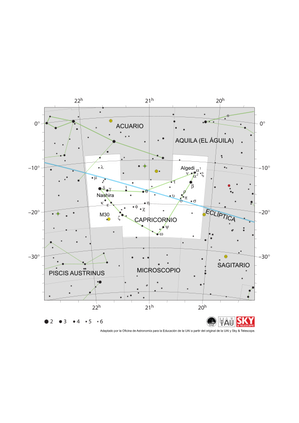
Mapa de la constelación de Capricornio
Pie de foto: La constelación de Capricornus (comúnmente llamada Capricornio), incluidas sus estrellas brillantes y las constelaciones circundantes. Capricornio está rodeada por (en el sentido de las agujas del reloj desde arriba) Aquario, Aquila, Sagitario, Microscopio y Piscis Austrinus. Capricornio se encuentra en la eclíptica (mostrada aquí como una línea azul), que es la trayectoria que el Sol parece seguir a través del cielo en el transcurso de un año. El Sol se encuentra en Capricornio desde mediados de enero hasta mediados de febrero. Los demás planetas del Sistema Solar se encuentran a menudo en Capricornio.
Capricornio se encuentra justo al sur del ecuador celeste y es visible para todos los observadores al sur del Círculo Polar Ártico. Capricornio es más visible por la noche en otoño en el hemisferio norte y en primavera en el hemisferio sur.
En el sudeste (abajo a la izquierda en este diagrama) de la constelación se encuentra el cúmulo globular M30 (representado aquí como un círculo amarillo con un signo de más superpuesto).
El eje-y de este diagrama está en grados de declinación con el norte hacia arriba y el eje-x está en horas de ascensión recta con el este a la izquierda. El tamaño de las estrellas marcadas aquí está relacionado con la magnitud aparente de la estrella, una medida de su brillo aparente. Los puntos más grandes representan estrellas más brillantes. Las letras griegas indican las estrellas más brillantes de la constelación. Están ordenadas según su brillo: la estrella más brillante se denomina alfa, la segunda más brillante beta, etc., aunque este orden no siempre se sigue con exactitud. Las líneas punteadas marcan los límites de las constelaciones según la UAI y las líneas verdes continuas marcan una de las formas habituales utilizadas para representar las figuras de las constelaciones. Ni los límites de las constelaciones, ni la línea que marca la eclíptica, ni las líneas que unen las estrellas aparecen en el cielo.
Crédito: Adaptado por la Oficina de Astronomía para la Educación de la UAI a partir del original de UAI/Sky & Telescope
License: CC-BY-4.0 Creative Commons Reconocimiento 4.0 Internacional (CC BY 4.0) íconos
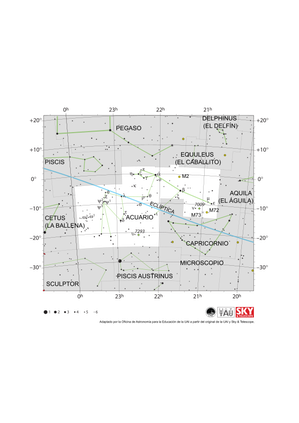
Mapa de la constelación de Acuario
Pie de foto: La constelación de Acuario junto con sus estrellas brillantes y las constelaciones circundantes. Acuario está rodeada por (en el sentido de las agujas del reloj desde arriba) Pegaso, Equuleus, Aquila, Capricornio, Piscis Austrinus, Sculptor, Cetus y Piscis. Acuario se encuentra en la eclíptica (mostrada aquí como una línea azul), que es la trayectoria que el Sol parece seguir a través del cielo en el transcurso de un año. El Sol está en Acuario desde mediados de febrero hasta mediados de marzo. Los demás planetas del Sistema Solar se encuentran a menudo en Acuario.
Acuario abarca el ecuador celeste y, por tanto, es visible en algún momento del año desde todo el planeta Tierra. En las regiones más árticas o antárticas del mundo, algunas partes de la constelación pueden no ser visibles. Acuario es más visible por las tardes en el otoño del hemisferio norte y en la primavera del hemisferio sur.
Los círculos amarillos con símbolos de más superpuestos marcan los cúmulos globulares M2 y M72. Los círculos verdes superpuestos con símbolos de más marcan las nebulosas planetarias NGC 7293 (la nebulosa de la Hélice) y NGC 7002 (la nebulosa de Saturno). M73 (marcada con un símbolo x) es una agrupación coincidente de estrellas anteriormente clasificada erróneamente como cúmulo abierto.
El eje-y de este diagrama está en grados de declinación con el norte hacia arriba y el eje-x está en horas de ascensión recta con el este a la izquierda. El tamaño de las estrellas marcadas aquí está relacionado con la magnitud aparente de la estrella, una medida de su brillo aparente. Los puntos más grandes representan estrellas más brillantes. Las letras griegas indican las estrellas más brillantes de la constelación. Están ordenadas según su brillo: la estrella más brillante se denomina alfa, la segunda más brillante beta, etc., aunque este orden no siempre se sigue con exactitud. Las líneas punteadas marcan los límites de las constelaciones según la UAI y las líneas verdes continuas marcan una de las formas habituales utilizadas para representar las figuras de las constelaciones. Ni los límites de las constelaciones, ni la línea que marca la eclíptica, ni las líneas que unen las estrellas aparecen en el cielo.
Crédito: Adaptado por la Oficina de Astronomía para la Educación de la UAI a partir del original de UAI/Sky & Telescope
License: CC-BY-4.0 Creative Commons Reconocimiento 4.0 Internacional (CC BY 4.0) íconos
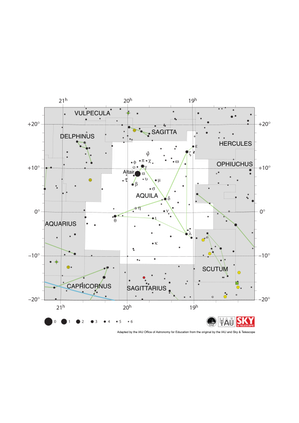
Aquila Constellation Map
Pie de foto: The constellation Aquila with its bright stars and surrounding constellations. Aquila is surrounded by (going clockwise from the top): Sagitta, Hercules, Ophiuchus, Serpens Cauda, Scutum, Sagittarius, Capricornus, Aquarius and Delphinus. Aquila is most notable for its brightest star Altair. This forms one vertex of the prominent Summer Triangle asterism that is visible in northern hemisphere summer evenings.
Aquila spans the celestial equator and thus some part of it is visible from all of the Earth at some point in the year. It is most visible in the evenings in the late northern hemisphere summer and late southern hemisphere winter.
The y-axis of this diagram is in degrees of declination with north as up and the x-axis is in hours of right ascension with east to the left. The sizes of the stars marked here relate to the star's apparent magnitude, a measure of its apparent brightness. The larger dots represent brighter stars. The Greek letters mark the brightest stars in the constellation. These are ranked by brightness with the brightest star being labeled alpha, the second brightest beta, etc., although this ordering is not always followed exactly. The dotted boundary lines mark the IAU's boundaries of the constellations and the solid green lines mark one of the common forms used to represent the figures of the constellations. The blue line in the lower right of the diagram is the ecliptic. Neither the constellation boundaries, nor the line marking the ecliptic, nor the lines joining the stars appear on the sky.
Crédito: Adapted by the IAU Office of Astronomy for Education from the original by IAU/Sky & Telescope
License: CC-BY-4.0 Creative Commons Reconocimiento 4.0 Internacional (CC BY 4.0) íconos
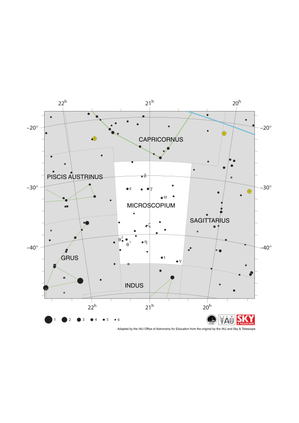
Microscopium Constellation Map
Pie de foto: The constellation Microscopium with its brighter stars and surrounding constellations. Microscopium is surrounded by (going clockwise from the top): Capricornus, Sagittarius, Telescopium, Indus, Grus and Piscis Austrinus. Microscopium is a faint constellation with relatively few bright stars.
Microscopium is a southern constellation and thus the whole constellation is visible at some point in the year throughout the southern hemisphere. The whole constellation is also visible in equatorial and some temperate regions of the northern hemisphere with parts of the constellation visible from other northern temperate regions. Microscopium is best viewed in the evening in the northern hemisphere autumn and southern hemisphere spring.
The y-axis of this diagram is in degrees of declination with north as up and the x-axis is in hours of right ascension with east to the left. The sizes of the stars marked here relate to the star's apparent magnitude, a measure of its apparent brightness. The larger dots represent brighter stars. The Greek letters mark the brightest stars in the constellation. These are ranked by brightness with the brightest star being labeled alpha, the second brightest beta, etc., although this ordering is not always followed exactly. The dotted boundary lines mark the IAU's boundaries of the constellations and the solid green lines mark one of the common forms used to represent the figures of the constellations. Neither the constellation boundaries, nor the line marking the ecliptic, nor the lines joining the stars appear on the sky. The ecliptic is marked with a blue line in the top right.
Crédito: Adapted by the IAU Office of Astronomy for Education from the original by the IAU and Sky & Telescope
License: CC-BY-4.0 Creative Commons Reconocimiento 4.0 Internacional (CC BY 4.0) íconos