Glossary term: 광도계급
Description: 별의 고유 밝기는 별의 온도와 크기에 따라 달라집니다. 별이 더 뜨거울수록 더 밝고, 더 클수록 더 밝습니다. 스펙트럼 유형은 별빛의 스펙트럼 선의 모양에 따라 별을 분류하는 방법입니다. 이 분류는 별의 온도 변화와 관련이 있습니다. 광도계급은 같은 스펙트럼 유형의 별들 중에서 얼마나 밝은지를 기준으로 별을 구분하는 방법입니다. 광도계급은 로마 숫자로 표시합니다. 수소핵 융합하여 빛을 내는 주계열성은 왜성(V)으로 분류됩니다. 예를 들어, 태양의 등급은 G2 V입니다. 이보다 밝고 큰 별들은 차례로 준거성(IV), 거성(III), 밝은 거성(II), 초거성(I)으로 분류됩니다. 초거성 중에서 광도가 낮은 것은 Ib, 가장 밝은 것은 Ia로 나뉩니다. 이 별들은 모두 핵 속의 수소를 다 태워버린 진화한 별들입니다. 금속이 부족한 왜성은 주계열성보다 아래에 있으며, 금속 함량이 낮은 수소 연소 별입니다. 백색왜성은 주계열성보다 더 아래에 있는 별로, 핵에서 수소 핵융합을 멈춘 항성의 잔해입니다.
Related Terms:
See this term in other languages
Term and definition status: The original definition of this term in English have been approved by a research astronomer and a teacher The translation of this term and its definition is still awaiting approval
The OAE Multilingual Glossary is a project of the IAU Office of Astronomy for Education (OAE) in collaboration with the IAU Office of Astronomy Outreach (OAO). The terms and definitions were chosen, written and reviewed by a collective effort from the OAE, the OAE Centers and Nodes, the OAE National Astronomy Education Coordinators (NAECs) and other volunteers. You can find a full list of credits here. All glossary terms and their definitions are released under a Creative Commons CC BY-4.0 license and should be credited to "IAU OAE".
If you notice a factual or translation error in this glossary term or definition then please get in touch.
In Other Languages
- 아랍어: فئة اللمعان
- 독일어: Leuchtkraftklasse
- 영어: Luminosity Class
- 스페인어: Clase de luminosidad
- 프랑스어: Classe de luminosité
- 이탈리아어: Classe di luminosità
- 일본어: 光度階級 (external link)
- 브라질 포르투갈어: Classe de luminosidade
- 중국어 간체: 光度等级
- 중국어 번체: 光度等級
Related Diagrams
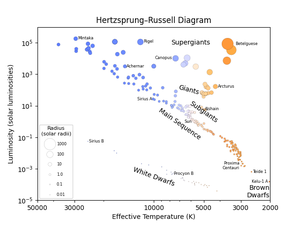
Hertzsprung-Russell diagram
Caption: This diagram shows the temperature and luminosity of different stars. The size of each point represents the star’s radius and its colour is the colour the human eye would see. The stars range in colour from a washed-out blue to a washed-out reddish-orange. No star has a pure colour like red, green or blue as stars’ spectra include light from lots of different colours. However the reddest stars are commonly referred to as red and the bluest stars as blue. The sample of stars used to make this diagram was chosen to show a wide range of stars of different types so the relative number of each type of star is not representative of how commonly each type is found.
From the top left to bottom right there is a long line of stars burning hydrogen in their cores. This is called the main sequence. On this line, one sees the stars Mintaka, Achernar, Sirius A, the Sun and Proxima Centauri. The objects around Proxima Centauri at the lower right end of the main sequence are known as red dwarfs. To the lower right of the red dwarfs are Teide 1 and Kelu-1 A. These two objects are brown dwarfs, objects too low in mass to have cores hot enough to fuse hydrogen for a sustained period of time. As they do not burn hydrogen, brown dwarfs are not considered main sequence stars. The name brown dwarf is unrelated to their colour.
Above the main sequence, we find subgiants, giants and supergiants. These are stars that have finished burning hydrogen in their core and have evolved into larger objects. A star’s brightness depends on its temperature and size so giant stars are brighter than stars with a smaller radius but the same temperature. In time these objects will move towards the end of their lives and undergo either a planetary nebula phase or become supernovae. Stars which end their lives with a planetary nebula phase become a type of stellar remnant called a white dwarf. Such objects are much smaller than stars of the same temperature and thus are fainter and are found significantly below the main sequence. Stars which end their lives as supernovae become either black holes or neutron stars. These are not shown on this plot.
Credit: IAU OAE/Niall Deacon
License: CC-BY-4.0 Creative Commons 저작자표시 4.0 국제 (CC BY 4.0) icons