Glossary term: 구덩이
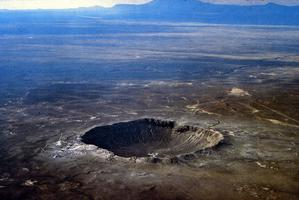
Description: 구덩이는 고체 행성이나 위성 또는 다른 소형 천체들의 표면에서 발견되는 원형의 함몰지형입니다. 일부 구덩이는, 특히 지구와 금성에서, 화산 분화구이지만 대부분은 큰 우주 암석이나 혜성 핵의 충돌로 인해 생긴 충돌 구덩이입니다. 지구 표면에는 수십 개의 충돌 구덩이가 있고 달에는 수천 개의 충돌 구덩이가 있습니다. 달 표면에 있는 원형의 넓고 어두운 지형인 달의 바다는 수십억 년 전에 형성된 후에 용암으로 채워져 굳어진 거대한 충돌 구덩이입니다.
Related Terms:
See this term in other languages
Term and definition status: The original definition of this term in English have been approved by a research astronomer and a teacher The translation of this term and its definition is still awaiting approval
The OAE Multilingual Glossary is a project of the IAU Office of Astronomy for Education (OAE) in collaboration with the IAU Office of Astronomy Outreach (OAO). The terms and definitions were chosen, written and reviewed by a collective effort from the OAE, the OAE Centers and Nodes, the OAE National Astronomy Education Coordinators (NAECs) and other volunteers. You can find a full list of credits here. All glossary terms and their definitions are released under a Creative Commons CC BY-4.0 license and should be credited to "IAU OAE".
If you notice a factual or translation error in this glossary term or definition then please get in touch.
Related Media
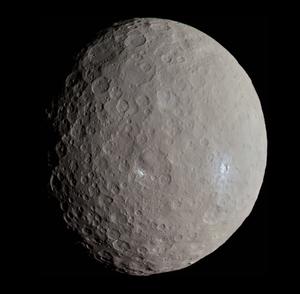
Ceres
Caption: True-colour image of the asteroid Ceres acquired by the spaceprobe Dawn in May 2015, at a distance of 13641 km. The prominent, bright crater at right is Haulani. The smaller bright spot to its left is exposed on the floor of Oxo. Ejecta from these impacts appears to have exposed bright material, probably water ice.
Credit: NASA / JPL-Caltech / UCLA / MPS / DLR / IDA / Justin Cowart
Related Activities
Impact Craters
astroEDU educational activity (links to astroEDU website) Description: A literal Earth-Shattering experiment
License: CC-BY-4.0 Creative Commons 저작자표시 4.0 국제 (CC BY 4.0) icons
Tags:
History
, Impact
, Experiment
Age Ranges:
10-12
, 12-14
, 14-16
Education Level:
Middle School
, Primary
, Secondary
Areas of Learning:
Guided-discovery learning
, Modelling
, Traditional Science Experiment
Costs:
Low Cost
Duration:
1 hour
Group Size:
Group
Skills:
Analysing and interpreting data
, Asking questions
, Constructing explanations
, Engaging in argument from evidence
, Using mathematics and computational thinking
Meteoroids, Meteors and Meteorites
astroEDU educational activity (links to astroEDU website) Description: Unveiling the mystery of "shooting stars": meteors, meteorites and meteroids
License: CC-BY-4.0 Creative Commons 저작자표시 4.0 국제 (CC BY 4.0) icons
Tags:
Geology
Age Ranges:
6-8
, 8-10
, 10-12
, 12-14
Education Level:
Middle School
, Primary
Areas of Learning:
Interactive Lecture
Costs:
Low Cost
Duration:
1 hour 30 mins
Group Size:
Group
Skills:
Analysing and interpreting data
, Asking questions
, Communicating information
, Engaging in argument from evidence
Age that crater!
astroEDU educational activity (links to astroEDU website) Description: Learn how to age craters with this Predict, Explain, Observe, Explain Activity!
License: CC-BY-4.0 Creative Commons 저작자표시 4.0 국제 (CC BY 4.0) icons
Tags:
Craters
, Game
, Maps
, Geology
Age Ranges:
4-6
, 6-8
, 8-10
Education Level:
Middle School
, Primary
Areas of Learning:
Observation based
, Structured-inquiry learning
Costs:
Low Cost
Duration:
1 hour
Group Size:
Group
Skills:
Asking questions
, Communicating information
, Constructing explanations
, Developing and using models
, Engaging in argument from evidence