Termo do glossário: Grande Mancha Vermelha
Descrição: A Grande Mancha Vermelha é uma gigantesca tempestade anticiclônica na atmosfera de Júpiter, localizada a 22 graus ao sul de seu equador. Com cerca de 15.000 quilômetros (km) de comprimento e quase 12.000 km de largura, ela é atualmente um pouco maior que a Terra, embora tenha atingido dimensões muito maiores no passado. Os ventos dentro da Grande Mancha Vermelha podem ultrapassar 400 quilômetros por hora (km/h) (250 milhas por hora (mph)). A razão de sua coloração vermelha ainda é desconhecida, embora existam várias hipóteses concorrentes. Uma grande mancha vermelha em Júpiter foi descoberta pelo astrônomo Giovanni Cassini em 1665 e foi observada durante meio século. No entanto, há um intervalo de aproximadamente um século nas observações, de modo que não se sabe se esta mancha é a mesma que a observada nos últimos duzentos anos.
Termos relacionados:
Ver este termo em outros idiomas
Status do termo e da definição: A definição original deste termo em inglês foi aprovada por um astrônomo(a) pesquisador(a) e um(a) professor(a) A tradução deste termo e de sua definição ainda aguarda aprovação
O Glossário Multilíngue da OAE é um projeto do Escritório da IAU de Astronomia para a Educação(OAE) em colaboração com o Escritório da IAU para Divulgação da Astronomia (OAO). Os termos e definições foram selecionados, escritos e revisados por meio de um esforço coletivo da OAE, dos Centros e Nós da OAE, dos Coordenadores Nacionais de Educação em Astronomia (NAECs) da OAE e de outros voluntários. Você pode encontrar uma lista completa dos créditos aqui. Todos os termos do glossário e suas definições são disponibilizados sob uma licença Creative Commons CC BY-4.0 e devem ser creditados à "IAU OAE".
Se você notar algum erro factual ou de tradução neste termo do glossário ou em sua definição, por favor entre em contato.
Em outros idiomas
- Árabe: البقعة الحمراء العظيمة
- Alemão: Großer Roter Fleck
- Inglês: Great Red Spot
- Espanhol: La Gran Mancha Roja
- Francês: Grande tache rouge
- Italiano: Grande Macchia Rossa
- Japonês: 大赤斑 (link externo)
- Chinês Simplificado: 大红斑
- Chinês Tradicional: 大紅斑
Mídia relacionada
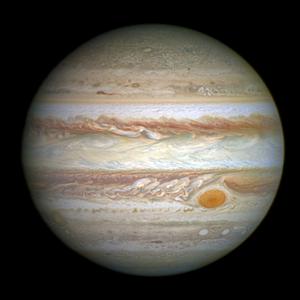
Júpiter
Legenda: Esta imagem do disco completo de Júpiter foi obtida em 21 de abril de 2014 com a Wide Field Camera 3 (WFC3) do Hubble. Ela mostra a proeminente grande mancha vermelha, um gigantesco ciclone. Faixas de nuvens cobrem a superfície, cujas cores provêm de gases como amônia e outros compostos químicos.
Crédito: NASA, ESA e A. Simon (Centro Espacial Goddard)
link do crédito
License: CC-BY-4.0 Creative Commons Attribution 4.0 International (CC BY 4.0) ícones