Termo do glossário: Planetas Externos
Descrição: Em nosso Sistema Solar, os planetas exteriores são Júpiter, Saturno, Urano e Netuno. Suas órbitas estão fora do cinturão de asteroides, e todos esses planetas são os chamados planetas gigantes, com uma atmosfera extremamente espessa composta principalmente de hidrogênio. Isso os torna fisicamente distintos dos planetas interiores, cada um dos quais é um corpo rochoso relativamente pequeno com uma atmosfera relativamente fina.
Os planetas em torno de estrelas que não o nosso Sol não se enquadram necessariamente em grupos internos e externos com características semelhantes — conhecemos várias estrelas com pelo menos um gigante gasoso, um “Júpiter quente”, em órbita próxima.
Termos relacionados:
Ver este termo em outros idiomas
Status do termo e da definição: A definição original deste termo em inglês foi aprovada por um astrônomo(a) pesquisador(a) e um(a) professor(a) A tradução deste termo e de sua definição ainda aguarda aprovação
O Glossário Multilíngue da OAE é um projeto do Escritório da IAU de Astronomia para a Educação(OAE) em colaboração com o Escritório da IAU para Divulgação da Astronomia (OAO). Os termos e definições foram selecionados, escritos e revisados por meio de um esforço coletivo da OAE, dos Centros e Nós da OAE, dos Coordenadores Nacionais de Educação em Astronomia (NAECs) da OAE e de outros voluntários. Você pode encontrar uma lista completa dos créditos aqui. Todos os termos do glossário e suas definições são disponibilizados sob uma licença Creative Commons CC BY-4.0 e devem ser creditados à "IAU OAE".
Se você notar algum erro factual ou de tradução neste termo do glossário ou em sua definição, por favor entre em contato.
Em outros idiomas
- Árabe: الكواكب الخارجية
- Alemão: Äußere Planeten
- Inglês: Outer Planets
- Espanhol: Planetas exteriores
- Francês: Planètes extérieures
- Italiano: Pianeti esterni
- Coreano: 외행성
- Albanesa: Planetët e jashtëm
- Chinês Simplificado: 外行星
- Chinês Tradicional: 外行星
Mídia relacionada
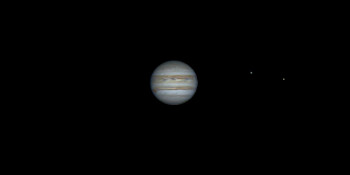
Jupiter's Rotation, by Vishal Sharma, India
Legenda: Third place in the 2021 IAU OAE Astrophotography Contest, category Galilean moons: Jupiter’s Rotation, by Vishal Sharma, India.
This time-lapse beautifully shows the rotation of Jupiter and the passage of two Galilean moons on the right side of the frame. Jupiter completes one rotation in just under 10 hours and we see as the Great Red Spot makes its way from left to right. The two moons travel a noticeable fraction of their orbit in this short time. This image was taken in 2020 in the North of India.
Crédito: Vishal Sharma/IAU OAE
License: CC-BY-4.0 Creative Commons Attribution 4.0 International (CC BY 4.0) ícones
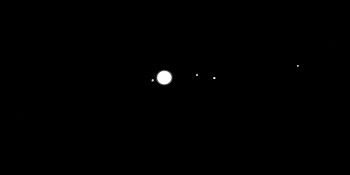
Jupiter Moons Movie2, by Nicolas Hurez, Paul-Antoine Matrangolo, and Carl Pennypacker, United States of America
Legenda: Second place in the 2021 IAU OAE Astrophotography Contest, category Galilean moons.
This sequence shows the orbit of the four Galilean moons around the planet Jupiter. Almost two entire orbits of the innermost moon, Io, can be seen, with the other moons (Europa and Ganymede, but in particular Callisto) being further away, orbiting noticeably slower. The images were obtained in 2018 with the Las Cumbres Global Observatory at different locations on Earth, allowing a continuous sequence of images over approximately half a week without gaps during the day. With clear skies and over the course of several nights, the motion of the Galilean moons can also be observed with binoculars (ideally steady your elbows on a surface).
Crédito: Nicolas Hurez, Paul-Antoine Matrangolo and Carl Pennypacker/IAU OAE
License: CC-BY-4.0 Creative Commons Attribution 4.0 International (CC BY 4.0) ícones
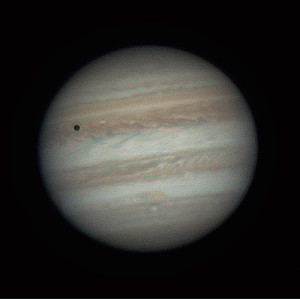
Jupiter, Io and its shadow, by Ralf Burkart, Germany
Legenda: First place in the 2021 IAU OAE Astrophotography Contest, category Galilean moons.
This time-lapse of Jupiter taken in 2017 from Germany beautifully illustrates the transit of one of the Galilean moons, Io, in front of Jupiter. As this is simply a moon casting a shadow on a planet it is equivalent to a lunar eclipse on Earth observed from further away. While the shadow of the moon is clearly visible from the beginning, it might be difficult to spot the moon itself against the background of the beautiful atmospheric bands of Jupiter the first time the video is seen. Watching it repeatedly allows appreciating the rapid motion and rotation in this fantastic observation.
Crédito: Ralf Burkart/IAU OAE
License: CC-BY-4.0 Creative Commons Attribution 4.0 International (CC BY 4.0) ícones
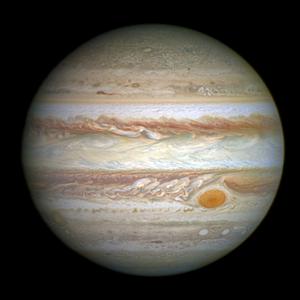
Júpiter
Legenda: Esta imagem do disco completo de Júpiter foi obtida em 21 de abril de 2014 com a Wide Field Camera 3 (WFC3) do Hubble. Ela mostra a proeminente grande mancha vermelha, um gigantesco ciclone. Faixas de nuvens cobrem a superfície, cujas cores provêm de gases como amônia e outros compostos químicos.
Crédito: NASA, ESA e A. Simon (Centro Espacial Goddard)
link do crédito
License: CC-BY-4.0 Creative Commons Attribution 4.0 International (CC BY 4.0) ícones
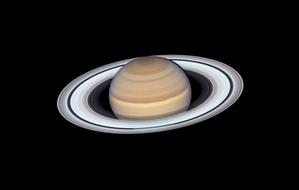
Saturno
Legenda: A Wide Field Camera 3 do Telescópio Espacial Hubble da NASA/ESA observou Saturno em 20 de junho de 2019, quando o planeta fez sua maior aproximação Terra naquele ano, a aproximadamente 1,36 bilhão de quilômetros de distância. A imagem mostra faixas coloridas de gás na superfície do planeta, bem como seus proeminentes anéis compostos por gelo e material rochoso.
Crédito: NASA, ESA, A. Simon (Centro Espacial Goddard) e M.H. Wong (Universidade da Califórnia, Berkeley)
link do crédito
License: CC-BY-4.0 Creative Commons Attribution 4.0 International (CC BY 4.0) ícones