Termo do glossário: Mancha solar
Descrição: Uma mancha solar é uma região temporária e mais fria, causada por um forte campo magnético na fotosfera do Sol. As manchas solares são áreas onde tubos de fluxo magnético emergem das profundezas do Sol. O alto campo magnético aumenta a pressão magnética nessas regiões. Para manter a mesma pressão que o entorno, a pressão do gás e do plasma na mancha solar deve cair, tornando-a mais fria que o entorno. Como são mais frias do que a fotosfera circundante, as manchas solares podem ser vistas por um telescópio como manchas escuras na superfície do Sol. O tamanho das manchas solares varia de dezenas de quilômetros a mais de cem mil quilômetros. Elas podem persistir por períodos de tempo que variam de alguns dias a alguns meses. O número e a localização das manchas solares no Sol variam ao longo do ciclo solar. Acredita-se que outras estrelas também tenham manchas causadas por seus campos magnéticos.
Termos relacionados:
Ver este termo em outros idiomas
Status do termo e da definição: A definição original deste termo em inglês foi aprovada por um astrônomo(a) pesquisador(a) e um(a) professor(a) A tradução deste termo e de sua definição ainda aguarda aprovação
O Glossário Multilíngue da OAE é um projeto do Escritório da IAU de Astronomia para a Educação (OAE) em colaboração com o Escritório da IAU para Divulgação da Astronomia (OAO). Os termos e definições foram selecionados, escritos e revisados por meio de um esforço coletivo da OAE, dos Centros e Nós da OAE, dos Coordenadores Nacionais de Educação em Astronomia (NAECs) da OAE e de outros voluntários. Você pode encontrar uma lista completa dos créditos aqui. Todos os termos do glossário e suas definições são disponibilizados sob uma licença Creative Commons CC BY-4.0 e devem ser creditados à "IAU OAE".
Se você notar algum erro factual ou de tradução neste termo do glossário ou em sua definição, por favor entre em contato.
Em outros idiomas
- Árabe: بقعة شمسية
- Alemão: Sonnenfleck
- Inglês: Sunspot
- Espanhol: Mancha solar
- Persa: لکه خورشیدی
- Francês: Tache solaire
- Italiano: Macchia solare
- Japonês: 黒点 (link externo)
- Coreano: 태양흑점
- Chinês Simplificado: 太阳黑子
- Chinês Tradicional: 太陽黑子
Mídia relacionada
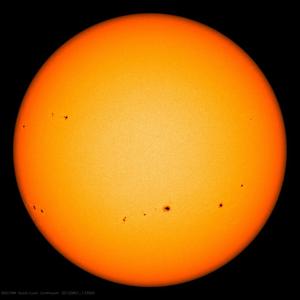
Manchas solares
Legenda: Nesta imagem, o Sol aparece pontilhado por grupos de manchas solares ao longo de quase nove dias entre julho e agosto de 2012. As manchas solares vistas nesta imagem foram fontes de erupções solares e ejeções de massa coronal (CME). Nesta imagem em particular, o Sol está se aproximando do máximo de atividade de seu ciclo (ciclo solar), período em que observamos muitas manchas se formando ao longo do equador solar. Essas manchas solares e essa atividade são observadas no hemisfério sul do Sol; antes disso, a maior parte da atividade estava concentrada no hemisfério norte.
Crédito: NASA/SDO/HMI
link do crédito
License: PD Domínio Público ícones

Close-up view of a sunspot
Legenda: This image of a sunspot was taken by the Daniel K Inouye Solar Telescope (DKIST), operated by the U.S. National Science Foundation. It was taken only in light with a wavelength of 530 nanometers, within the greenish-yellow part of the visible spectrum.
The picture reveals the detail of the spot's structure and the Sun’s photosphere. The dark central region, known as the umbra, is surrounded by a lighter area called the penumbra with radially elongated features stretching towards the umbra. Note that the umbra and penumbra here are not the same as the umbra and penumbra that occur during an eclipse.
The sunspot measures approximately 5000 kilometres in diameter, roughly equivalent to the east-west span of China. While the umbra appears black, it is actually hot and bright. It only appears dark because it is a few thousand kelvin cooler than the surrounding solar photosphere. Surrounding the sunspot, granulation patterns of plasma are visible on the photospheric surface of the Sun.
Crédito: NSO/NSF/AURA
link do crédito
License: CC-BY-4.0 Creative Commons Attribution 4.0 International (CC BY 4.0) ícones
Atividades relacionadas

Measure the Sun's Rotation Period
astroEDU educational activity (links to astroEDU website) Description: Find out the Sun’s rotation period, applying the simple equation of average speed to a real astronomical case.
License: CC-BY-4.0 Creative Commons Attribution 4.0 International (CC BY 4.0) ícones
Tags:
Hands-on
, History
, Experiment
, Galileo
, average speed
Faixas etárias:
16-19
Nível de ensino:
Médio
Áreas de aprendizagem:
Aprendizagem por investigação estruturada
Custos:
Baixo custo
Duração:
1 hour 30 mins
Tamanho do grupo:
Grupo
Habilidades:
Analisar e interpretar dados
, Engajar-se em argumentação com base em evidências
, Planejar e realizar pesquisas
, Usar matemática e pensamento computacional
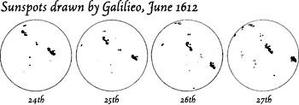
Is the Sun rotating? Follow the sunspots!
astroEDU educational activity (links to astroEDU website) Description: Like a "modern" Galileo, use true astronomical satellite observations to discover if the Sun (and other celestial objects) are rotating!
License: CC-BY-4.0 Creative Commons Attribution 4.0 International (CC BY 4.0) ícones
Tags:
Hands-on
, History
, Experiment
, Galileo
Faixas etárias:
12-14
, 14-16
, 16-19
Nível de ensino:
Ensino fundamental
, Médio
Áreas de aprendizagem:
Aprendizagem por investigação estruturada
Custos:
Baixo custo
Duração:
1 hour
Tamanho do grupo:
Grupo
Habilidades:
Analisar e interpretar dados
, Planejar e realizar pesquisas








