بلغات أخرى
- الألمانيّة: Sonnenfleck
- الإنجليزيّة: Sunspot
- الإسبانيّة: Mancha solar
- الفارسيّة: لکه خورشیدی
- الفرنسيّة: Tache solaire
- الإيطاليّة: Macchia solare
- اليابانيّة: 黒点 (رابط خارجي)
- الكوريّة: 태양흑점
- البرتغاليّة البرازيليّة: Mancha solar
- الصينيّة المبسطة: 太阳黑子
- الصينيّة التقليدية: 太陽黑子
وسائط ذات صلة
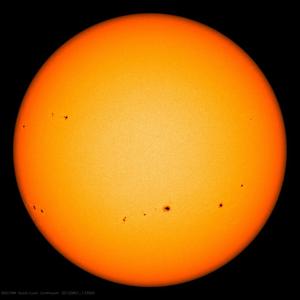
البقع الشمسية

Close-up view of a sunspot
الشرح: This image of a sunspot was taken by the Daniel K Inouye Solar Telescope (DKIST), operated by the U.S. National Science Foundation. It was taken only in light with a wavelength of 530 nanometers, within the greenish-yellow part of the visible spectrum.
The picture reveals the detail of the spot's structure and the Sun’s photosphere. The dark central region, known as the umbra, is surrounded by a lighter area called the penumbra with radially elongated features stretching towards the umbra. Note that the umbra and penumbra here are not the same as the umbra and penumbra that occur during an eclipse.
The sunspot measures approximately 5000 kilometres in diameter, roughly equivalent to the east-west span of China. While the umbra appears black, it is actually hot and bright. It only appears dark because it is a few thousand kelvin cooler than the surrounding solar photosphere. Surrounding the sunspot, granulation patterns of plasma are visible on the photospheric surface of the Sun.
المصدر: NSO/NSF/AURA
رابط المصدر
License: CC-BY-4.0 المشاع الإبداعي نَسب المُصنَّف 4.0 دولي (CC BY 4.0) أيقونات
الأنشطة المرتبطة
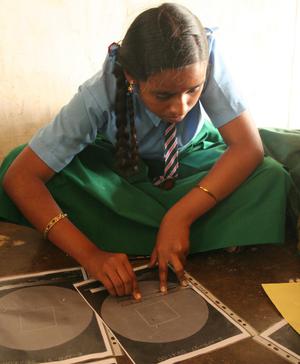
Measure the Sun's Rotation Period
astroEDU educational activity (links to astroEDU website) Description: Find out the Sun’s rotation period, applying the simple equation of average speed to a real astronomical case.
License: CC-BY-4.0 المشاع الإبداعي نَسب المُصنَّف 4.0 دولي (CC BY 4.0) أيقونات
وسوم:
Hands-on
, History
, Experiment
, Galileo
, average speed
الفئات العمرية:
16-19
المرحلة التعليمية:
المرحلة الثانوية
مجالات التعلم:
تعلم منظم قائم على الاستقصاء
التكاليف:
تكلفة منخفضة
المدة:
ساعة ونصف
حجم المجموعة:
جماعي
المهارات:
تحليل البيانات وتفسيرها
, بناء حجج استنادًا إلى الأدلة
, تخطيط وتنفيذ التحقيقات
, استخدام الرياضيات والتفكير الحاسوبي
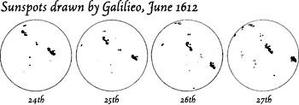
Is the Sun rotating? Follow the sunspots!
astroEDU educational activity (links to astroEDU website) Description: Like a "modern" Galileo, use true astronomical satellite observations to discover if the Sun (and other celestial objects) are rotating!
License: CC-BY-4.0 المشاع الإبداعي نَسب المُصنَّف 4.0 دولي (CC BY 4.0) أيقونات
وسوم:
Hands-on
, History
, Experiment
, Galileo
الفئات العمرية:
12-14
, 14-16
, 16-19
المرحلة التعليمية:
المرحلة المتوسطة
, المرحلة الثانوية
مجالات التعلم:
تعلم منظم قائم على الاستقصاء
التكاليف:
تكلفة منخفضة
المدة:
ساعة واحدة
حجم المجموعة:
جماعي
المهارات:
تحليل البيانات وتفسيرها
, تخطيط وتنفيذ التحقيقات