Glossary term: Space Station
Description: A space station is a spacecraft in an orbit for a substantial period of time that provides a long-term home for humans in space. Specifically, it provides suitable living conditions, from breathable air to well-regulated temperature. All space stations so far have been dependent on regular deliveries of food and water. So far, space stations are or have been in low Earth orbits, with the International Space Station orbiting around 420 kilometers above sea level. An orbiting station is in free fall, with the astronauts, equipment, and space station all experiencing the same acceleration from the Earth's gravity. As the astronauts and equipment inside the space station are accelerating at the same magnitude and direction as their surroundings in the space station they experience the sensation of weightlessness, even though they are not actually weightless. This sensation is often called microgravity, although this name can be confusing as the Earth's gravitational pull is still substantial on the space station, astronauts, and equipment. Space stations are primarily used for research, notably on the effect of microgravity on human beings; an important preparation for further stages of space exploration.
Related Terms:
See this term in other languages
Term and definition status: This term and its definition have been approved by a research astronomer and a teacher
The OAE Multilingual Glossary is a project of the IAU Office of Astronomy for Education (OAE) in collaboration with the IAU Office of Astronomy Outreach (OAO). The terms and definitions were chosen, written and reviewed by a collective effort from the OAE, the OAE Centers and Nodes, the OAE National Astronomy Education Coordinators (NAECs) and other volunteers. You can find a full list of credits here. All glossary terms and their definitions are released under a Creative Commons CC BY-4.0 license and should be credited to "IAU OAE".
If you notice a factual error in this glossary definition then please get in touch.
In Other Languages
- Arabic: المحطة الفضائية
- German: Raumstation
- Spanish: Estación espacial
- French: Station spatiale
- Italian: Stazione spaziale
- Brazilian Portuguese: Estação Espacial
- Simplified Chinese: 空间站
- Traditional Chinese: 空間站
Related Media
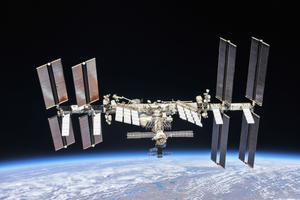
International Space Station
Caption: The International Space Station (ISS) is in orbit around the Earth. Different crews with personnel from many countries have been working there constantly since 2000. The ISS is a laboratory that provides a microgravity environment for experiments in engineering, science, and medicine. The entire structure is more than 100 metres long and flies at an altitude of approximately 400 kilometres above ground.
Credit: NASA
credit link
License: PD Public Domain icons

Astronauts working outside the ISS
Caption: In this image, astronauts Robert L. Curbeam (USA) and Christer Fuglesang (Sweden) are seen working outside the International Space Station (ISS), visible against the backdrop of the Earth with New Zealand visible below. They are attaching a truss segment to the ISS to keep it rigid and to route electricity and liquid coolants. Extending over 15 meters and weighing more than 10,000 kilograms, these trusses are not easy objects to work with, especially outside of a space station. The astronauts are wearing large white spacesuits and are attached to the hull of the ISS to ensure they do not drift off into space.
Credit: STS-116 Shuttle Crew, NASA
credit link
License: PD Public Domain icons