This page describes an image Latitude and Longitude

下载文件 ( 图像 434.22 kB)
下载 PDF 文件 (PDF file 449.61 kB)
Also available in black and white
下载文件 ( 图像 433.51 kB)
下载 PDF 文件 (PDF file 358.89 kB)
图示说明:
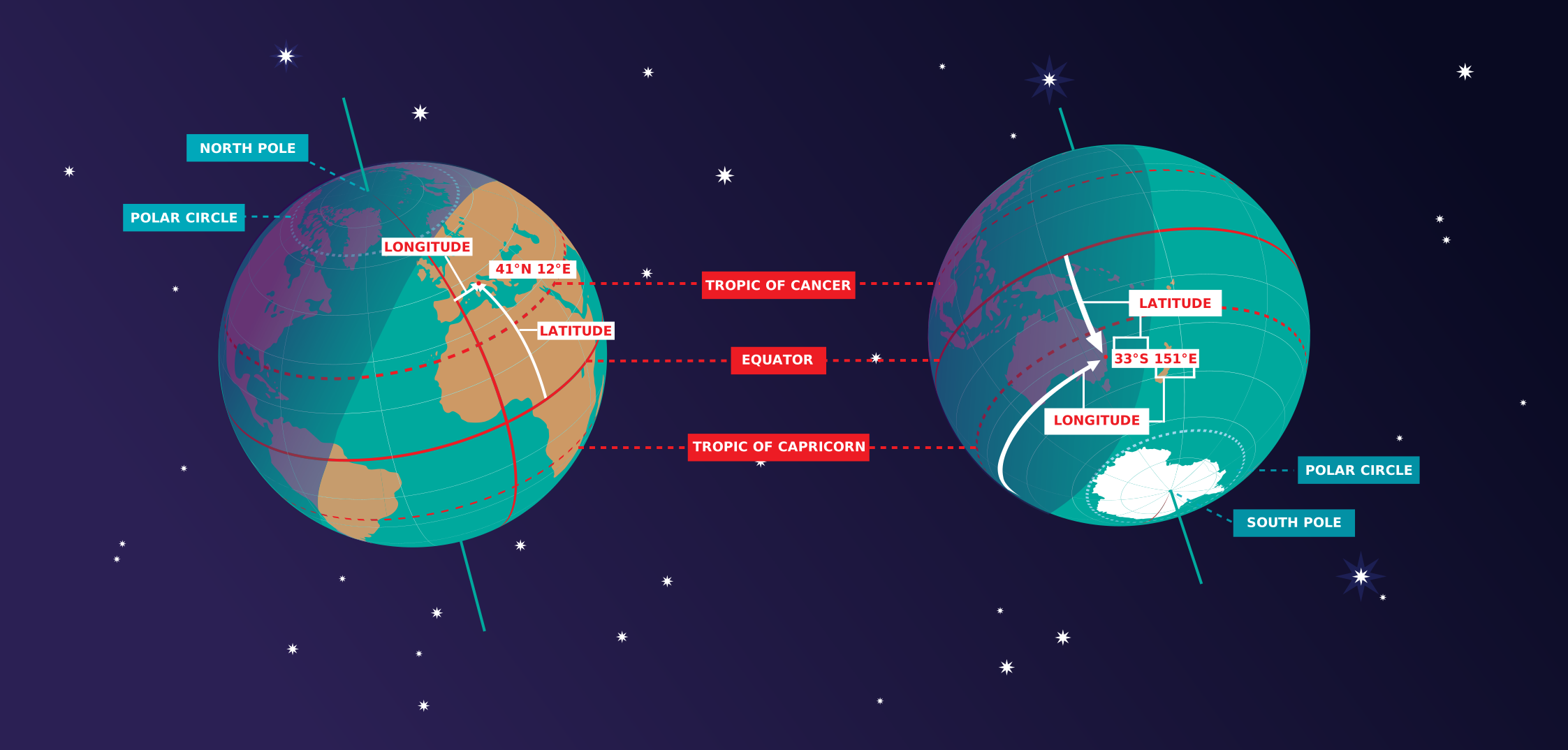
Two views of the Earth, one viewing the Northern Hemisphere, one viewing the Southern Hemisphere. The Earth rotates around its axis, an imaginary line that runs through the Earth from the North Pole to the South Pole. The Equator is an imaginary line that is the same distant from both the North Pole and the South Pole.
The positions of two cities, Rome in the Northern Hemisphere and Sydney in the Southern Hemisphere are marked here with red dots. Arrows indicate the two spherical coordinates latitude and longitude.
Latitude marks the position north or south of the equator. Here we can see Rome has the letter N in its latitude as it is in the Northern Hemisphere and Sydney has the letter S in its latitude as it is in the Southern Hemisphere. Latitude can vary from 90° N at the North Pole to 0° at the Equator to 90° S at the South Pole.
Longitude measures the position around the equator. While the choice of the zero point for latitude as the equator seems obvious, the choice of the zero point for longitude is more subjective. By convention the zero point in longitude is the prime meridian which passes through the Royal Greenwich Observatory in the UK. This is marked here as a solid line originating at the North Pole. Longitude is measured in degrees east or west of the prime meridian. As both Rome and Sydney lie to the east of Greenwich, they have the letter E as part of their longitude. Moving west to east, longitude varies from 180° W on the other side of the world from the prime meridian to 0° on the prime meridian before reaching 180° E again on the other side of world from the prime meridian.
This diagram shows the Earth at the December solstice. Two views are presented, one viewing the Northern Hemisphere and one viewing the Southern Hemisphere about nine hours later. The shaded region shows the night side of the Earth, with the day side being lighter. As it is the December solstice, the Sun appears overhead at the Tropic of Capricorn. This is a line of constant latitude at 23°26′09.3″ S. Six months later, at the June solstice, the Sun will appear to be overhead at the Tropic of Cancer at 23°26′09.3″ N. As the Sun appears over the Tropic of Capricorn more of the Southern Hemisphere is illuminated than the Northern Hemisphere. Indeed below the Antarctic Circle (the Polar Circle around the South Pole) the Sun does not set at this time of year leading to a Polar Day. Conversely, north of the Arctic Circle (the Polar Circle around the North Pole) the Sun does not rise at this time of year, leading to a Polar Night.
图示来源: Maria Cristina Fortuna/IAU OAE.
图示翻译状态: 尚未由审核人员批准
图示授权许可: 知识共享许可协议 署名 4.0 国际 (CC BY 4.0) 知识共享许可协议 署名 4.0 国际 (CC BY 4.0) 图标
相关术语表词条:
北回归线
, 北极
, 南回归线
, 南极
, 回归线
, 地球自转
, 地轴
, 极圈
, 极夜
, 极昼
, 热带地区
, 纬度
, 经度
, 赤道
分类:
肉眼天文学
, 地球
Want to make your own translation or version of this diagram? Then
download the SVG
version of this diagram in English (513.17 kB). You can edit this using
software like Inkscape (free) or Adobe Illustrator
(proprietary). Just remember to credit the author of the original appropriately.
Also available in black and white ( 图像 513.17 kB).
You can also make your own version or translation of this diagram by adding adding text to a version of
this diagram with no text. Just download one of the following files:
Download Text-Free File ( 图像 406.03 kB)
Download Text-Free PDF File (PDF file 444.87 kB)
Also available in black and white:
Download Text-Free File ( 图像 407.33 kB)
Download Text-Free PDF File (PDF file 356.11 kB)
OAE 网站上展示的图示说明是由 OAE、OAE 各中心与节点、OAE 的 国家天文教育协调员 (NAEC) 和其他志愿者共同撰写、翻译与审核的。您可以在这里 查看我们翻译项目的完整致谢名单。所有媒体文件说明均遵循 Creative Commons CC BY-4.0 许可协议 进行发布,应注明来源为"IAU OAE"。媒体文件本身可能具有不同的许可协议(见上文),请根据“来源”部分注明相应来源。
如果您发现此图示或其说明中有任何错误,请联系我们。