词条 极圈
描述: 极圈是地球上两条特定的纬线圈。位于北纬66°33′48.8″的极圈称为北极圈,位于南纬66°33′48.8″的极圈称为南极圈。由于地球自转轴是倾斜的,北极圈以北和南极圈以南地区的冬季为“极夜”,夏季为“极昼”。极夜期间,太阳在地平线以下的时间超过24小时,暗夜可持续数月。极昼期间,太阳在地平线以上的时间超过24小时,白昼可持续数月。越靠近极点,则极昼和极夜最长。对于每个极地区域,极夜出现在冬至前后,极昼出现在夏至前后。
相关词条
用其他语言查看该词条
词条和定义状态: 该术语的英文原始定义已通过天文研究人员和教师的审核 该术语及其定义的译文仍待审核
OAE多语言词汇表是由国际天文学联合会(IAU) 天文教育办公室(OAE) 和 国际天文学联合会(IAU) 天文推广办公室(OAO)合作的项目。. 术语和定义由 OAE中心, OAE 国家天文教育协调员(NAECs) 以及其他志愿者共同选择、撰写和审阅。您可以在 找到完整的致谢列表。所有词汇表术语及其定义均根据 Creative Commons CC BY-4.0许可证发布 且版权归属于 “IAU OAE”。
如果您发现此词汇术语或定义中的事实或翻译错误, 请向 发邮件 联系.
其他语言版本
- 阿拉伯语: الدائرة القطبية
- 德语: Polarkreis
- 英语: Polar Circle
- 西班牙语: Círculo Polar Ártico
- 法语: Cercle polaire
- 意大利语: Circolo polare
- 韩语: 극권
- 马拉地语: ध्रुवीय वर्तुळ
- 尼泊尔语: ध्रुवीय वृत्त
- 巴西葡萄牙语: Círculo Polar
- 繁体中文: 極圈
相关媒体

当太阳反弹时
图注: 这张照片拍摄于挪威的北角。由于该地的纬度原因,从四月到八月的夏季,太阳从未真正落下。这就形成了独特的连续白昼现象,即所谓的极昼。这组迷人的照片拍摄于 2022 年,展示了太阳每 30 分钟穿越地平线的不懈旅程。当太阳位于天空的最低点时,它不会落下,而是看起来像是从地平线反弹回来的。照片最右边的地球就像一个哨兵,标志着欧洲大陆的最北端。
来源: Milos Obert/IAU OAE (CC BY 4.0)
日食钟——极昼中的日食
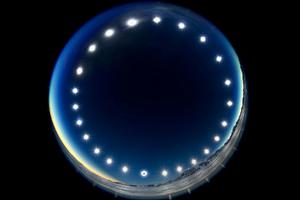
图注: 这幅图像是于2021年12月4日的日全食期间在南极洲的联合冰川拍摄的,由24小时内先后拍摄到的多张照片组合而成,展示了太阳的昼弧。它展示了被称为“极昼”的独特现象——在极昼中,太阳在天空中巡行而不落下。在极昼期间,极圈内的地区会经历24小时的连续日照,太阳长时间不落山。这幅图像还提供了罕见的日食视角——从地球看去,月球从太阳和地球之间穿过。在图像最下方的太阳照片中,月球覆盖了太阳圆面。
来源: Stephanie Ziyi Ye/IAU OAE (CC BY 4.0)
相关图表

Latitude and Longitude
图注: Two views of the Earth, one viewing the Northern Hemisphere, one viewing the Southern Hemisphere. The Earth rotates around its axis, an imaginary line that runs through the Earth from the North Pole to the South Pole. The Equator is an imaginary line that is the same distant from both the North Pole and the South Pole.
The positions of two cities, Rome in the Northern Hemisphere and Sydney in the Southern Hemisphere are marked here with red dots. Arrows indicate the two spherical coordinates latitude and longitude.
Latitude marks the position north or south of the equator. Here we can see Rome has the letter N in its latitude as it is in the Northern Hemisphere and Sydney has the letter S in its latitude as it is in the Southern Hemisphere. Latitude can vary from 90° N at the North Pole to 0° at the Equator to 90° S at the South Pole.
Longitude measures the position around the equator. While the choice of the zero point for latitude as the equator seems obvious, the choice of the zero point for longitude is more subjective. By convention the zero point in longitude is the prime meridian which passes through the Royal Greenwich Observatory in the UK. This is marked here as a solid line originating at the North Pole. Longitude is measured in degrees east or west of the prime meridian. As both Rome and Sydney lie to the east of Greenwich, they have the letter E as part of their longitude. Moving west to east, longitude varies from 180° W on the other side of the world from the prime meridian to 0° on the prime meridian before reaching 180° E again on the other side of world from the prime meridian.
This diagram shows the Earth at the December solstice. Two views are presented, one viewing the Northern Hemisphere and one viewing the Southern Hemisphere about nine hours later. The shaded region shows the night side of the Earth, with the day side being lighter. As it is the December solstice, the Sun appears overhead at the Tropic of Capricorn. This is a line of constant latitude at 23°26′09.3″ S. Six months later, at the June solstice, the Sun will appear to be overhead at the Tropic of Cancer at 23°26′09.3″ N. As the Sun appears over the Tropic of Capricorn more of the Southern Hemisphere is illuminated than the Northern Hemisphere. Indeed below the Antarctic Circle (the Polar Circle around the South Pole) the Sun does not set at this time of year leading to a Polar Day. Conversely, north of the Arctic Circle (the Polar Circle around the North Pole) the Sun does not rise at this time of year, leading to a Polar Night.
来源: Maria Cristina Fortuna/IAU OAE
相关活动
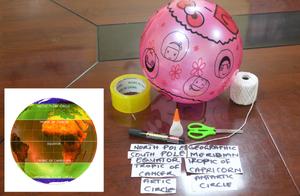
Discover Earth's climate with a balloon
astroEDU educational activity (links to astroEDU website) Description: Discover the secrets of Earth's climate zones with a hands-on experience
License: CC-BY-4.0 知识共享许可协议 署名 4.0 国际 (CC BY 4.0) 图标
年龄段:
8-10
, 10-12
受教育等级:
初中
, Primary
学习领域:
趣味活动
, 引导式发现学习
, 建模
, 以观察为主
, 项目式学习
, 结构化探究式学习
费用:
低成本
时间跨度:
45 分钟
组别大小:
小组
技能:
提出问题
, 构建解释
, 开发和使用模型