Glossary term: 日冕物質拋射(CME)
Description: 日冕物質拋射(或CME)是指太陽(以及其他類似恆星)向日球層(或其他恆星的星球層)中爆炸性噴射太陽等離子體及其磁場。CME是一種磁場爆發活動,通常與太陽耀斑有關。CME是物質的物理上的拋射,與僅限於可見輻射的“耀斑”不同。CME在結構、密度和速度方面變化很大,撞擊地球的CME可能引發嚴重的地磁風暴。
Related Terms:
See this term in other languages
Term and definition status: The original definition of this term in English have been approved by a research astronomer and a teacher The translation of this term and its definition is still awaiting approval
This is an automated transliteration of the simplified Chinese translation of this term
The OAE Multilingual Glossary is a project of the IAU Office of Astronomy for Education (OAE) in collaboration with the IAU Office of Astronomy Outreach (OAO). The terms and definitions were chosen, written and reviewed by a collective effort from the OAE, the OAE Centers and Nodes, the OAE National Astronomy Education Coordinators (NAECs) and other volunteers. You can find a full list of credits here. All glossary terms and their definitions are released under a Creative Commons CC BY-4.0 license and should be credited to "IAU OAE".
If you notice a factual or translation error in this glossary term or definition then please get in touch.
In Other Languages
- 阿拉伯語: قذف الكتلة الإكليلي (CME)
- 德語: Koronaler Massenauswurf (CME)
- 英語: Coronal Mass Ejection (CME)
- 西班牙語: Eyección de masa coronal (CME)
- 法語: Éjection de masse coronale (EMC ou CME en anglais)
- 義大利語: Espulsione di massa coronale (CME)
- 日語: コロナ質量放出 (external link)
- 韓語: 코로나질량방출(CME)
- 巴西葡萄牙語: Ejeção de massa coronal (CME)
- 簡體中文: 日冕物质抛射(CME)
Related Media
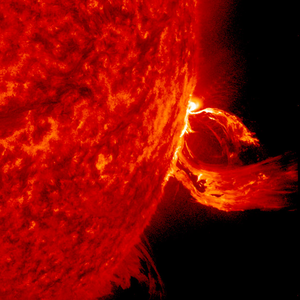
A Coronal Mass Ejection
Caption: A burst of solar material can be seen erupting from the Sun in this view, illustrating a coronal mass ejection (CME)—a large eruption of plasma and magnetic field from the Sun’s outer atmosphere, or corona. These CMEs are caused by magnetic explosions in the Sun's corona. During a CME, huge amounts of electrically charged particles are launched into space at great speeds, carrying part of the Sun’s magnetic field with them. These events are driven by changes in the Sun’s magnetic structure and release vast clouds of hot gas that travel outward into the solar system. When a CME moves through space, it can interact with a planet’s magnetic field and atmosphere, sometimes creating spectacular auroras or, in strong cases, interfering with artificial satellites and power systems.
CMEs are often associated with a temporary brightening of the region of the Sun where the CME originated. This is known as a solar flare. Stars other than the Sun can also have CMEs and flares.
This image was taken by NASA's Solar Dynamics Observatory (SDO). This is a space mission to monitor the Sun. The image here is taken at a special wavelength which partially ionised helium emits strongly at.
Credit: NASA/Goddard/SDO
credit link
License: PD Public Domain icons