Término del glosario: Eyección de masa coronal (CME)
Descripción: Una eyección de masa coronal (o CME por sus siglas en inglés) es la expulsión explosiva de plasma solar y su campo magnético desde el Sol (y otras estrellas similares) hacia la heliosfera (o astrosfera en el caso de otras estrellas). Las CME son explosiones magnéticas, normalmente asociadas a erupciones solares. Una CME es una eyección física de material, a diferencia de una «erupción», que se limita a la radiación visible. Las CME varían ampliamente en cuanto a estructura, densidad y velocidad. Las CME que impactan en la Tierra pueden provocar importantes tormentas geomagnéticas.
Términos relacionados:
Ver este término en otros idiomas
Estado del término y la definición: La definición original de este término en inglés ha sido aprobada por unastrónomo o astrónoma investigadora y un docente La traducción de este término y su definición aún están pendientes de aprobación
El Glosario multilingüe de la OAE es un proyecto de la Oficina de Astronomía para la Educación de la UAI (OAE) en colaboración con la Oficina de Divulgación de Astronomía de la UAI (OAO). Los términos y definiciones fueron seleccionados, redactados y revisados gracias al esfuerzo colectivo de la OAE, los Centros y Nodos de la OAE, los Coordinadores Nacionales de Educación Astronómica (NAECs) y otros voluntarios. Puedes encontrar una lista completa de créditos aquí. Todos los términos del glosario y sus definiciones se publican bajo la licencia Creative Commons CC BY-4.0 y deben atribuirse a la "IAU OAE".
Si detectas algún error de contenido o de traducción en este término del glosario o en ladefinición, ponte en contacto con nosotros.
En otros idiomas
- Árabe: قذف الكتلة الإكليلي (CME)
- Alemán: Koronaler Massenauswurf (CME)
- Inglés: Coronal Mass Ejection (CME)
- Francés: Éjection de masse coronale (EMC ou CME en anglais)
- Italiano: Espulsione di massa coronale (CME)
- Japonés: コロナ質量放出 (enlace externo)
- Coreano: 코로나질량방출(CME)
- Portugués de Brasil: Ejeção de massa coronal (CME)
- Chino simplificado: 日冕物质抛射(CME)
- Chino tradicional: 日冕物質拋射(CME)
Contenidos relacionados
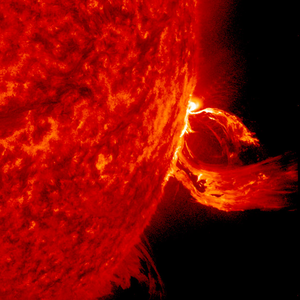
A Coronal Mass Ejection
Pie de foto: A burst of solar material can be seen erupting from the Sun in this view, illustrating a coronal mass ejection (CME)—a large eruption of plasma and magnetic field from the Sun’s outer atmosphere, or corona. These CMEs are caused by magnetic explosions in the Sun's corona. During a CME, huge amounts of electrically charged particles are launched into space at great speeds, carrying part of the Sun’s magnetic field with them. These events are driven by changes in the Sun’s magnetic structure and release vast clouds of hot gas that travel outward into the solar system. When a CME moves through space, it can interact with a planet’s magnetic field and atmosphere, sometimes creating spectacular auroras or, in strong cases, interfering with artificial satellites and power systems.
CMEs are often associated with a temporary brightening of the region of the Sun where the CME originated. This is known as a solar flare. Stars other than the Sun can also have CMEs and flares.
This image was taken by NASA's Solar Dynamics Observatory (SDO). This is a space mission to monitor the Sun. The image here is taken at a special wavelength which partially ionised helium emits strongly at.
Crédito: NASA/Goddard/SDO
enlace de crédito
License: PD Dominio público íconos