وسائط ذات صلة

Fornax Galaxy Cluster
الشرح: Galaxies can reside in groups, such as our own local group, or in clusters of galaxies. The Fornax Galaxy Cluster is one of the nearest such large groupings of galaxies. Visible in this image taken by the Very Large Telescope Survey Telescope VST (at the European Southern Observatory in Chile) are elliptical galaxies (without defined structures and in a yellow tint) but also spiral galaxies such as NGC 1365 towards the bottom right. This galaxy in particular is classified as a barred spiral galaxy due to its prominent and well-defined bar. The center of the Fornax Cluster is the giant elliptical galaxy NGC 1399, visible as the largest galaxy on the left of the image.
المصدر: ESO. Acknowledgement: Aniello Grado and Luca Limatola
رابط المصدر
License: CC-BY-4.0 المشاع الإبداعي نَسب المُصنَّف 4.0 دولي (CC BY 4.0) أيقونات
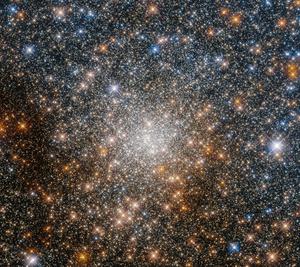
نجوم في عنقود نجمي كروي بالقرب من قلب مجرة درب التبانة
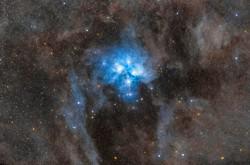
The Pleiades M45 with Majestic Dust
الشرح: Honourable mention in the 2022 IAU OAE Astrophotography Contest, category Still images of celestial patterns.
Taken in Dar Eid in Saint Catherine/Sinai, Egypt, in October 2021, this image shows the Pleiades, an open cluster also known as The Seven Sisters.
The Pleiades are located in the north-western part of the constellation Taurus, the Bull. This constellation originates from ancient Babylonian or even Sumerian belief, where it was designated the Bull of Heaven, a mighty creature owned by the sky god. In Late Babylonian times, the Pleiades were called The Bristle at the hunchback of The Bull. In China, the asterism is also called The Hair, but this does not necessarily imply any relationship between the East Asian and West Asian names of this asterism, although exchange is hypothesised with the establishment of the Silk Road.
In ancient Babylonian texts the term The Hair does not appear. Instead, the Pleiades are only called The Star Cluster in Sumerian, and the Sumerian term was used in later languages as a loanword. The Sumerian and early Babylonian religion associated all constellations with specific deities, including gods, demons, messengers of gods. The Star Cluster was associated with a deity of the Netherworld that was called The Seven and was considered an ensemble of seven speaking weapons or strongly armed gods. The later Greek name of the Seven Sisters might possibly have sprung from an intercultural misunderstanding of this older religious association, since, in fact, seven stars are not seen in this cluster.
The star cluster of the Pleiades is really prominent in the sky, and thus was used for several cultural purposes, such as determining the calendar and the spring equinox. However, its significance is frequently overstated in cultural astronomy. As the tradition of representing it with seven dots originates from an ancient Sumerian belief, we should be careful about interpreting any group of seven dots on cave walls and archaeological sites across Europe, Asia and America from the Stone Age onwards as a representation of the Pleiades.
Modern astrophysics has found that the star cluster of the Pleiades is extraordinarily young, so there was certainly not an additional star in ancient times. Furthermore, we know that the bright stars are only the core region of an open star cluster that consists of hundreds of stars scattered over an area of the sky which exceeds the bright core by one or two of its diameters in any direction. The photograph does not even show the whole cluster. The group is thought to be about 400 light-years away from Earth, which is relatively close in astronomical terms.
المصدر: Mohamed Usama/IAU OAE
License: CC-BY-4.0 المشاع الإبداعي نَسب المُصنَّف 4.0 دولي (CC BY 4.0) أيقونات