بلغات أخرى
- الألمانيّة: Scheibengalaxie
- الإنجليزيّة: Disk Galaxy
- الإسبانيّة: Galaxia de disco
- الفرنسيّة: Galaxie à disque
- الإيطاليّة: Galassia a disco
- اليابانيّة: 円盤銀河 (رابط خارجي)
- الكوريّة: 원반은하
- البرتغاليّة البرازيليّة: Disco Galaxy
- الصينيّة المبسطة: 盘状星系
- الصينيّة التقليدية: 盤狀星系
وسائط ذات صلة
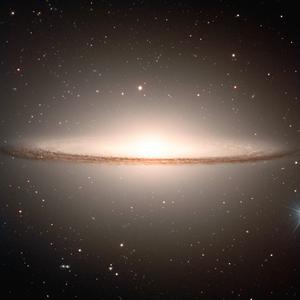
مجرة سومبريرو

A visible light image of the Andromeda Galaxy
الشرح: The Andromeda Galaxy viewed in visible light. Like our Milky Way, Andromeda is a barred spiral galaxy. Here we can see its bright core and spiral disk. The glow from the stars in the disk is interrupted by lanes of dust that form part of its spiral structure.
Andromeda is the largest galaxy in the Local Group of galaxies that includes the Milky Way.
To the left of the core and just above the disk we see the dwarf galaxy M32 and to the right and below the disk we see the dwarf galaxy M110. These are both satellite galaxies of the Andromeda Galaxy.
المصدر: Torben Hansen
رابط المصدر
License: CC-BY-2.0 المشاع الإبداعي نَسب المُصنَّف 2.0 عام أيقونات

The Lenticular Galaxy NGC 2787
الشرح: The lenticular galaxy NGC 2787. This galaxy is a disk galaxy but lacks the large, dominant spiral arm structure seen in the disks of spiral galaxies. Its core is very bright compared to the core of a spiral galaxy. Thin rings of dust can be seen in the galaxy's disk.
المصدر: NASA/ESA and The Hubble Heritage Team
رابط المصدر
License: CC-BY-4.0 المشاع الإبداعي نَسب المُصنَّف 4.0 دولي (CC BY 4.0) أيقونات

Spiral Galaxy UGC 2885
الشرح: This image shows UGC 2885, a spiral galaxy located in the constellation Perseus, about 230 million light-years from Earth. Spiral galaxies have rotating disks of stars, gas, and dust, with spiral arms extending outward from the central region. In UGC 2885, these arms are very broad and faint, revealing the galaxy’s large size. This galaxy is tilted at an angle to the observer on Earth, meaning it does not appear as the circular "grand design" spiral it would look like if viewed face-on, nor as the thin line with a central bulge it would appear as if viewed edge-on.
UGC 2885 is remarkable because it is roughly twice the diameter of the Milky Way. It was studied by astronomer Vera Rubin, whose observations of how galaxies rotate — including systems like this one — played a key role in the search for dark matter.
The bright star which appears to the left of the galaxy's center is a foreground object not related to the galaxy.
المصدر: NASA, ESA, Benne Holwerda (University of Louisville)
رابط المصدر
License: PD الملكية العامة أيقونات








.jpg)
