Glossar-Begriff: Widder
Beschreibung: Der Widder (Aries) ist das kleinste Sternbild des Tierkreises. Die Sterne, aus denen dieses Sternbild besteht, befinden sich in dem Teil des Himmels, der die Ekliptik (die Ebene, die durch die Umlaufbahn der Erde um die Sonne definiert ist) schneidet. Von der Erde aus können wir also regelmäßig die Planeten und auch die Sonne im Sternbild Widder finden. Im Fall der Sonne ist dies von Mitte April bis Mitte Mai der Fall (zu dieser Zeit können wir die Sterne des Sternbilds natürlich nicht sehen). Der Widder ist eines der 88 modernen Sternbilder, die von der Internationalen Astronomischen Union festgelegt wurden, aber er geht viel weiter zurück. Bereits im zweiten Jahrhundert war der Widder eines der 48 Sternbilder des Astronomen Claudius Ptolemäus.
Ähnliche Begriffe:
Dieser Begriff in anderen Sprachen
Begriffs- und Definitionsstatus Die Originaldefinition dieses Begriffes auf Englisch wurden von einem forschenden Astronom und einer Lehrkraft bestätigt Die Übersetzung dieses Begriffs und seiner Definition warten auf Prüfung und Bestätigung
The OAE Multilingual Glossary is a project of the IAU Office of Astronomy for Education (OAE) in collaboration with the IAU Office of Astronomy Outreach (OAO). The terms and definitions were chosen, written and reviewed by a collective effort from the OAE, the OAE Centers and Nodes, the OAE National Astronomy Education Coordinators (NAECs) and other volunteers. You can find a full list of credits here. All glossary terms and their definitions are released under a Creative Commons CC BY-4.0 license and should be credited to "IAU OAE".
Wenn dir ein inhaltlicher oder Übersetzungsfehler in diesem Glossarbegriff oder dieser Definition auffallen, bitte kontaktiere uns.
Ähnliche Medien
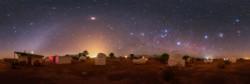
Chilenische Observatorien im Home Office, von Robert Barsa, Slowakei
Unterschrift: Dritter Platz beim IAU OAE Astrofotografie-Wettbewerb 2021, Kategorie Große Sternfelder.
Dieses reichhaltige Panoramabild zeigt eine Reihe von Sternbildern, Deep-Sky-Objekten und Planeten. Der hellste Lichtpunkt mit einem blassen rötlichen Farbton (links von der Mitte) ist der Planet Mars. Ganz unten links im Bild, direkt über dem schrägen Dach des Gebäudes, sind zwei Lichtpunkte zu sehen, die sehr nahe beieinander liegen. Es handelt sich um die Planeten Jupiter (heller) und Saturn. Die beiden unscharfen wolkenartigen Objekte ganz rechts im Bild sind die Große und die Kleine Magellansche Wolke. Dabei handelt es sich um Satelliten-Zwerggalaxien der Milchstraße, die sich in einer Entfernung von etwa 160.000 bzw. 200.000 Lichtjahren befinden. Die Andromedagalaxie, die sich in einer Entfernung von etwa 2,5 Millionen Lichtjahren befindet, erscheint auf diesem Bild als kleiner, schräger Fleck zwischen dem Mars und dem hellsten Leuchten am Horizont (näher am Horizont). Das helle Leuchten stammt nicht von der Sonne oder dem Mond, sondern von den Lichtern der Stadt San Pedro de Atacama.
Auffällige Sternbilder sind: Orion – zu erkennen an den drei Sternen, die den Gürtel des Orion bilden; Stier – eine kleine dreieckige Ansammlung von Sternen links vom Orion, zu erkennen an dem hellorangenen Stern (Aldebaran) an der Spitze des Dreiecks; Großer Hund – unten rechts vom Orion, zu erkennen an dem hellen Stern Sirius (dem hellsten Stern am Nachthimmel) und drei Sternen in Form eines Dreiecks direkt über der Sternwartenkuppel im Vordergrund; Pegasus – zu erkennen an der Trapezform diagonal unter dem Mars. Weitere Sternbilder sind Andromeda, Perseus und Widder. Verschiedene Kulturen auf der ganzen Welt haben ihre eigenen Namen und reichhaltigen Geschichten, die mit diesen und vielen anderen Sternbildern verbunden sind.
Oben rechts im Gürtel des Orion befindet sich eine gewinkelte Reihe von Sternen (das Schwert des Orion), in der sich ein rosafarbener Fleck befindet (der mit bloßem Auge wie ein unscharfer Stern aussieht). Es ist der Orionnebel, eine stellare Kinderstube, die 1500 Lichtjahre von der Erde entfernt ist und in der Sterne entstehen. Links vom Stier befindet sich ein kompakter, unscharfer Fleck, der Sternhaufen der Plejaden. Die Farbunterschiede zwischen den Sternen sind auf die Temperatur der Sterne zurückzuführen. Der rötlich-orange Stern unten links im Gürtel des Orion ist beispielsweise der rote Riesenstern Beteigeuze. Kältere Sterne erscheinen rötlicher als die weißen und bläulichen Sterne mit höherer Temperatur. Im Vergleich zum menschlichen Auge werden die Farben im Bild durch die höhere Empfindlichkeit der Digitalkamera verstärkt.
Bild: Robert Barsa/IAU OAE
License: CC-BY-4.0 Creative Commons Namensnennung 4.0 International (CC BY 4.0) Symbole
Ähnliche Diagramme
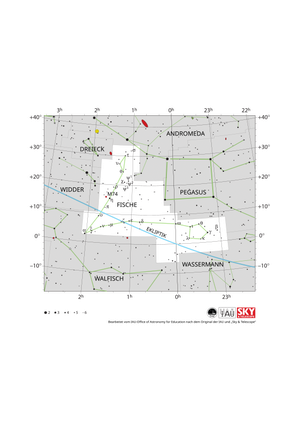
Karte des Sternbilds Fische
Unterschrift: Das Sternbild Fische (lateinisch Pisces) mit seinen hellen Sternen und den umliegenden Sternbildern. Das Sternbild Fische ist umgeben von (im Uhrzeigersinn von oben beginnend) Andromeda, Pegasus, Wassermann, Walfisch, Widder und Dreieck. Die Fische liegen auf der Ekliptik (hier als blaue Linie dargestellt). Dies ist die Bahn, die die Sonne im Laufe eines Jahres scheinbar am Himmel durchläuft. Die Sonne befindet sich von Mitte März bis Mitte April im Sternbild Fische. Somit steht die Sonne auch zur März-Tagundnachtgleiche diesem Sternbild. An diesem Punkt kreuzt die Ekliptik den Himmelsäquator. Die Position der Sonne zur Frühlings-Tagundnachtgleiche dient als Nullpunkt für die Himmelskoordinate der Rektaszension. Auch die anderen Planeten des Sonnensystems sind häufig im Sternbild Fische zu finden.
Die Fische erstrecken sich über den Himmelsäquator und sind daher im Laufe des Jahres von jedem Ort der Erde aus zu sehen. Lediglich in den arktischsten oder antarktischen Regionen der Welt sind einige Teile des Sternbilds möglicherweise nicht sichtbar. Am leichtesten beobachtbar ist das Sternbild Fische abends im Herbst der nördlichen Hemisphäre und im Frühling der südlichen Hemisphäre.
Die Spiralgalaxie M74 vom Typ „Grand Design“ ist in dieser Abbildung mit einem kleinen roten Kreis markiert.
Die y-Achse dieses Diagramms zeigt die Deklination in Grad, wobei Norden oben liegt, und die x-Achse zeigt die Rektaszension in Stunden mit Osten nach links. Die Größe der hier markierten Sterne bezieht sich auf deren scheinbare Helligkeit, ein Maß für die ankommende Strahlungsintensität. Die größeren Punkte repräsentieren hellere Sterne. Die griechischen Buchstaben kennzeichnen die hellsten Sterne des Sternbilds. Diese sind nach Helligkeit geordnet, wobei der hellste Stern mit Alpha bezeichnet wird, der zweithellste mit Beta usw. – wobei diese Reihenfolge nicht immer exakt eingehalten wird. Die gepunkteten Grenzlinien markieren die offiziellen Sternbildgrenzen der IAU, und die durchgezogenen grünen Linien zeigen eine der üblichen Formen, um die Figuren der Sternbilder darzustellen. Weder die Sternbildgrenzen noch die Verbindungslinien zwischen den Sternen sind am realen Himmel zu sehen.
Bild: Bearbeitet vom IAU-Office of Astronomy for Education nach dem Original der IAU und „Sky & Telescope“
License: CC-BY-4.0 Creative Commons Namensnennung 4.0 International (CC BY 4.0) Symbole
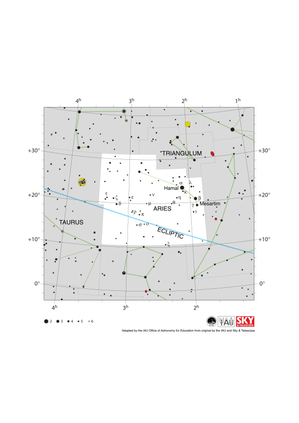
Aries Constellation Map
Unterschrift: The constellation Aries along with its bright stars and surrounding constellations. Aries is surrounded by (going clockwise from the top) Triangulum, Pisces, Cetus, Taurus and Perseus. Aries lies on the ecliptic (shown here as a blue line), this is the path the Sun appears to take across the sky over the course of a year. The Sun is in Aries from mid April to mid May. The other planets of the Solar System can often be found in Aries.
Aries lies just north of the celestial equator and is thus visible at some time in the year from all of planet Earth except for the most antarctic regions of the world. Aries is most visible in the evenings in the northern hemisphere winter and southern hemisphere summer.
The y-axis of this diagram is in degrees of declination with north as up and the x-axis is in hours of right ascension with east to the left. The sizes of the stars marked here relate to the star's apparent magnitude, a measure of its apparent brightness. The larger dots represent brighter stars. The Greek letters mark the brightest stars in the constellation. These are ranked by brightness with the brightest star being labeled alpha, the second brightest beta, etc., although this ordering is not always followed exactly. The dotted boundary lines mark the IAU's boundaries of the constellations and the solid green lines mark one of the common forms used to represent the figures of the constellations. Neither the constellation boundaries, nor the line marking the ecliptic, nor the lines joining the stars appear on the sky.
Bild: Adapted by the IAU Office of Astronomy for Education from the original by IAU/Sky & Telescope
License: CC-BY-4.0 Creative Commons Namensnennung 4.0 International (CC BY 4.0) Symbole
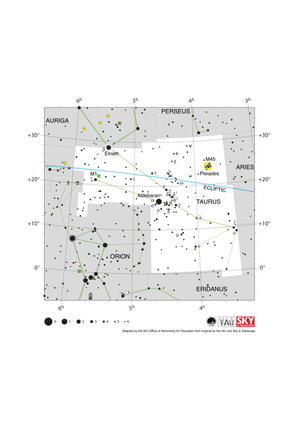
Taurus Constellation Map
Unterschrift: The constellation Taurus along with its bright stars and surrounding constellations. Taurus is surrounded by (going clockwise from the top) Perseus, Aries, Cetus, Eridanus, Orion, Gemini and Auriga. Taurus’s brightest star Aldebaran appears in the middle of the constellation. Taurus lies on the ecliptic (shown here as a blue line), this is the path the Sun appears to take across the sky over the course of a year. The Sun is in Taurus from mid May to late June. The other planets of the Solar System can often be found in Taurus.
Taurus lies mostly north of the celestial equator with a small part in the celestial southern hemisphere. The whole constellation is visible at some point in the year to whole planet except for the Antarctic and a small region around the North Pole. Taurus is most visible in the evenings in the northern hemisphere winter and southern hemisphere summer.
In the eastern part of Taurus we can find the supernova remnant M1 (commonly known as the Crab Nebula), marked here with a green square. In Taurus’s north-east find one of the sky’s most famous open stars clusters M45 (the Pleiades), marked here with a yellow circle. Many of the stars near Aldebaran (but not) Aldebaran are members of another star cluster, the Hyades. However this cluster is close to the solar system so is too dispersed on the sky to have a Messier object designation like the Pleiades has.
The y-axis of this diagram is in degrees of declination with north as up and the x-axis is in hours of right ascension with east to the left. The sizes of the stars marked here relate to the star's apparent magnitude, a measure of its apparent brightness. The larger dots represent brighter stars. The Greek letters mark the brightest stars in the constellation. These are ranked by brightness with the brightest star being labeled alpha, the second brightest beta, etc., although this ordering is not always followed exactly. The dotted boundary lines mark the IAU's boundaries of the constellations and the solid green lines mark one of the common forms used to represent the figures of the constellations. Neither the constellation boundaries, nor the line marking the ecliptic, nor the lines joining the stars appear on the sky.
Bild: Adapted by the IAU Office of Astronomy for Education from the original by IAU/Sky & Telescope
License: CC-BY-4.0 Creative Commons Namensnennung 4.0 International (CC BY 4.0) Symbole

Triangulum Constellation Map
Unterschrift: The constellation Triangulum with its bright stars and surrounding constellations. Triangulum is surrounded by (going clockwise from the top): Andromeda, Pisces, Aries and Perseus.
Triangulum is a northern constellation and thus the whole constellation is visible at some point in the year throughout the northern hemisphere. The whole constellation is also visible from equatorial and most temperate regions of the southern hemisphere. Triangulum is best viewed in the evening in the northern hemisphere winter and southern hemisphere summer.
The Triangulum Galaxy M33 lies in the constellation. This spiral galaxy is the third largest member of the local group of galaxies after the Andromeda Galaxy and Milky Way. It is marked here with a red ellipse.
The y-axis of this diagram is in degrees of declination with north as up and the x-axis is in hours of right ascension with east to the left. The sizes of the stars marked here relate to the star's apparent magnitude, a measure of its apparent brightness. The larger dots represent brighter stars. The Greek letters mark the brightest stars in the constellation. These are ranked by brightness with the brightest star being labeled alpha, the second brightest beta, etc., although this ordering is not always followed exactly. The dotted boundary lines mark the IAU's boundaries of the constellations and the solid green lines mark one of the common forms used to represent the figures of the constellations. The blue line at the bottom left of the diagram marks the ecliptic. Neither the constellation boundaries, nor the lines joining the stars, nor the ecliptic, appear on the sky.
Bild: Adapted by the IAU Office of Astronomy for Education from the original by the IAU and Sky & Telescope
License: CC-BY-4.0 Creative Commons Namensnennung 4.0 International (CC BY 4.0) Symbole