Glossar-Begriff: Tierkreis
Beschreibung: Der Tierkreis (oder Zodiak) ist ein Streifen des Himmels, der etwa 8 Grad nördlich und südlich der Ekliptiklinie liegt. Die scheinbare Bewegung der Sonne im Laufe eines Jahres und die Bewegung der Planeten verlaufen innerhalb dieser Zone. Im Tierkreis befinden sich 13 Sternbilder: Widder, Stier, Zwillinge, Krebs, Löwe, Jungfrau, Waage, Skorpion, Schütze, Schlangenträger, Steinbock, Wassermann und Fische. Die meisten dieser Sternbilder stellen Tiere dar. Der Name leitet sich aus dem Altgriechischen ab und bedeutet ungefähr "Kreis mit kleinen Tieren".
Ähnliche Begriffe:
Dieser Begriff in anderen Sprachen
Begriffs- und Definitionsstatus Die Originaldefinition dieses Begriffes auf Englisch wurden von einem forschenden Astronom und einer Lehrkraft bestätigt Die Übersetzung dieses Begriffs und seiner Definition warten auf Prüfung und Bestätigung
The OAE Multilingual Glossary is a project of the IAU Office of Astronomy for Education (OAE) in collaboration with the IAU Office of Astronomy Outreach (OAO). The terms and definitions were chosen, written and reviewed by a collective effort from the OAE, the OAE Centers and Nodes, the OAE National Astronomy Education Coordinators (NAECs) and other volunteers. You can find a full list of credits here. All glossary terms and their definitions are released under a Creative Commons CC BY-4.0 license and should be credited to "IAU OAE".
Wenn dir ein inhaltlicher oder Übersetzungsfehler in diesem Glossarbegriff oder dieser Definition auffallen, bitte kontaktiere uns.
Auf anderen Sprachen
- Arabisch: دائرة البروج
- Englisch: Zodiac
- Spanisch: Zodiaco
- Französisch: Zodiaque
- Italienisch: Zodiaco
- Japanisch: 黄道十二宮 (externer Link)
- Brasilianisches Portugiesisch: Zodíaco
- Vereinfachtes Chinesisch: 黄道十二宫
- Traditionelles Chinesisch: 黃道十二宮
Ähnliche Medien

Die Sterne und das Meer gemeinsam bewachen
Unterschrift: Auszeichnung beim IAU OAE Astrofoto-Wettbewerb 2022, Kategorie Weitwinkelaufnahmen von Himmelsmustern.
Die Komposition dieses Bildes fällt ins Auge: In der Ferne scheint eine Bergkette die Struktur der Milchstraße am Himmel darüber widerzuspiegeln. Die kräftigen, tageslichtähnlichen Farben der Landschaft werden durch den Mond erzeugt, die helle Lichtquelle am oberen Bildrand.
Dieses im Februar 2019 in Kinabalu in Malaysia aufgenommene Bild zeigt die Ausrichtung der Planeten und des Mondes entlang der Ekliptik, also der Ebene, in der alle Planeten die Sonne umkreisen. Während die Ekliptik die Zentrallinie des Tierkreises darstellt, befinden sich die Tierkreissternbilder in einem Bereich von etwa fünf bis zehn Grad auf beiden Seiten der Ekliptik. Vom Horizont beginnend Richtung oberer Bildmitte sind die Planeten Venus, Saturn und Jupiter aufgereiht. Die Planeten haben für die Menschen auf der ganzen Welt eine unterschiedliche kulturelle Bedeutung und sind tief in die sozialen, religiösen und praktischen Aspekte des Lebens eingebettet. In den Wardaman-Traditionen der australischen Ureinwohner zum Beispiel werden die Planeten mit den Geistern der Ahnen in Verbindung gebracht, die die Himmelsstraße (die Ekliptik) durchwandern. Das Erscheinen und Verschwinden der Planeten am Himmel wird mit verschiedenen Zeremonien in Verbindung gebracht. Wenn zum Beispiel die Venus als "Morgenstern" erscheint, nachdem sie zuvor der "Abendstern" war, markiert dies die Banumbirr-Zeremonie des Yolnu-Volkes im Arnhemland in Australien.
Das Bild zeigt auch die Sternbilder Skorpion (lat. Scorpius), Adler (lat. Aquila), Wolf (lat. Lupus) und das Südliche Dreieck (lat. Triangulum Australe), den Asterismus der Teekanne und die beiden Zeigersterne alpha und beta Centauri. Die Sternbilder, Asterismen und einzelne Sterne darin haben in vielen verschiedenen Kulturen eine Bedeutung.
Da Malaysia in der Nähe des Äquators liegt, gibt es sowohl Verbindungen zum Norden als auch zum Süden, und fast der gesamte Himmel ist im Laufe des Jahres sichtbar. Der Stern Antares wird vom Volk der Kokatha in der westlichen Wüste als Kogolongo, der Rotschwanz-Rabenkakadu, gesehen, während die Boorong ihn als Djuit bezeichnen, den Singsittich. Die beiden Sterne, die den Stachel des Skorpions bilden (Shaula und Lesath), werden als Karik Karik betrachtet, der Graubartfalke.
Bild: Likai Lin/IAU OAU
License: CC-BY-4.0 Creative Commons Namensnennung 4.0 International (CC BY 4.0) Symbole
Ähnliche Diagramme
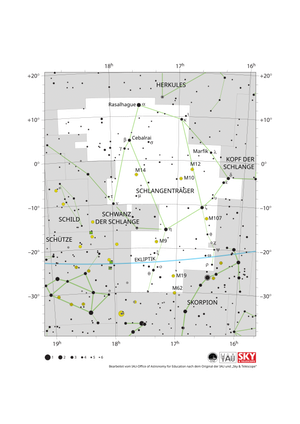
Karte des Sternbilds Schlangenträger
Unterschrift: Das Sternbild Schlangenträger (lateinisch Ophiuchus) mit seinen hellen Sternen und den umliegenden Sternbildern. Der Schlangenträger ist umgeben von (im Uhrzeigersinn von oben beginnend): Herkules, Kopf der Schlange, Skorpion, Schütze und Schwanz der Schlange. der Schlangenträger gehört zwar nicht zu den traditionellen zwölf Tierkreiszeichen, liegt jedoch auf der Ekliptik (hier als blaue Linie dargestellt), dies ist die Bahn, die die Sonne im Laufe eines Jahres scheinbar am Himmel zurücklegt. Die Sonne befindet sich von Ende November bis Mitte Dezember im Ophiuchus. Da die Planeten des Sonnensystems der Ekliptik folgen, sind sie regelmäßig auch im Sternbild Schlangenträger zu finden.
Der Schlangenträger erstreckt sich über den Himmelsäquator, sodass ein Teil des Sternbilds zu einem Zeitpunkt des Jahres von der gesamten Erde aus sichtbar ist. Während der Zeit, in der es abends am besten sichtbar ist (im Winter der südlichen Hemisphäre und im Sommer der nördlichen Hemisphäre), herrscht jedoch in weiten Teilen der Arktis ewiges Tageslicht, sodass die Sterne des Sternbilds von dort nicht zu sehen sind. Das gesamte Sternbild ist von den äquatorialen und gemäßigten Regionen beider Hemisphären aus sichtbar.
Da Ophiuchus nahe am galaktischen Zentrum liegt, enthält es viele Kugelsternhaufen wie M9, M10, M12, M14, M19, M62 und M107. Diese sind als gelbe Kreise mit überlagerten Pluszeichen gekennzeichnet.
Die y-Achse dieses Diagramms zeigt die Deklination in Grad, wobei Norden oben liegt, und die x-Achse zeigt die Rektaszension in Stunden mit Osten nach links. Die Größe der hier dargestellten Sterne bezieht sich auf deren scheinbare Helligkeit, ein Maß für die ankommende Strahlungsintensität. Die größeren Punkte repräsentieren hellere Sterne. Die griechischen Buchstaben kennzeichnen die hellsten Sterne des Sternbilds. Diese sind nach Helligkeit geordnet, wobei der hellste Stern mit Alpha bezeichnet wird, der zweithellste mit Beta usw. – wobei diese Reihenfolge nicht immer exakt eingehalten wird. Die gepunkteten Grenzlinien markieren die offiziellen Sternbildgrenzen der IAU, und die durchgezogenen grünen Linien zeigen eine der üblichen Formen, um die Figuren der Sternbilder darzustellen. Weder die Sternbildgrenzen noch die Verbindungslinien zwischen den Sternen sind am realen Himmel zu sehen.
Bild: Bearbeitet vom IAU-Office of Astronomy for Education nach dem Original der IAU und „Sky & Telescope“
License: CC-BY-4.0 Creative Commons Namensnennung 4.0 International (CC BY 4.0) Symbole
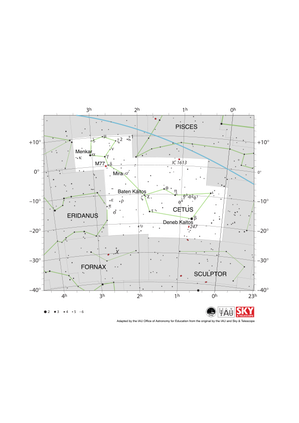
Cetus Constellation Map
Unterschrift: The constellation Cetus along with its bright stars and surrounding constellations. Cetus is surrounded by (going clockwise from the top): Pisces, Aquarius, Sculptor, Fornax, Eridanus, Taurus and Aries. Cetus lies just south of the ecliptic (shown here as a blue line), this is the path the Sun appears to take across the sky over the course of a year. While the Sun does not pass through Cetus, the other planets of the solar system and the Moon can sometimes be found in Cetus. The star Omicron Ceti or Mira is a famous variable star. This red giant varies in brightness by a factor of 600 over the course of its eleven month period.
Cetus spans the celestial equator, thus some part of the constellation is visible from all the the Earth at some point in the year. The full constellation is visible from equatorial and temperate regions of both hemispheres. Cetus is most visible in the evenings in the northern hemisphere late autumn and the southern hemisphere late spring.
The barred spiral galaxy M77 lies in Cetus as does the spiral galaxy NGC 247 and the dwarf irregular galaxy IC 1613. All three are marked here with red ellipses.
The y-axis of this diagram is in degrees of declination with north as up and the x-axis is in hours of right ascension with east to the left. The sizes of the stars marked here relate to the star's apparent magnitude, a measure of its apparent brightness. The larger dots represent brighter stars. Mira is marked with an open circle as it is a variable star not always visible to the naked eye. The Greek letters mark the brightest stars in the constellation. These are ranked by brightness with the brightest star being labeled alpha, the second brightest beta, etc., although this ordering is not always followed exactly. The dotted boundary lines mark the IAU's boundaries of the constellations and the solid green lines mark one of the common forms used to represent the figures of the constellations. Neither the constellation boundaries, nor the line marking the ecliptic, nor the lines joining the stars appear on the sky.
Bild: Adapted by the IAU Office of Astronomy for Education from the original by IAU/Sky & Telescope
License: CC-BY-4.0 Creative Commons Namensnennung 4.0 International (CC BY 4.0) Symbole
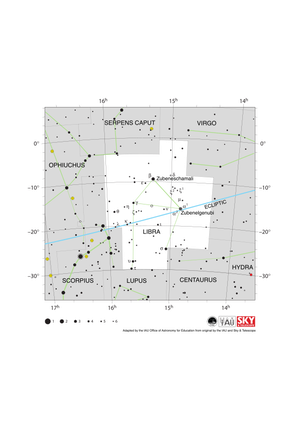
Libra Constellation Map
Unterschrift: The constellation Libra along with its bright stars and surrounding constellations. Libra is surrounded by (going clockwise from the top) Serpens Caput, Virgo, Hydra, Centaurus, Lupus, Scorpius and Ophiuchus. Libra lies on the ecliptic (shown here as a blue line), this is the path the Sun appears to take across the sky over the course of a year. The Sun is in Libra from late October to late November. The other planets of the Solar System can often be found in Libra.
Libra lies just south of the celestial equator and is thus visible at some time in all but the most arctic regions. Libra is most visible in the evenings in the northern hemisphere late spring/early summer and southern hemisphere late autumn/early winter.
The y-axis of this diagram is in degrees of declination with north as up and the x-axis is in hours of right ascension with east to the left. The sizes of the stars marked here relate to the star's apparent magnitude, a measure of its apparent brightness. The larger dots represent brighter stars. The Greek letters mark the brightest stars in the constellation. These are ranked by brightness with the brightest star being labeled alpha, the second brightest beta, etc., although this ordering is not always followed exactly. The dotted boundary lines mark the IAU's boundaries of the constellations and the solid green lines mark one of the common forms used to represent the figures of the constellations. Neither the constellation boundaries, nor the line marking the ecliptic, nor the lines joining the stars appear on the sky.
Bild: Adapted by the IAU Office of Astronomy for Education from the original by IAU/Sky & Telescope
License: CC-BY-4.0 Creative Commons Namensnennung 4.0 International (CC BY 4.0) Symbole
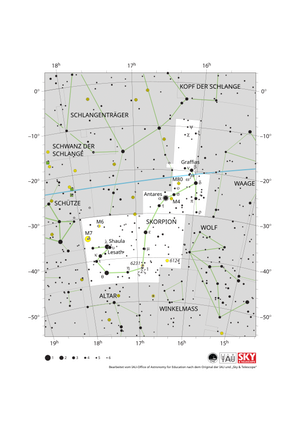
Karte des Sternbilds Skorpion
Unterschrift: Das Sternbild Skorpion (lateinisch Scorpio) mit seinen hellen Sternen und den umliegenden Sternbildern. Der Skorpion ist umgeben von (im Uhrzeigersinn von oben beginnend) dem Schlangenträger, dem Kopf der Schlange, der Waage, dem Wolf, dem Winkelmaß, dem Altar, der südlichen Krone und dem Schützen. Der hellste Stern des Skorpions, Antares, befindet sich im Herzen des Sternbilds, während sich der berühmte Schwanz des Skorpions nach Südosten (unten links) erstreckt. Der Skorpion liegt auf der Ekliptik (hier als blaue Linie dargestellt); dies ist die Bahn, die die Sonne im Laufe eines Jahres scheinbar am Himmel zurücklegt. Die Sonne verbringt nur eine kurze Zeit Ende November im Sternbild Skorpion. Die Planeten des Sonnensystems sind regelmäßig im Skorpion zu finden.
Der Skorpion liegt südlich des Himmelsäquators. Das gesamte Sternbild ist von den arktischen Regionen der Erde aus nicht sichtbar. Für Beobachter in den nördlichen Teilen Asiens, Europas und Nordamerikas sind Teile des Skorpions verdeckt. Der Skorpion ist am besten abends im Sommer der nördlichen Hemisphäre und im Winter der südlichen Hemisphäre zu sehen.
Die gelben Kreise markieren die Positionen der offenen Sternhaufen M6, M7 und NGC 6231, während die gelben Kreise mit darübergelegten Pluszeichen die Kugelsternhaufen M4 und M80 kennzeichnen.
Die y-Achse dieses Diagramms zeigt die Deklination in Grad, wobei Norden oben liegt, und die x-Achse zeigt die Rektaszension in Stunden mit Osten nach links. Die Größe der hier dargestellten Sterne bezieht sich auf deren scheinbare Helligkeit, ein Maß für die ankommende Strahlungsintensität. Die größeren Punkte repräsentieren hellere Sterne. Die griechischen Buchstaben kennzeichnen die hellsten Sterne des Sternbilds. Diese sind nach Helligkeit geordnet, wobei der hellste Stern mit Alpha bezeichnet wird, der zweithellste mit Beta usw. – wobei diese Reihenfolge nicht immer exakt eingehalten wird. Die gepunkteten Grenzlinien markieren die offiziellen Sternbildgrenzen der IAU, und die durchgezogenen grünen Linien zeigen eine der üblichen Formen, um die Figuren der Sternbilder darzustellen. Weder die Sternbildgrenzen noch die Verbindungslinien zwischen den Sternen sind am realen Himmel zu sehen.
Bild: Bearbeitet vom IAU-Office of Astronomy for Education nach dem Original der IAU und „Sky & Telescope“
License: CC-BY-4.0 Creative Commons Namensnennung 4.0 International (CC BY 4.0) Symbole
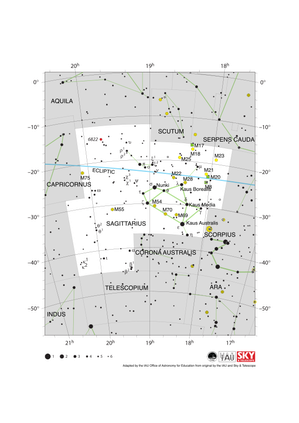
Sagittarius Constellation Map
Unterschrift: The constellation Sagittarius along with its bright stars and surrounding constellations. Sagittarius is surrounded by (going clockwise from the top) Aquila, Scutum, Serpens Cauda, Ophiuchus, Scorpius, Corona Australis, Telescopium, Microscopium and Capricornus. The brighter stars in Sagittarius form a distinctive teapot shape. Sagittarius lies on the ecliptic (shown here as a blue line), this is the path the Sun appears to take across the sky over the course of a year. The Sun is in Sagittarius from mid December to mid January. The other planets of the Solar System can often be found in Sagittarius.
Sagittarius lies south of the celestial equator. The famous teapot asterism is visible for all but the most arctic regions of the world but the most southerly parts of the constellation are not visible in northern parts of Asia, Europe and North America. Sagittarius is most visible in the evenings in the northern hemisphere summer and southern hemisphere winter.
The supermassive black hole Sagittarius A* which lies at the center of our Milky Way Galaxy is sits on the western (here right-hand) edge of Sagittarius. Due to it covering an area at the center of our Galaxy, Sagittarius is home to many star clusters including open clusters (marked here with yellow circles) and globular clusters (marked here with yellow circles with + signs superimposed on them). Three nebulae are also marked here with green squares.
The y-axis of this diagram is in degrees of declination with north as up and the x-axis is in hours of right ascension with east to the left. The sizes of the stars marked here relate to the star's apparent magnitude, a measure of its apparent brightness. The larger dots represent brighter stars. The Greek letters mark the brightest stars in the constellation. These are ranked by brightness with the brightest star being labeled alpha, the second brightest beta, etc., although this ordering is not always followed exactly. The dotted boundary lines mark the IAU's boundaries of the constellations and the solid green lines mark one of the common forms used to represent the figures of the constellations. Neither the constellation boundaries, nor the line marking the ecliptic, nor the lines joining the stars appear on the sky.
Bild: Adapted by the IAU Office of Astronomy for Education from the original by IAU/Sky & Telescope
License: CC-BY-4.0 Creative Commons Namensnennung 4.0 International (CC BY 4.0) Symbole