Glossar-Begriff: Umbra
Beschreibung: Im Zusammenhang mit Finsternissen ist der Kernschatten (Umbra) der Bereich des Weltraums, in dem ein Beobachter sieht, dass der eine Körper das Licht des anderen vollständig verdeckt. Bei einer Sonnenfinsternis zum Beispiel sieht ein Beobachter im Kernschatten, dass die Sonnenscheibe vollständig von der Mondscheibe verdeckt wird. Ein Beobachter, der sich im Halbschatten (Penumbra) befindet, sieht dagegen nur eine partielle Verfinsterung; im Falle einer Sonnenfinsternis wird die Sonnenscheibe nur teilweise vom Mond verdeckt. Wenn für einen Beobachter das bedeckende Objekt zu klein erscheint, um das dahinter liegende Objekt vollständig zu verdecken befindet sich der Beobachter in der sogenannten Antumbra. Das ist bei einer partiellen Sonnenfinsternis der Fall.
Alternative Bedeutung von Umbra: Der innere, dunklere Bereich eines Sonnenflecks wird als Umbra bezeichnet, der umgebende weniger dunkle Bereich als Penumbra.
Ähnliche Begriffe:
Dieser Begriff in anderen Sprachen
Begriffs- und Definitionsstatus Die Originaldefinition dieses Begriffes auf Englisch wurden von einem forschenden Astronom und einer Lehrkraft bestätigt Die Übersetzung dieses Begriffs und seiner Definition warten auf Prüfung und Bestätigung
The OAE Multilingual Glossary is a project of the IAU Office of Astronomy for Education (OAE) in collaboration with the IAU Office of Astronomy Outreach (OAO). The terms and definitions were chosen, written and reviewed by a collective effort from the OAE, the OAE Centers and Nodes, the OAE National Astronomy Education Coordinators (NAECs) and other volunteers. You can find a full list of credits here. All glossary terms and their definitions are released under a Creative Commons CC BY-4.0 license and should be credited to "IAU OAE".
Wenn dir ein inhaltlicher oder Übersetzungsfehler in diesem Glossarbegriff oder dieser Definition auffallen, bitte kontaktiere uns.
Auf anderen Sprachen
- Arabisch: الظل التام
- Englisch: Umbra
- Spanisch: Umbra
- Persisch: آمبرا (سایه کامل)
- Französisch: Ombre
- Indonesisch: Umbra
- Italienisch: Cono d'ombra
- Brasilianisches Portugiesisch: Umbra
- Vereinfachtes Chinesisch: 本影
- Traditionelles Chinesisch: 本影
Ähnliche Diagramme
Totale Sonnenfinsternis
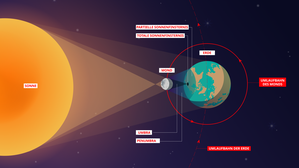
Unterschrift: Diese nicht maßstabsgetreue Darstellung zeigt, was während einer totalen Sonnenfinsternis geschieht. Der Mond umkreist die Erde, doch seine Umlaufbahn ist gegenüber der Umlaufbahn der Erde um die Sonne leicht geneigt. Während der Neumondphase befindet sich der Mond zwischen Erde und Sonne, doch aufgrund der geneigten Umlaufbahn des Mondes um die Erde liegt der Mond zu diesem Zeitpunkt normalerweise oberhalb oder unterhalb der Sonne. Zweimal im Jahr jedoch richtet sich die Umlaufbahn des Mondes so aus, dass der Mond in einer direkten Linie zwischen Erde und Sonne liegen kann. Zu diesen Zeitpunkten kann es zu einer Sonnenfinsternis kommen. Der Mond ist etwa 400-mal kleiner als die Sonne, befindet sich jedoch gleichzeitig auch 400-mal näher an der Erde als die Sonne. Daher haben Sonne und Mond von der Erde aus betrachtet ungefähr den gleichen Winkeldurchmesser. Daher ist es möglich, dass der Mond die Sonne von der Erde aus gesehen vollständig verdeckt. Dies wird als totale Sonnenfinsternis bezeichnet.
Hier sehen wir eine schematische Darstellung einer solchen Sonnenfinsternis. Der Mond wirft einen Schatten auf die Erde, der als Umbra bezeichnet wird. Dabei handelt es sich um einen annähernd kreisförmigen Schatten mit einem Durchmesser von einigen hundert Kilometern. Von jedem Ort innerhalb der Umbra aus gesehen verdeckt der Mond die Sonne vollständig, so dass dort eine totale Sonnenfinsternis zu beobachten ist. Außerhalb der Umbra gibt es Gebiete, in denen der Mond lediglich einen Teil der Sonne verdeckt. Dieser Halbschatten wird als Penumbra bezeichnet. Von Ort innerhalb der Penumbra aus ist eine partielle Sonnenfinsternis zu beobachten.
Eine Sonnenfinsternis ist ein dynamisches Ereignis, bei dem sich der Mond auf seiner Umlaufbahn weiterbewegt und die Erde gleichzeitig rotiert. Daher bewegen sich die Umbra und die Penumbra über die Erdoberfläche. Der Pfad, den die Umbra über die Erde zieht, wird als Totalitätszone bezeichnet. Betrachten wir eine bestimmte Region, die im Totalitätsstreifen liegt. Abgesehen von seltenen Fällen, in denen eine Sonnenfinsternis bei Sonnenaufgang beginnt, wird an einem Ort innerhalb der Totalitätszone zunächst zu sehen sein, wie der Mond einen Teil der Sonne verdeckt und sich allmählich über sie hinwegbewegt, bis die Sonne vollständig verdeckt ist. Von außerhalb der Erde betrachtet würde dies so aussehen, als würde sich zunächst die Halbschattenzone über diesen bestimmten Ort hinwegbewegen, gefolgt von der Kernschattenzone. Sobald sich der Mond so weiterbewegt hat, dass er die Sonne nicht mehr vollständig verdeckt, endet die Totalität und die Kernschattenzone entfernt sich von diesem bestimmten Ort. Der Mond bewegt sich so lange vor der Sonne entlangbewegen bis (sofern die Sonne nicht vor dem Ende der Sonnenfinsternis untergeht) die Sonne vollständig freigelegt ist. Von außerhalb der Erde betrachtet würde dies so aussehen, als würde sich der Kernschatten von unserem Ort entfernen, der Rand des Halbschattens sich nähern und schließlich über den Ort hinwegziehen.
Außerhalb der Totalitätszone gibt es ein viel größeres Gebiet, das in der Halbschattenzone liegt, aber vom Kernschatten nicht erfasst wird. In solchen Gebieten gibt es bei dieser Sonnenfinsternis keine totale, sondern nur eine partielle Sonnenfinsternis.
Bild: Aneta Margraf/IAU OAE
License: CC-BY-4.0 Creative Commons Namensnennung 4.0 International (CC BY 4.0) Symbole