Glossar-Begriff: Andromeda
Beschreibung: Andromeda ist ein Sternbild, das vor allem dafür bekannt ist, dass sich die Andromeda-Galaxie in ihm befindet. Der Name stammt aus der griechischen Mythologie: Andromeda war die Tochter von König Kepheus und Königin Kassiopeia und wurde dem Meeresungeheuer Walfisch geopfert. Sie wurde von dem Helden Perseus gerettet, der sie daraufhin heiratete.
Ähnliche Begriffe:
Dieser Begriff in anderen Sprachen
Begriffs- und Definitionsstatus Die Originaldefinition dieses Begriffes auf Englisch wurden von einem forschenden Astronom und einer Lehrkraft bestätigt Die Übersetzung dieses Begriffs und seiner Definition warten auf Prüfung und Bestätigung
The OAE Multilingual Glossary is a project of the IAU Office of Astronomy for Education (OAE) in collaboration with the IAU Office of Astronomy Outreach (OAO). The terms and definitions were chosen, written and reviewed by a collective effort from the OAE, the OAE Centers and Nodes, the OAE National Astronomy Education Coordinators (NAECs) and other volunteers. You can find a full list of credits here. All glossary terms and their definitions are released under a Creative Commons CC BY-4.0 license and should be credited to "IAU OAE".
Wenn dir ein inhaltlicher oder Übersetzungsfehler in diesem Glossarbegriff oder dieser Definition auffallen, bitte kontaktiere uns.
Auf anderen Sprachen
- Arabisch: المرأة المسلسلة
- Bengali: অ্যান্ড্রোমিডা
- Englisch: Andromeda
- Spanisch: Andrómeda
- Französisch: Andromède
- Hindi: एंड्रोमेडा
- Italienisch: Andromeda
- Koreanisch: 안드로메다자리
- Marathi: अँड्रोमेडा
- Brasilianisches Portugiesisch: Andrômeda
- Vereinfachtes Chinesisch: 仙女座
- Traditionelles Chinesisch: 仙女座
Ähnliche Diagramme

Andromeda-Sternbildkarte
Unterschrift: Das Sternbild Andromeda mit den hellen Sternen und den umliegenden Sternbildern. Andromeda ist im Uhrzeigersinn von oben aus gehend umgeben von Kassiopeia, Eidechse, Pegasus, Fische, Widder, Dreieck und Perseus. Der hellste Stern in Andromeda (Alpheratz) befindet sich im unteren Teil des Sternbildes. Zusammen mit drei Sternen im Pegasus bildet er die Sterngruppe, die als "Großes Quadrat des Pegasus" bekannt ist. Die nächsten beiden hellen Sterne im Sternbild (Mirach und Almach) bilden eine Linie, die sich von Alpheratz aus nach Nordosten erstreckt.
Andromeda ist ein nördliches Sternbild und am besten abends im Herbst auf der Nordhalbkugel zu sehen. Es ist von der gesamten nördlichen Hemisphäre und den meisten gemäßigten Regionen der südlichen Hemisphäre aus sichtbar, jedoch nicht von den antarktischen und subantarktischen Regionen aus.
Das berühmteste Objekt in Andromeda, die Andromedagalaxie, ist hier mit einer roten Ellipse und der Messier-Katalognummer M31 gekennzeichnet.
Der gelbe Kreis auf der linken Seite markiert die Position des offenen Sternhaufens NGC 752 und der grüne Kreis auf der rechten Seite markiert NGC 7662 (den blauen Schneeballnebel), einen planetarischen Nebel.
Die y-Achse dieses Diagramms ist in Deklinationsgraden mit Norden nach oben und die x-Achse in Stunden der Rektaszension mit Osten nach links angegeben. Die Größe der hier markierten Sterne bezieht sich auf die scheinbare Helligkeit des Sterns. Je größer die Punkte, desto heller scheinen die Sterne die sie darstellen. Die griechischen Buchstaben kennzeichnen die hellsten Sterne des Sternbildes. Diese sind nach Helligkeit geordnet, wobei der hellste Stern mit Alpha, der zweithellste mit Beta usw. bezeichnet wird, obwohl diese Reihenfolge nicht immer genau eingehalten wird. Die gepunkteten Begrenzungslinien markieren die IAU-Grenzen der Sternbilder und die durchgezogenen grünen Linien markieren eine der üblichen Formen, die zur Darstellung der Sternbilder verwendet werden. Weder die Grenzen der Sternbilder noch die Linien, die die Sterne verbinden, sind so am Himmel sichtbar.
Bild: Angepasst vom IAU Office of Astronomy for Education nach dem Original von IAU/Sky & Telescope
License: CC-BY-4.0 Creative Commons Namensnennung 4.0 International (CC BY 4.0) Symbole
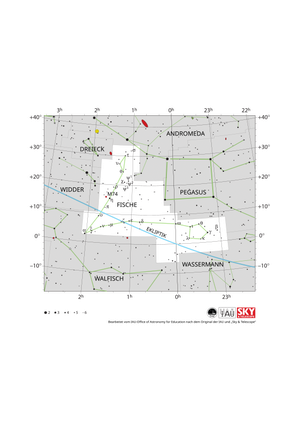
Karte des Sternbilds Fische
Unterschrift: Das Sternbild Fische (lateinisch Pisces) mit seinen hellen Sternen und den umliegenden Sternbildern. Das Sternbild Fische ist umgeben von (im Uhrzeigersinn von oben beginnend) Andromeda, Pegasus, Wassermann, Walfisch, Widder und Dreieck. Die Fische liegen auf der Ekliptik (hier als blaue Linie dargestellt). Dies ist die Bahn, die die Sonne im Laufe eines Jahres scheinbar am Himmel durchläuft. Die Sonne befindet sich von Mitte März bis Mitte April im Sternbild Fische. Somit steht die Sonne auch zur März-Tagundnachtgleiche diesem Sternbild. An diesem Punkt kreuzt die Ekliptik den Himmelsäquator. Die Position der Sonne zur Frühlings-Tagundnachtgleiche dient als Nullpunkt für die Himmelskoordinate der Rektaszension. Auch die anderen Planeten des Sonnensystems sind häufig im Sternbild Fische zu finden.
Die Fische erstrecken sich über den Himmelsäquator und sind daher im Laufe des Jahres von jedem Ort der Erde aus zu sehen. Lediglich in den arktischsten oder antarktischen Regionen der Welt sind einige Teile des Sternbilds möglicherweise nicht sichtbar. Am leichtesten beobachtbar ist das Sternbild Fische abends im Herbst der nördlichen Hemisphäre und im Frühling der südlichen Hemisphäre.
Die Spiralgalaxie M74 vom Typ „Grand Design“ ist in dieser Abbildung mit einem kleinen roten Kreis markiert.
Die y-Achse dieses Diagramms zeigt die Deklination in Grad, wobei Norden oben liegt, und die x-Achse zeigt die Rektaszension in Stunden mit Osten nach links. Die Größe der hier markierten Sterne bezieht sich auf deren scheinbare Helligkeit, ein Maß für die ankommende Strahlungsintensität. Die größeren Punkte repräsentieren hellere Sterne. Die griechischen Buchstaben kennzeichnen die hellsten Sterne des Sternbilds. Diese sind nach Helligkeit geordnet, wobei der hellste Stern mit Alpha bezeichnet wird, der zweithellste mit Beta usw. – wobei diese Reihenfolge nicht immer exakt eingehalten wird. Die gepunkteten Grenzlinien markieren die offiziellen Sternbildgrenzen der IAU, und die durchgezogenen grünen Linien zeigen eine der üblichen Formen, um die Figuren der Sternbilder darzustellen. Weder die Sternbildgrenzen noch die Verbindungslinien zwischen den Sternen sind am realen Himmel zu sehen.
Bild: Bearbeitet vom IAU-Office of Astronomy for Education nach dem Original der IAU und „Sky & Telescope“
License: CC-BY-4.0 Creative Commons Namensnennung 4.0 International (CC BY 4.0) Symbole

Cassiopeia Sternkarte
Unterschrift: Das Sternbild Kassiopeia mit seinen hellsten Sternen und den umliegenden Sternbildern. Cassiopeia ist (im Uhrzeigersinn von oben gesehen) umgeben von den Sternbildern: Cepheus, Andromeda, Perseus und Giraffe.
Kassiopeia ist ein nördliches Sternbild, das von der gesamten nördlichen Hemisphäre und den äquatorialen Regionen der südlichen Hemisphäre aus sichtbar ist. Am besten ist es abends im Spätherbst der nördlichen Hemisphäre und im späten Frühjahr der südlichen Hemisphäre zu sehen.
Die offenen Sternhaufen M52, M103, NGC 457 und NGC 663 liegen in diesem Sternbild und sind in der Karte mit gelben Kreisen markiert. Zwei elliptische Zwerggalaxien NGC 147 und NGC 185 liegen im südlichen Teil des Sternbildes. Sie sind mit roten Ellipsen markiert und gravitativ an die größere Andromedagalaxie gebunden, die südlich im gleichnamigen Sternbild liegt.
Die y-Achse dieses Diagramms ist in die Deklinationsachse, mit Norden am oberen Ende. Die x-Achse ist in die Rektaszensionsachse in Stunden (Osten nach links). Die Größe der hier markierten Sterne bezieht sich auf ihre scheinbare Helligkeit, wobei größeren Punkte für hellere Sterne stehen. Die hellsten Sterne des Sternbildes sind mit griechischen Buchstaben gekennzeichnet. Die so markierten Sterne sind nach Helligkeit geordnet, wobei der hellste Stern mit Alpha, der zweithellste mit Beta usw. bezeichnet wird, obwohl diese Reihenfolge nicht immer genau eingehalten wird. Die gepunkteten Begrenzungslinien markieren die IAU-Grenzen der Sternbilder und die durchgezogenen grünen Linien markieren eine der üblichen Formen, die zur Darstellung der Sternbilder verwendet wird. Weder die Grenzen der Sternbilder noch die Linien, die die Sterne verbinden, erscheinen am Himmel.
Bild: Angepasst vom IAU Office of Astronomy for Education nach dem Original von IAU/Sky & Telescope
License: CC-BY-4.0 Creative Commons Namensnennung 4.0 International (CC BY 4.0) Symbole
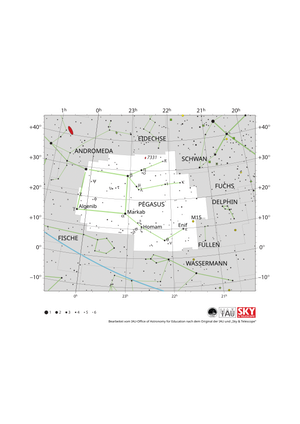
Karte des Sternbilds Pegasus
Unterschrift: Das Sternbild Pegasus mit seinen hellen Sternen und den umliegenden Sternbildern. Pegasus ist umgeben von (im Uhrzeigersinn von oben): Eidechse, Schwan, Fuchs, Delphin, Füllen, Wassermann, Fische und Andromeda. Pegasus ist bekannt für den markanten Sternenverband „Das Quadrat des Pegasus“, der aus seinen drei hellsten Sternen sowie dem hellsten Stern im Sternbild Andromeda besteht.
Pegasus ist ein nördliches Sternbild, daher ist das gesamte Sternbild einem Zeitpunkt im Jahr auf der gesamten nördlichen Hemisphäre sichtbar. Das gesamte Sternbild ist auch in den äquatorialen und gemäßigten Zonen der südlichen Hemisphäre sichtbar, wobei zumindest Teile des Sternbilds von allen Regionen der Südhalbkugel aus zu sehen sind, mit Ausnahme der extrem antarktischen Gebiete. Pegasus lässt sich am besten am Abend im Herbst der nördlichen Hemisphäre und im Frühling der südlichen Hemisphäre beobachten.
Der Kugelsternhaufen M15 liegt im Pegasus und ist hier mit einem gelben Kreis mit einem überlagerten Pluszeichen gekennzeichnet. Die Spiralgalaxie NGC 7331 liegt ebenfalls im Pegasus und ist hier mit einer roten Ellipse markiert.
Die y-Achse dieses Diagramms zeigt die Deklination in Grad, wobei Norden oben liegt, und die x-Achse zeigt die Rektaszension in Stunden mit Osten nach links. Die Größe der hier dargestellten Sterne bezieht sich auf deren scheinbare Helligkeit, ein Maß für die ankommende Strahlungsintensität. Die größeren Punkte repräsentieren hellere Sterne. Die griechischen Buchstaben kennzeichnen die hellsten Sterne des Sternbilds. Diese sind nach Helligkeit geordnet, wobei der hellste Stern mit Alpha bezeichnet wird, der zweithellste mit Beta usw. – wobei diese Reihenfolge nicht immer exakt eingehalten wird. Die gepunkteten Grenzlinien markieren die offiziellen Sternbildgrenzen der IAU, und die durchgezogenen grünen Linien zeigen eine der üblichen Formen, um die Figuren der Sternbilder darzustellen. Weder die Sternbildgrenzen noch die Verbindungslinien zwischen den Sternen sind am realen Himmel zu sehen.
Bild: Bearbeitet vom IAU-Office of Astronomy for Education nach dem Original der IAU und „Sky & Telescope“
License: CC-BY-4.0 Creative Commons Namensnennung 4.0 International (CC BY 4.0) Symbole

Triangulum Constellation Map
Unterschrift: The constellation Triangulum with its bright stars and surrounding constellations. Triangulum is surrounded by (going clockwise from the top): Andromeda, Pisces, Aries and Perseus.
Triangulum is a northern constellation and thus the whole constellation is visible at some point in the year throughout the northern hemisphere. The whole constellation is also visible from equatorial and most temperate regions of the southern hemisphere. Triangulum is best viewed in the evening in the northern hemisphere winter and southern hemisphere summer.
The Triangulum Galaxy M33 lies in the constellation. This spiral galaxy is the third largest member of the local group of galaxies after the Andromeda Galaxy and Milky Way. It is marked here with a red ellipse.
The y-axis of this diagram is in degrees of declination with north as up and the x-axis is in hours of right ascension with east to the left. The sizes of the stars marked here relate to the star's apparent magnitude, a measure of its apparent brightness. The larger dots represent brighter stars. The Greek letters mark the brightest stars in the constellation. These are ranked by brightness with the brightest star being labeled alpha, the second brightest beta, etc., although this ordering is not always followed exactly. The dotted boundary lines mark the IAU's boundaries of the constellations and the solid green lines mark one of the common forms used to represent the figures of the constellations. The blue line at the bottom left of the diagram marks the ecliptic. Neither the constellation boundaries, nor the lines joining the stars, nor the ecliptic, appear on the sky.
Bild: Adapted by the IAU Office of Astronomy for Education from the original by the IAU and Sky & Telescope
License: CC-BY-4.0 Creative Commons Namensnennung 4.0 International (CC BY 4.0) Symbole