This page describes an image Tucana Constellation Map
Descargar archivo ( imagen 113.87 kB)
Descargar archivo PDF (PDF file 161.52 kB)
Pie de foto del diagrama:
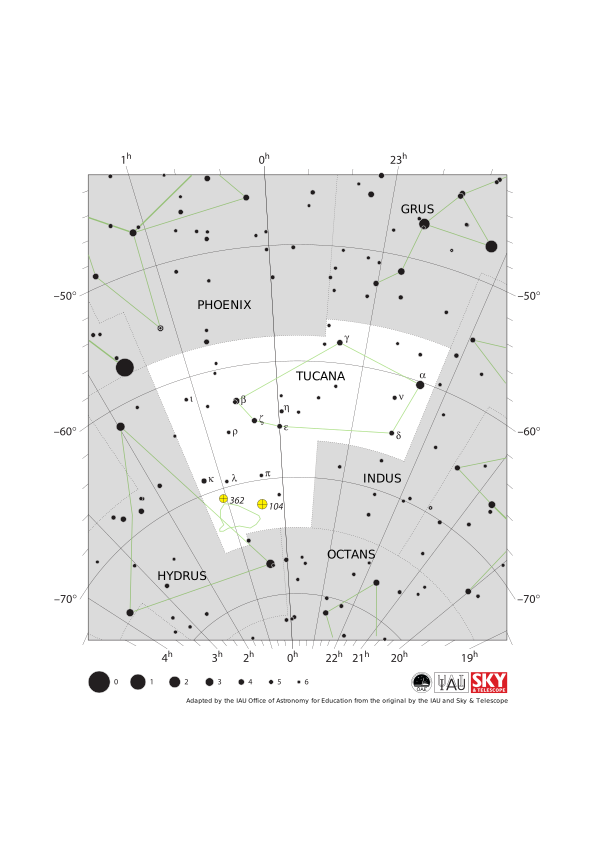
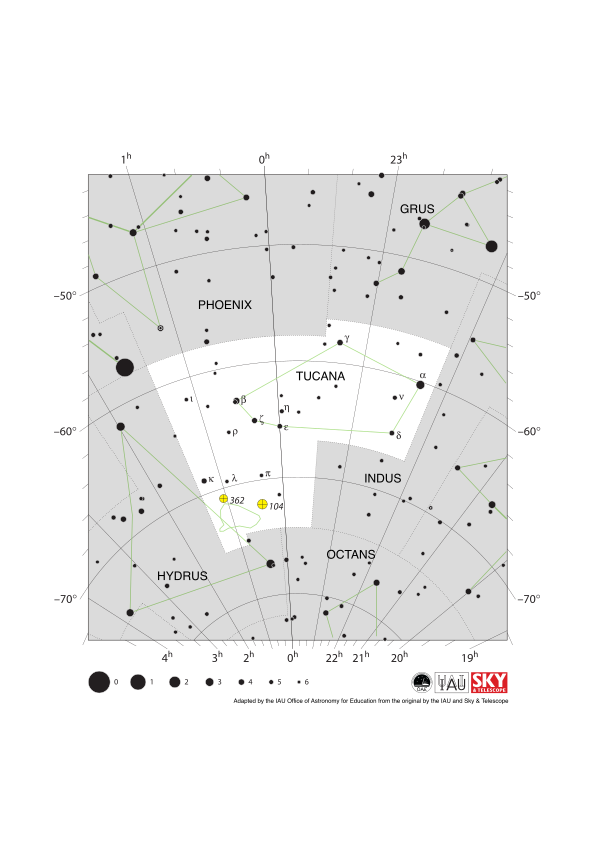
The constellation Tucana with its bright stars and surrounding constellations. Tucana is surrounded by (going clockwise from the top): Grus, Indus, Octans, Hydrus, Eridanus and Phoenix.
Tucana is a southern constellation and thus the whole constellation is visible at some point in the year throughout the southern hemisphere. The whole constellation is visible to some equatorial regions of the northern hemisphere with parts of the constellation visible to the remaining northern equatorial regions. Tucana is best viewed in the northern hemisphere autumn and southern hemisphere spring.
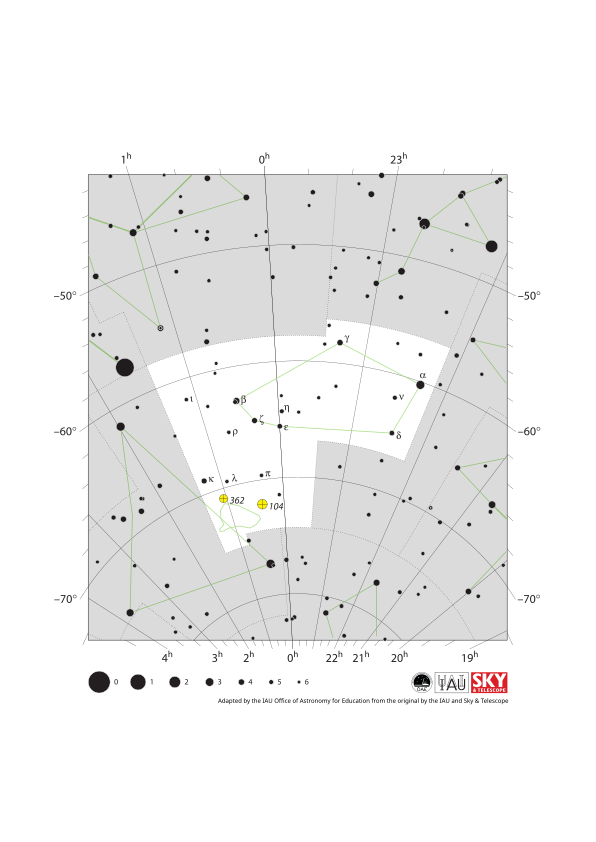
The Small Magellanic Cloud (SMC), a satellite galaxy of the Milky Way lies in Tucana with a small part spilling over into the neighbouring constellation of Hydrus. The SMC is marked here with a green loop in the south east of Tucana. The globular clusters NGC 104, also known as 47 Tucanae or 47 Tuc, and NGC 362 lie in Tucana and are marked here with yellow circles with plus signs superimposed on them. While these two clusters appear close to the SMC on the sky, they are both significantly closer than that satellite galaxy.
The y-axis of this diagram is in degrees of declination with north as up and the x-axis is in hours of right ascension with east to the left. The sizes of the stars marked here relate to the star's apparent magnitude, a measure of its apparent brightness. The larger dots represent brighter stars. The Greek letters mark the brightest stars in the constellation. These are ranked by brightness with the brightest star being labeled alpha, the second brightest beta, etc., although this ordering is not always followed exactly. The dotted boundary lines mark the IAU's boundaries of the constellations and the solid green lines mark one of the common forms used to represent the figures of the constellations. Neither the constellation boundaries, nor the lines joining the stars appear on the sky.
Crédito del diagrama Adapted by the IAU Office of Astronomy for Education from the original by the IAU and Sky & Telescope. Enlace del crédito
Estado de la traducción del diagrama: Aún no ha sido aprobado por un revisor o revisora
Licencia del diagrama: Creative Commons Reconocimiento 4.0 Internacional (CC BY 4.0) Creative Commons Reconocimiento 4.0 Internacional (CC BY 4.0) íconos
Términos relacionados del glosario:
Ascensión recta (AR)
, Constelación
, Coordenadas celestes
, Cúmulo globular
, Declinación
, Magnitud Aparente
, Pequeña Nube de Magallanes (SMC)
Categorías:
Astronomía a simple vista
¿Quieres hacer tu propia traducción o versión de este diagrama? Entonces
descarga la versión SVG
de este diagrama en inglés (356.45 kB). Puedes editarla utilizando
programas como Inkscape (gratuito) o Adobe Illustrator
(de pago). Solo recuerda citar al autor del original de forma adecuada.
También puedes crear tu propia versión o traducción de este diagrama añadiendotexto a una versión de
este diagrama sin texto. Solo tienes que descargar uno de los siguientes archivos:
Descargar archivo sin texto( imagen 107.93 kB)
Descargar archivo PDF sin texto (Archivo PDF 148.95 kB)
En otros idiomas
Inglés: Tucana Constellation MapItaliano: Mappa della Costellazione del Tucano
Alemán: Tukan-Sternkarte
Los pies de foto de los diagramas que aparecen en la página web de la OAE fueron redactados, traducidos y revisados gracias al esfuerzo colectivo de la OAE, los Centros y Nodos de la OAE, los Coordinadores Nacionales de Education Astronómica (NAECs) de la OAE y otros voluntarios. Una lista completa de créditos para nuestro proyecto de traducción puede encontrarse aquí. Todos los pies de foto de los archivos multimedia se publican bajo una licencia Creative Commons CC BY-4.0 license y deben atribuirse a la "IAU OAE" como fuente. Los propios archivos multimedia pueden tener diferentes licencias (véase más arriba) y deben citarse tal y como se indica más arriba en "credit".
Si detectas algún error en este diagrama o en su pie de foto, por favor get contáctanos.