This page describes an image Annual Parallax
Descargar archivo ( imagen 1.43 MB)
Descargar archivo PDF (PDF file 248.89 kB)
Also available in black and white
Descargar archivo ( imagen 1.43 MB)
Descargar archivo PDF (PDF file 248.89 kB)
Pie de foto del diagrama:
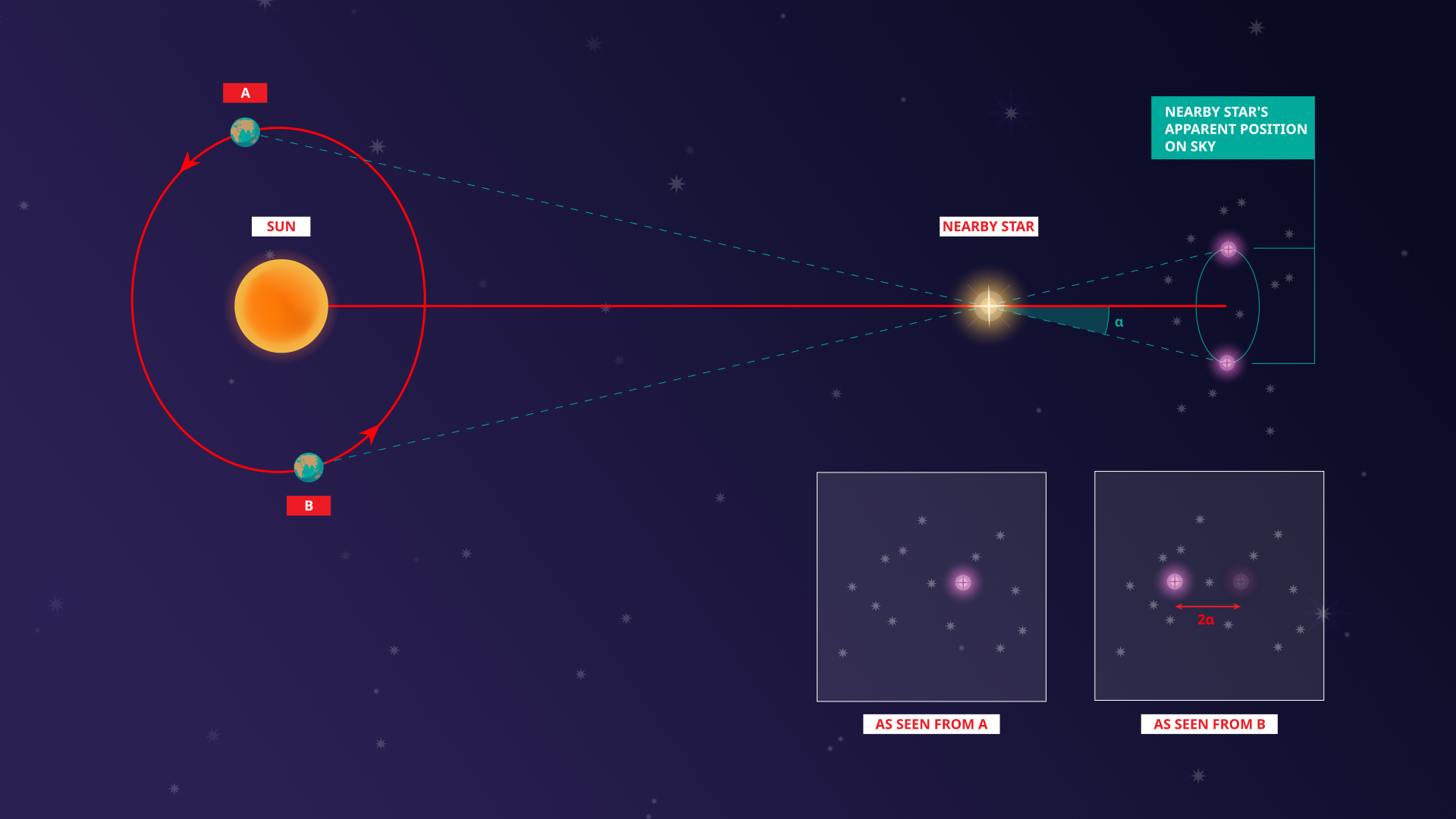
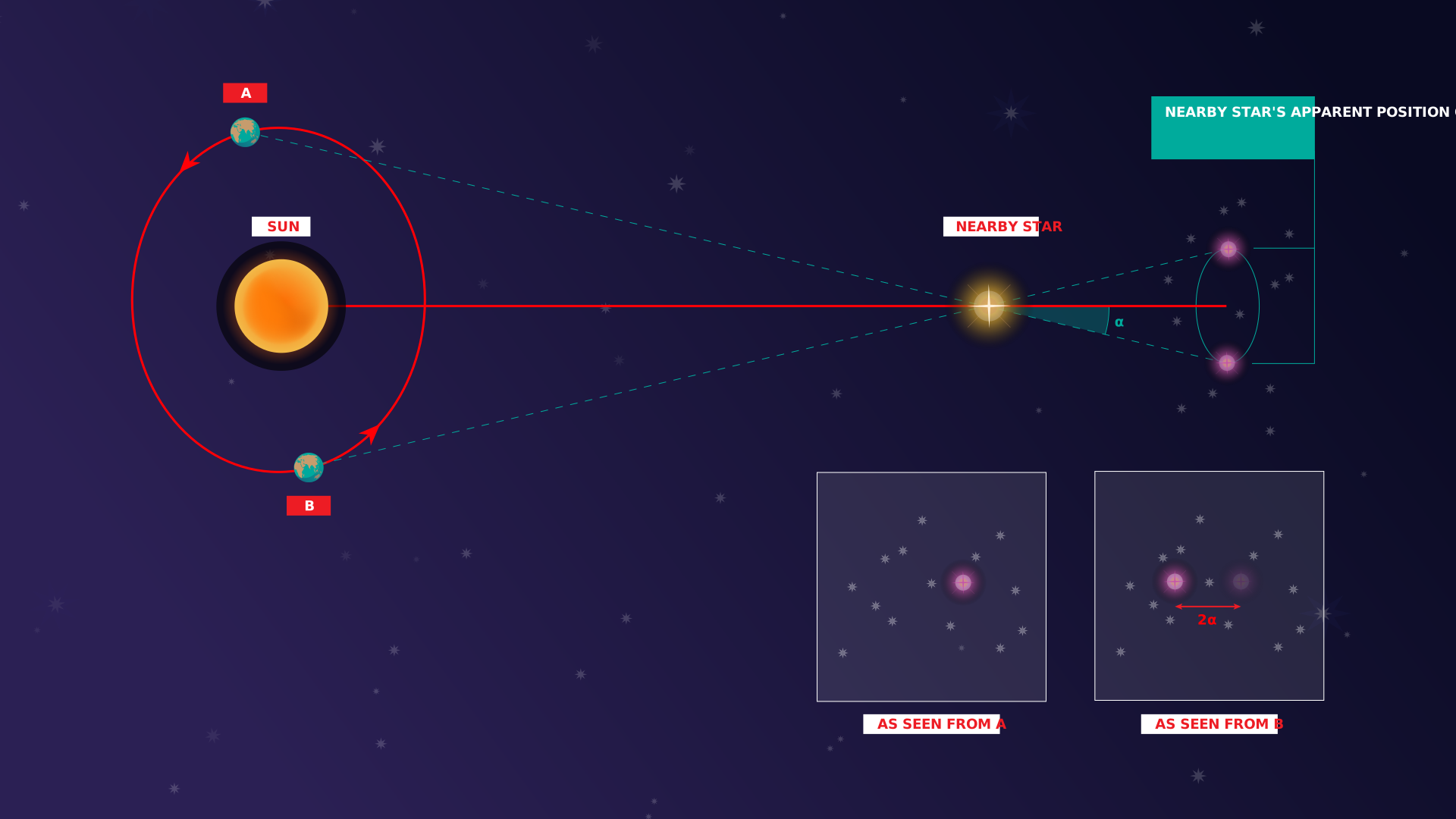
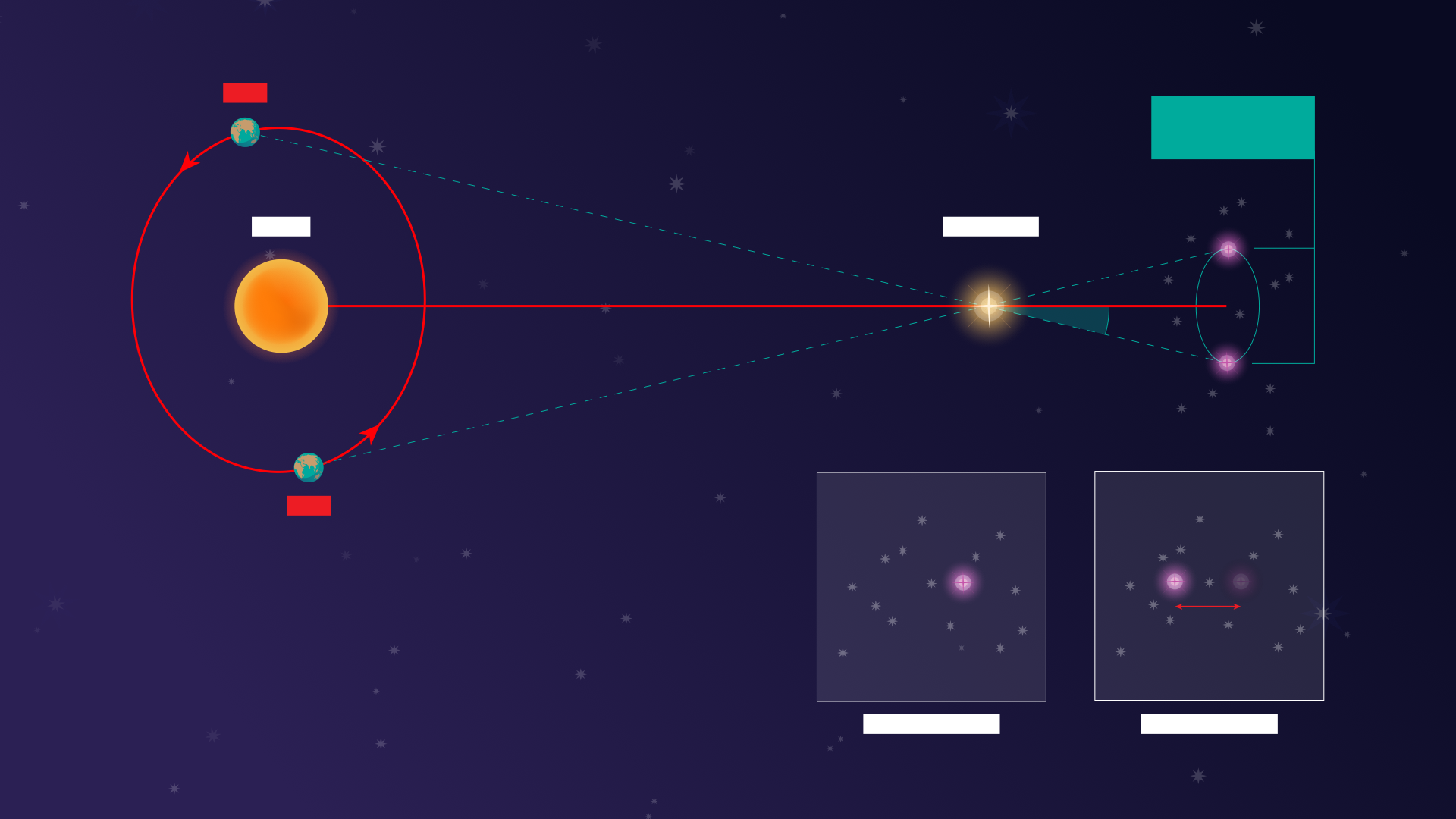
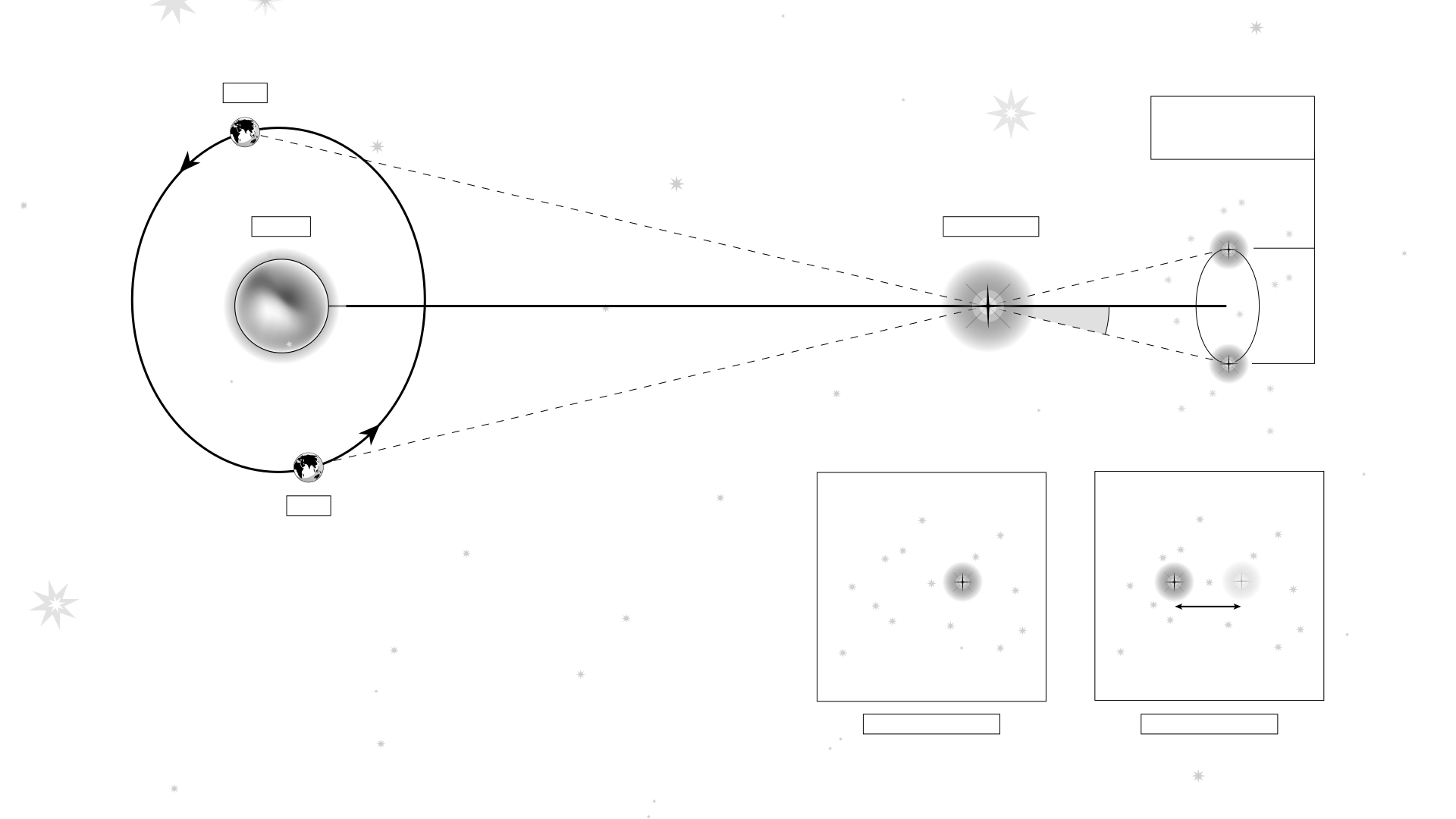
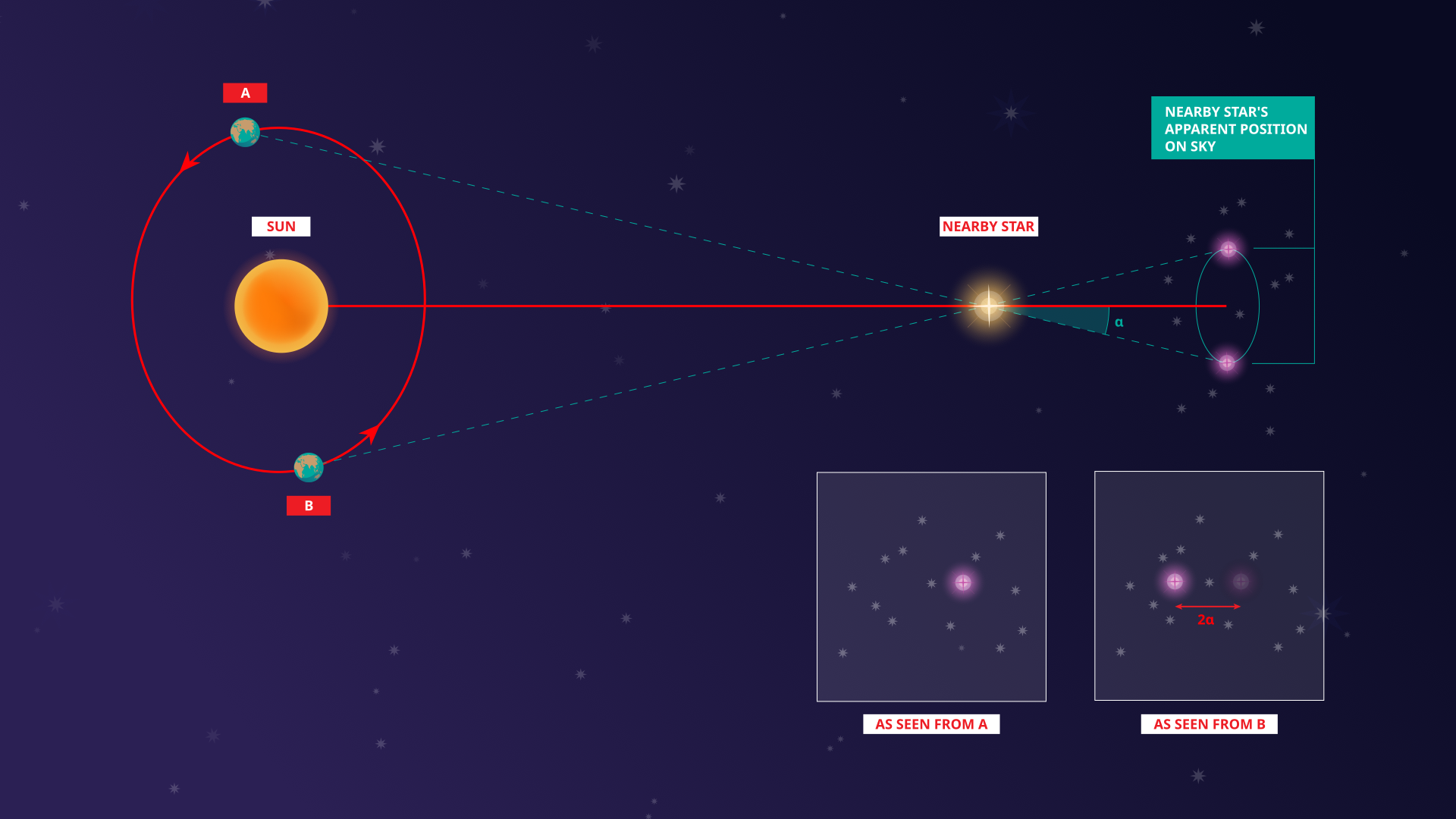
Distance determination has historically been a challenge for astronomy. One of the primary ways to measure distance is to use annual parallax. The Earth orbits around the Sun over the course of a year meaning that it moves from one side of the Sun (shown here as position A) to the other side of the Sun (position B) over the course of six months. It then moves back to its original position over the remaining six months. This movement subtly changes the perspective an observer on Earth sees the night sky from. This is similar to the change in viewing perspective you may get when viewing a scene from your left eye and then your right eye. The change of viewing perspective causes nearby objects to shift in position in your vision. The annual motion of the Earth around the Sun changes the perspective of the observer enough to shift the observed positions of celestial objects. How big this effect is depends on the distance to the celestial object. Nearby stars will have bigger shifts in observed position than more distant stars.
The positional shift is known as the trigonometric or annual parallax (which we will call α here) and is defined as the shift in position of a star compared to what an observer at the center of the Solar System (the Sun) would see. In this diagram we see the star viewed from perspectives six months apart (positions A and B). When observed from position A the star’s shift in position will be α while when observed at position B it will be –α. Thus the relative difference in the stars position between being observed at position A and position B will be 2α.
The size of the trigonometric or annual parallax in arcseconds is approximately 1 divided by the distance in parsecs. An arcsecond (often represented by a ″ symbol) is the angular diameter a one-metre-long stick would have when viewed from 206 km away. A parsec (often abbreviated to pc) is 3.26 light years or 30.86 trillion kilometres. This is 206,265 astronomical units (the typical distance between the Earth and the Sun). No other star is closer than 1 pc to the Sun so all stars in the sky have trigonometric parallaxes less than one arcsecond.
While trigonometric parallaxes have long been used to measure the distances to objects in our Solar System or nearby stars, recent advances have pushed the boundaries of these distance measures further. The Gaia satellite has pushed the boundaries of parallax measurements to over a thousand parsecs. Arrays of radio telescopes can also very accurately measure the positions of very distant objects and thus their trigonometric parallax.
Note the Earth and Sun are not to scale here and the Earth’s axial tilt is not accurately represented.
Crédito del diagrama Aneta Margraf/IAU OAE.
Estado de la traducción del diagrama: Aún no ha sido aprobado por un revisor o revisora
Licencia del diagrama: Creative Commons Reconocimiento 4.0 Internacional (CC BY 4.0) Creative Commons Reconocimiento 4.0 Internacional (CC BY 4.0) íconos
Términos relacionados del glosario:
Diámetro Angular
, Paralaje
, Paralaje anual
, Unidad Astronómica
Categorías:
Astronomía observacional
¿Quieres hacer tu propia traducción o versión de este diagrama? Entonces
descarga la versión SVG
de este diagrama en inglés (189.90 kB). Puedes editarla utilizando
programas como Inkscape (gratuito) o Adobe Illustrator
(de pago). Solo recuerda citar al autor del original de forma adecuada.
Also available in black and white ( imagen 189.90 kB).
También puedes crear tu propia versión o traducción de este diagrama añadiendotexto a una versión de
este diagrama sin texto. Solo tienes que descargar uno de los siguientes archivos:
Descargar archivo sin texto( imagen 1.40 MB)
Descargar archivo PDF sin texto (Archivo PDF 244.27 kB)
Also available in black and white:
Descargar archivo sin texto ( imagen 167.00 kB)
Descargar archivo PDF sin texto (PDF file 275.50 kB)
Los pies de foto de los diagramas que aparecen en la página web de la OAE fueron redactados, traducidos y revisados gracias al esfuerzo colectivo de la OAE, los Centros y Nodos de la OAE, los Coordinadores Nacionales de Education Astronómica (NAECs) de la OAE y otros voluntarios. Una lista completa de créditos para nuestro proyecto de traducción puede encontrarse aquí. Todos los pies de foto de los archivos multimedia se publican bajo una licencia Creative Commons CC BY-4.0 license y deben atribuirse a la "IAU OAE" como fuente. Los propios archivos multimedia pueden tener diferentes licencias (véase más arriba) y deben citarse tal y como se indica más arriba en "credit".
Si detectas algún error en este diagrama o en su pie de foto, por favor get contáctanos.