This page describes an image Annual Parallax
Baixar arquivo ( imagem 1.43 MB)
Baixar arquivo PDF (PDF file 248.89 kB)
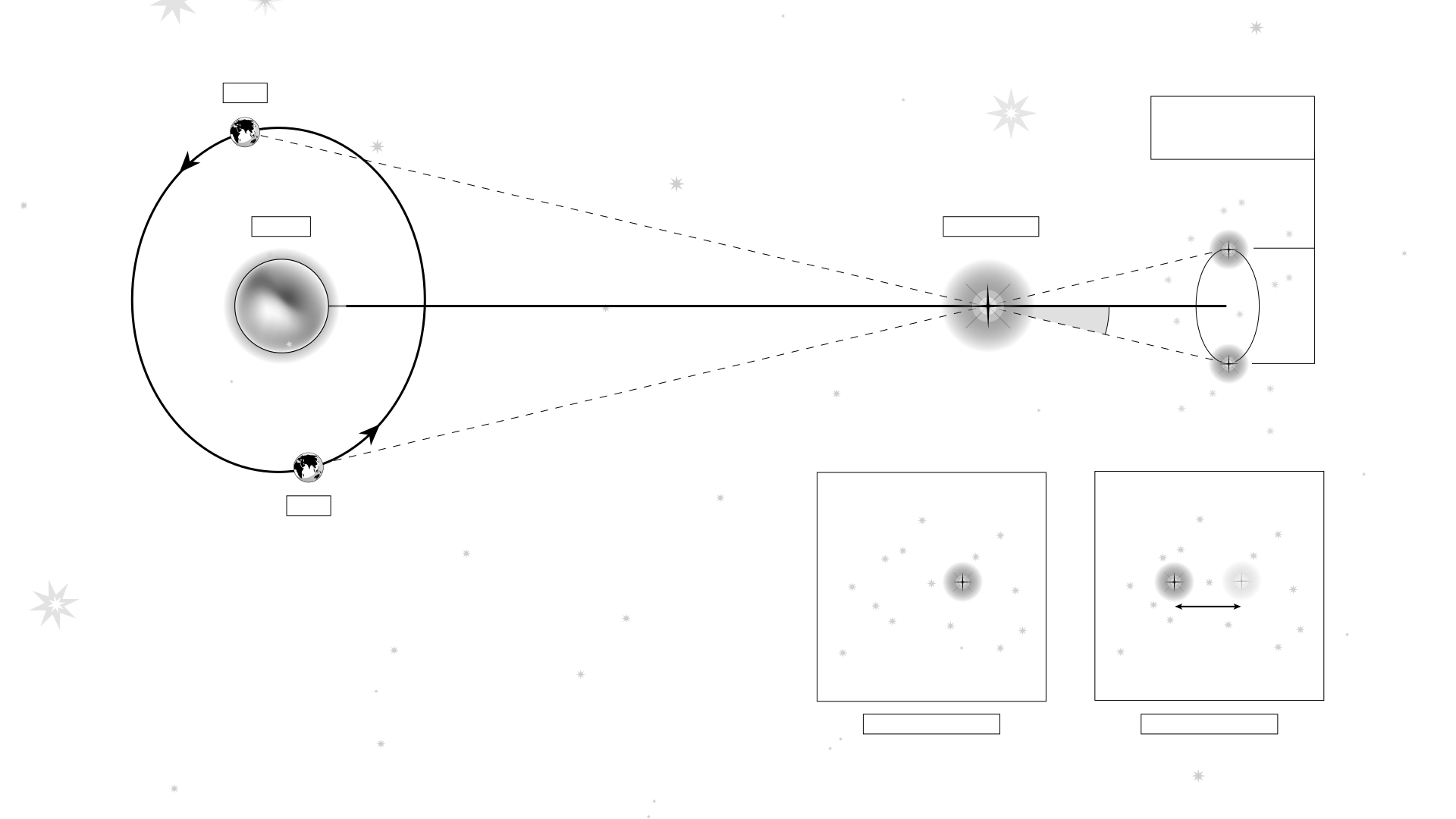
Also available in black and white
Baixar arquivo ( imagem 1.43 MB)
Baixar arquivo PDF (PDF file 248.89 kB)
Legenda do diagrama:
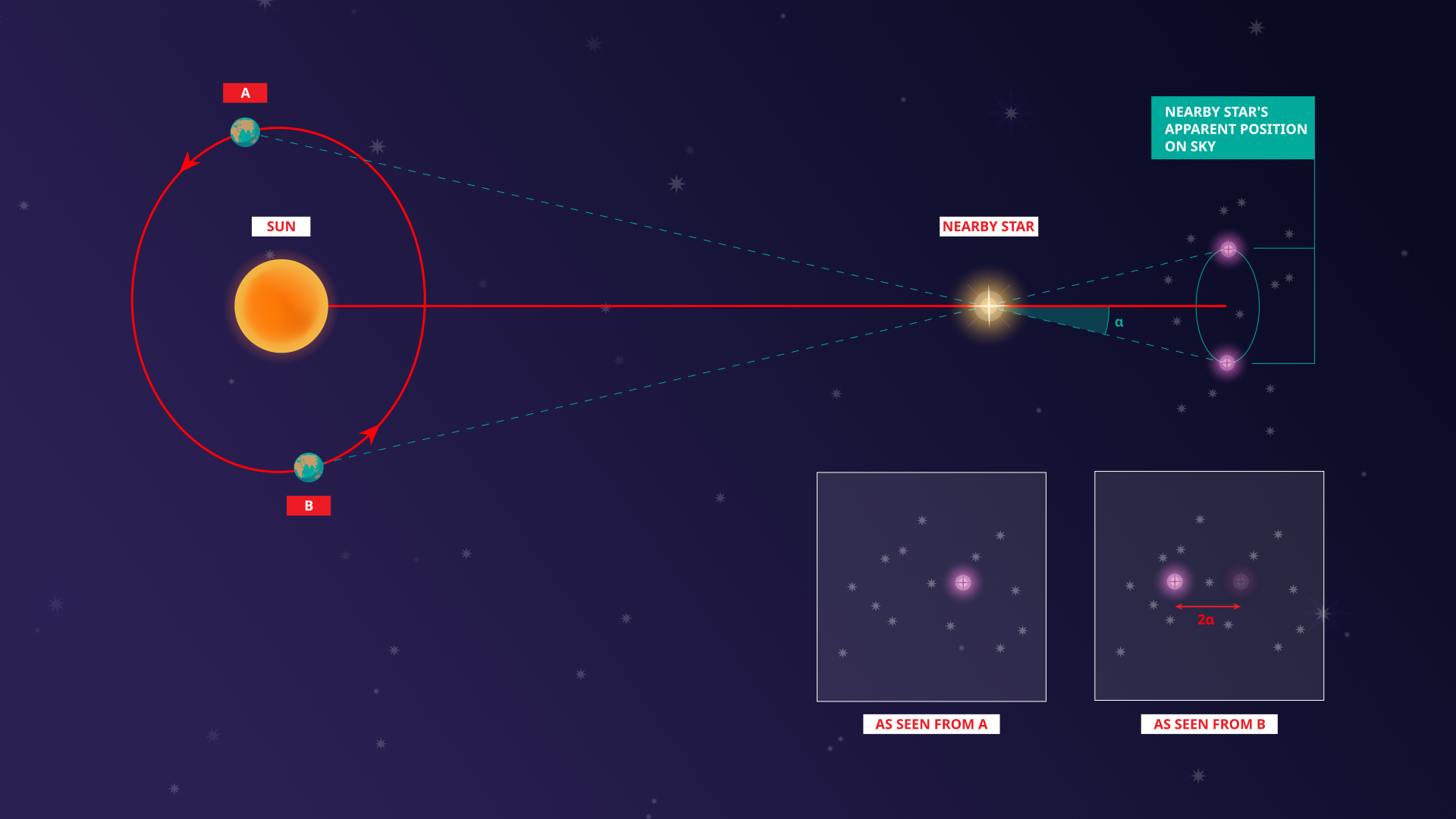
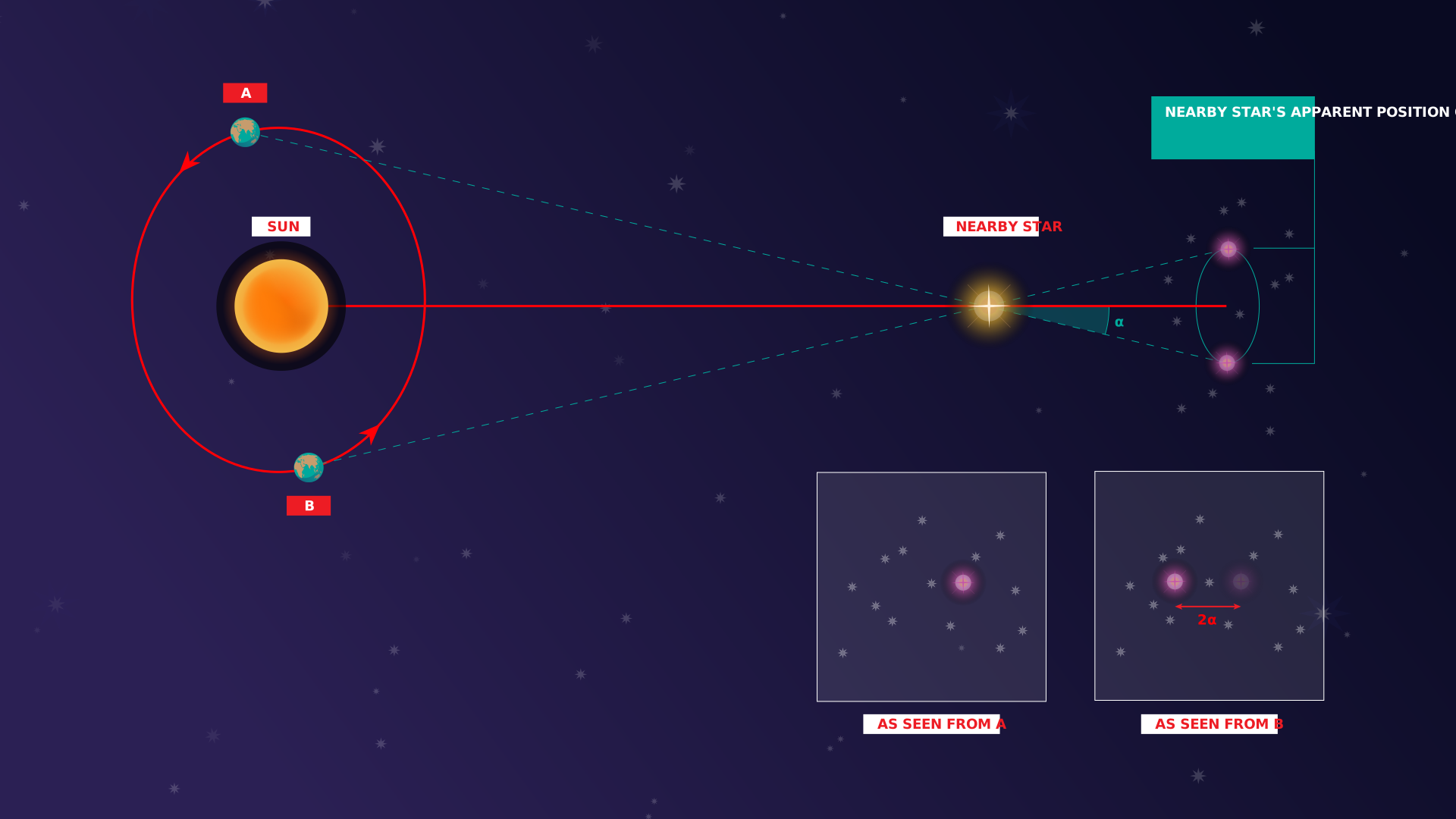
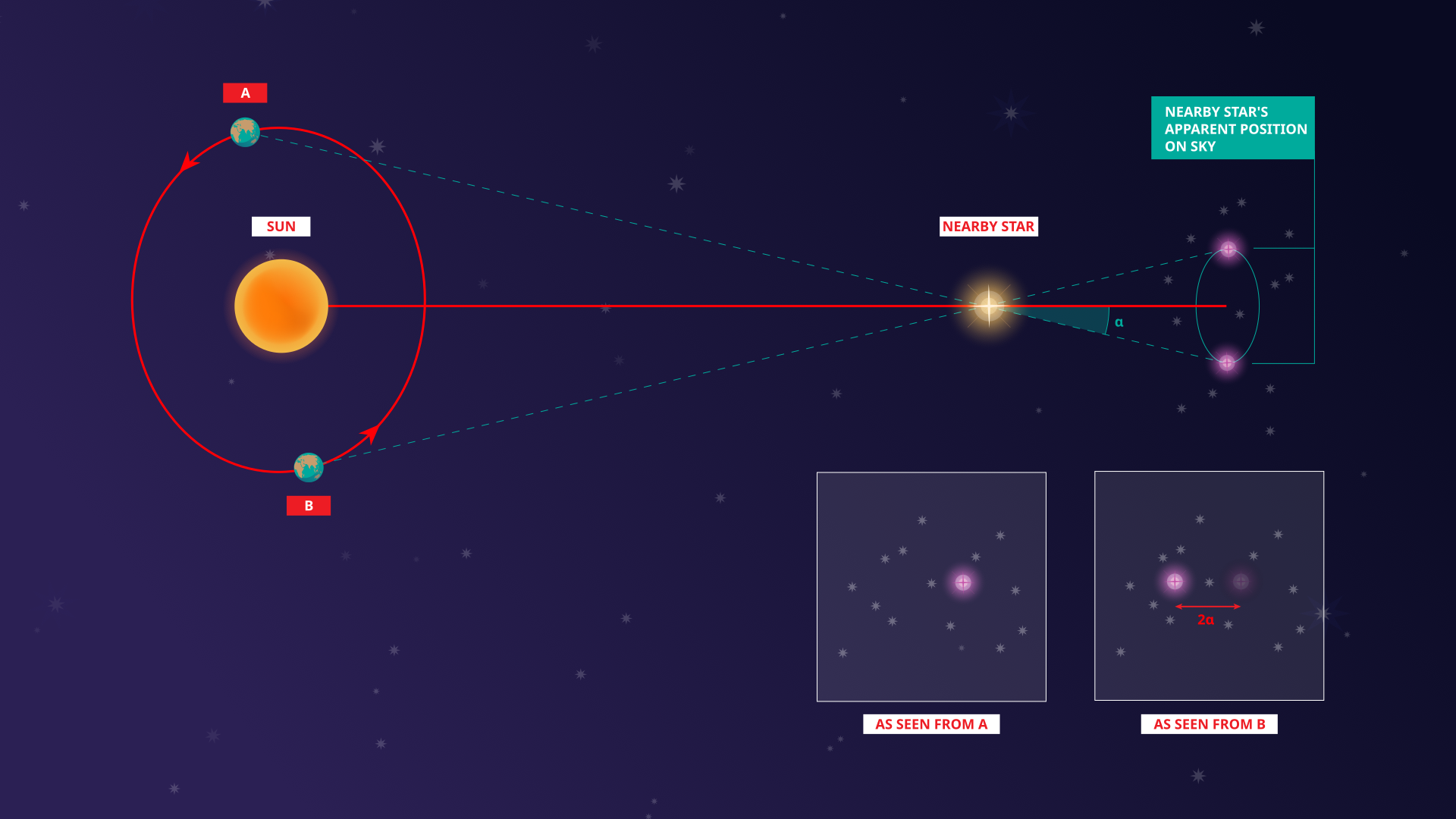
Distance determination has historically been a challenge for astronomy. One of the primary ways to measure distance is to use annual parallax. The Earth orbits around the Sun over the course of a year meaning that it moves from one side of the Sun (shown here as position A) to the other side of the Sun (position B) over the course of six months. It then moves back to its original position over the remaining six months. This movement subtly changes the perspective an observer on Earth sees the night sky from. This is similar to the change in viewing perspective you may get when viewing a scene from your left eye and then your right eye. The change of viewing perspective causes nearby objects to shift in position in your vision. The annual motion of the Earth around the Sun changes the perspective of the observer enough to shift the observed positions of celestial objects. How big this effect is depends on the distance to the celestial object. Nearby stars will have bigger shifts in observed position than more distant stars.
The positional shift is known as the trigonometric or annual parallax (which we will call α here) and is defined as the shift in position of a star compared to what an observer at the center of the Solar System (the Sun) would see. In this diagram we see the star viewed from perspectives six months apart (positions A and B). When observed from position A the star’s shift in position will be α while when observed at position B it will be –α. Thus the relative difference in the stars position between being observed at position A and position B will be 2α.
The size of the trigonometric or annual parallax in arcseconds is approximately 1 divided by the distance in parsecs. An arcsecond (often represented by a ″ symbol) is the angular diameter a one-metre-long stick would have when viewed from 206 km away. A parsec (often abbreviated to pc) is 3.26 light years or 30.86 trillion kilometres. This is 206,265 astronomical units (the typical distance between the Earth and the Sun). No other star is closer than 1 pc to the Sun so all stars in the sky have trigonometric parallaxes less than one arcsecond.
While trigonometric parallaxes have long been used to measure the distances to objects in our Solar System or nearby stars, recent advances have pushed the boundaries of these distance measures further. The Gaia satellite has pushed the boundaries of parallax measurements to over a thousand parsecs. Arrays of radio telescopes can also very accurately measure the positions of very distant objects and thus their trigonometric parallax.
Note the Earth and Sun are not to scale here and the Earth’s axial tilt is not accurately represented.
Crédito do diagrama: Aneta Margraf/IAU OAE.
Status da tradução dos diagramas: Ainda não aprovado por um revisor
Licença do diagrama: Creative Commons Atribuição 4.0 Internacional (CC BY 4.0) Creative Commons Atribuição 4.0 Internacional (CC BY 4.0) ícones
Termos relacionados do glossário:
Diâmetro angular
, Paralaxe
, Paralaxe Anual
, Unidade astronômica
Categorias
Astronomia Observacional
Quer criar sua própria tradução ou versão deste diagrama? Então
baixe a versão SVG
deste diagrama em inglês (189.90 kB). Você pode editá-la usando
programas como o Inkscape (gratuito) ou o Adobe Illustrator
(proprietário). Apenas lembre-se de creditar adequadamente o autor do original.
Also available in black and white ( imagem 189.90 kB).
Você também pode criar sua própria versão ou tradução deste diagrama adicionando texto a uma versão
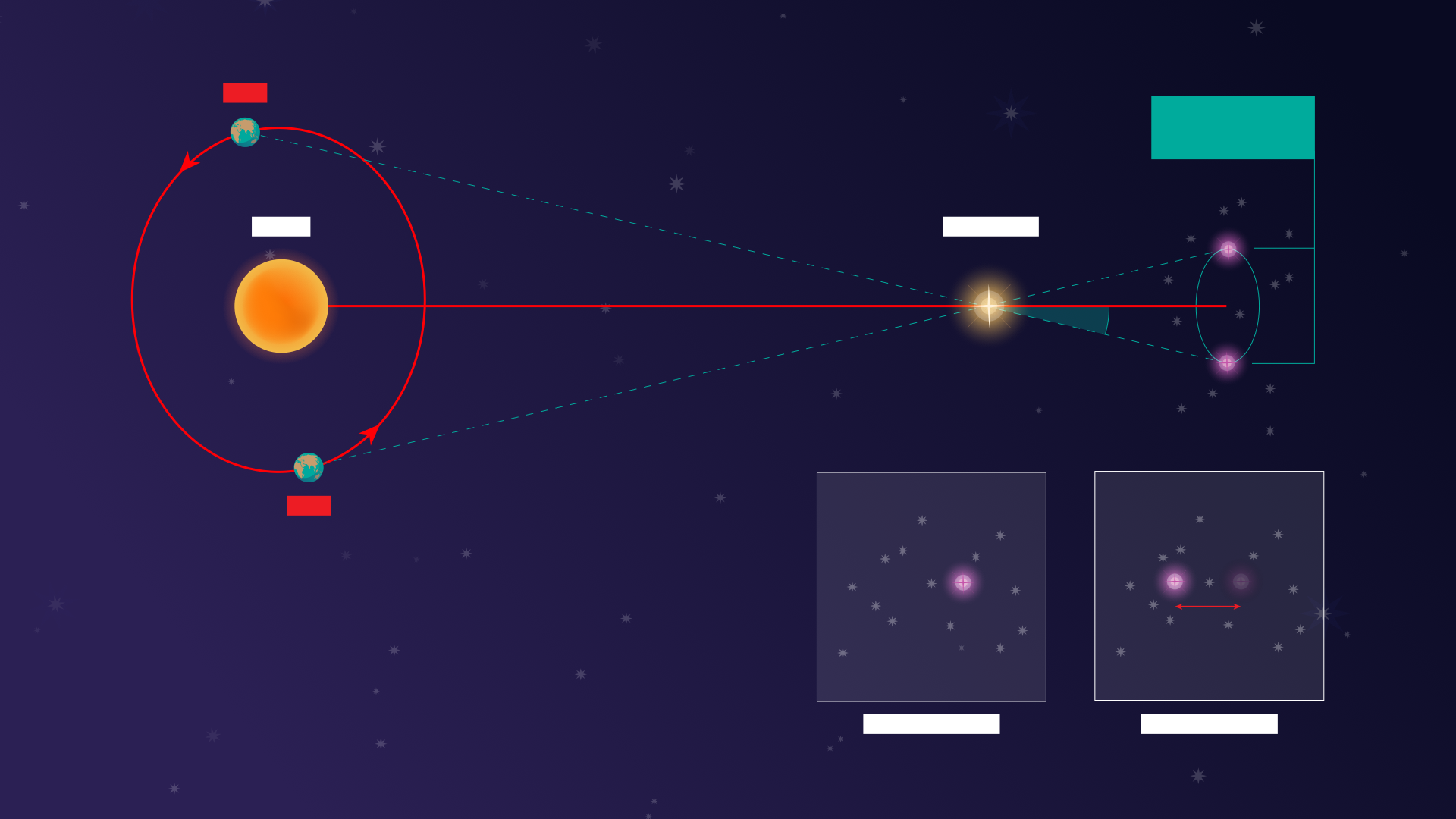
deste diagrama sem texto. Basta baixar um dos arquivos abaixo:
Baixar arquivo sem texto ( imagem 1.40 MB)
Baixar arquivo PDF sem texto (arquivo PDF 244.27 kB)
Also available in black and white:
Baixar arquivo sem texto ( imagem 167.00 kB)
Baixar arquivo PDF sem texto (arquivo PDF 275.50 kB)
As legendas dos diagramas apresentadas no site da OAE foram escritas, traduzidas e revisadas por meio de um esforço coletivo da OAE, dos Centros e Nós da OAE, dos Coordenadores Nacionais de Educação em Astronomia (NAECs) da OAE e de outros voluntários. Você pode encontrar a lista completa de créditos do nosso projeto de tradução aqui. Todas as legendas de arquivos de mídia são publicadas sob uma licença Creative Commons CC BY-4.0 e devem ser creditadas à "IAU OAE". Os próprios arquivos de mídia podem ter licenças diferentes (veja acima) e devem ser creditados conforme indicado acima em "crédito".
Se você notar algum erro neste diagrama ou em sua legenda, por favor entre em contato.