Término del glosario: Planeta terrestre
Descripción: Un planeta terrestre es aquel compuesto principalmente por materiales como la roca y el hierro. Los planetas terrestres carecen de la atmósfera densa de hidrógeno y helio que se encuentra en los planetas gigantes gaseosos; en su lugar, tienen atmósferas mucho más finas o carecen por completo de atmósfera. Los planetas terrestres suelen tener masas menores que los planetas gigantes y son de menor tamaño.
En el Sistema Solar, los planetas terrestres son Mercurio, Venus, la Tierra y Marte.
Uno de los principales objetivos de la astronomía de exoplanetas ha sido la búsqueda de planetas terrestres de tamaño y composición similares a los de la Tierra que se encuentren en la zona habitable de su estrella.
Términos relacionados:
- Atmósfera
- Tierra
- Exoplaneta
- Planeta gigante
- Zona habitable
- Marte
- Mercurio
- Planeta
- Sistema Solar
- Venus
Ver este término en otros idiomas
Estado del término y la definición: La definición original de este término en inglés ha sido aprobada por unastrónomo o astrónoma investigadora y un docente La traducción de este término y su definición aún están pendientes de aprobación
El Glosario multilingüe de la OAE es un proyecto de la Oficina de Astronomía para la Educación de la UAI (OAE) en colaboración con la Oficina de Divulgación de Astronomía de la UAI (OAO). Los términos y definiciones fueron seleccionados, redactados y revisados gracias al esfuerzo colectivo de la OAE, los Centros y Nodos de la OAE, los Coordinadores Nacionales de Educación Astronómica (NAECs) y otros voluntarios. Puedes encontrar una lista completa de créditos aquí. Todos los términos del glosario y sus definiciones se publican bajo la licencia Creative Commons CC BY-4.0 y deben atribuirse a la "IAU OAE".
Si detectas algún error de contenido o de traducción en este término del glosario o en ladefinición, ponte en contacto con nosotros.
En otros idiomas
- Árabe: كوكب أرضي
- Bengalí: শিলাময় গ্রহ
- Alemán: Gesteinsplanet
- Inglés: Terrestrial Planet
- Francés: Planète tellurique
- Italiano: Pianeta terrestre
- Japonés: 地球型惑星 (enlace externo)
- Portugués de Brasil: Planeta terrestre
- Chino simplificado: 类地行星
- Chino tradicional: 類地行星
Contenidos relacionados
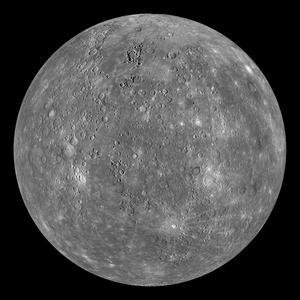
Mercury
Pie de foto: This image is a composite of a picture mosaic of the planet Mercury's surface obtained by the MESSENGER (Mercury Surface, Space Environment, Geochemistry and Ranging) space probe. MESSENGER was launched by NASA in 2004 and explored Mercury from 2011 to 2015.
Crédito: NASA/Johns Hopkins University Applied Physics Laboratory/Carnegie Institution of Washington
enlace de crédito
License: PD Dominio público íconos
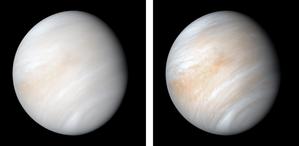
Venus in visible light
Pie de foto: This picture taken by NASA's Mariner 10 probe shows what the planet Venus looks like when looking at it with naked eyes. Venus is enshrouded inside a thick cloudy atmosphere dominated by carbon dioxide, never revealing its hot surface.
Crédito: NASA/JPL-Caltech
enlace de crédito
License: PD Dominio público íconos
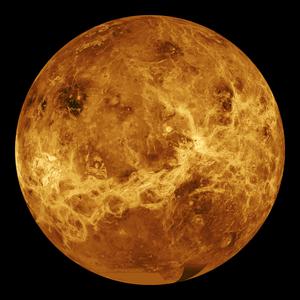
Venus' surface
Pie de foto: This image is a computer-aided rendering of the surface of the planet Venus. Since visual light cannot penetrate the thick clouds in Venus' atmosphere, the image was obtained with radio waves. NASA's space probe Megallan, launched in 1989 mapped Venus' surface between 1990 and 1994.
Crédito: NASA/JPL
enlace de crédito
License: PD Dominio público íconos
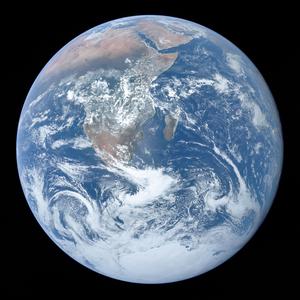
Earth as observed from Apollo 17
Pie de foto: Full disk view of the Earth taken on 7 December 1972, by the crew of the Apollo 17 spacecraft en route to the Moon at a distance of about 29,000 kilometres (18,000 mi). It shows Africa, Antarctica, and the Arabian Peninsula.
Crédito: NASA/Apollo 17 crew/Project Apollo Archive
License: PD Dominio público íconos
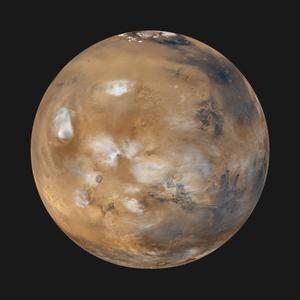
Mars
Pie de foto: This image of the planet Mars taken by NASA's Mars Global Surveyor Orbiter in 1999 shows its dry surface. The picture features the most spectacular geological regions on Mars. Besides the deep Valles Marineris valley we see four volcanoes. While three of them form the Tharsis ridge, the Olympus Mons is largest volcano we have so far discovered in the Solar System. Ice clouds cover parts of the Martian surface.
Crédito: NASA/JPL/MSSS
enlace de crédito
License: PD Dominio público íconos