Término del glosario: Mercurio
Descripción: Mercurio es el planeta más cercano al Sol y el más pequeño de los ocho planetas principales del Sistema Solar. Es un planeta rocoso y terrestre con un radio de unos 2500 kilómetros (km), lo que lo hace ligeramente más grande que la Luna de la Tierra. Tiene una masa equivalente a 0.055 veces la de la Tierra. Debido a su proximidad, el Sol es siete veces más brillante visto desde Mercurio, y la superficie de Mercurio se ve muy afectada por el viento solar. Su muy delgada exosfera está compuesta por material producido por esta interacción, además de materia expulsada de la superficie debido a la frecuente caída de objetos. La delgada atmósfera no puede mantener la temperatura del planeta, por lo que la superficie es extremadamente fría (-180 grados Celsius) durante la noche y extremadamente caliente (400 grados Celsius) durante el día, y por lo tanto muy seca.
Su distancia típica al Sol es de unos 58 millones de km, aproximadamente 0.39 unidades astronómicas (distancia Tierra-Sol), tardando poco menos de 88 días en completar una órbita. No se conoce ninguna luna que orbite alrededor de Mercurio.
Dado que Mercurio orbita alrededor del Sol más cerca que la Tierra, siempre aparece cerca del Sol en el cielo. Mercurio recibe su nombre del veloz dios mensajero romano, debido a su rápido movimiento a través del cielo. Dos sondas espaciales (Mariner 10 y MESSENGER) han visitado Mercurio, y está previsto que la misión BepiColombo llegue a mediados de la década de 2020.
Términos relacionados:
Ver este término en otros idiomas
Estado del término y la definición: La definición original de este término en inglés ha sido aprobada por unastrónomo o astrónoma investigadora y un docente La traducción de este término y su definición aún están pendientes de aprobación
El Glosario multilingüe de la OAE es un proyecto de la Oficina de Astronomía para la Educación de la UAI (OAE) en colaboración con la Oficina de Divulgación de Astronomía de la UAI (OAO). Los términos y definiciones fueron seleccionados, redactados y revisados gracias al esfuerzo colectivo de la OAE, los Centros y Nodos de la OAE, los Coordinadores Nacionales de Educación Astronómica (NAECs) y otros voluntarios. Puedes encontrar una lista completa de créditos aquí. Todos los términos del glosario y sus definiciones se publican bajo la licencia Creative Commons CC BY-4.0 y deben atribuirse a la "IAU OAE".
Si detectas algún error de contenido o de traducción en este término del glosario o en ladefinición, ponte en contacto con nosotros.
Contenidos relacionados
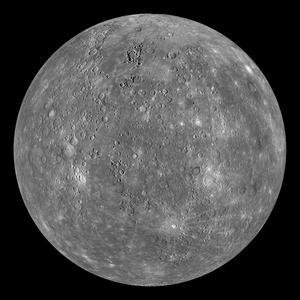
Mercury
Pie de foto: This image is a composite of a picture mosaic of the planet Mercury's surface obtained by the MESSENGER (Mercury Surface, Space Environment, Geochemistry and Ranging) space probe. MESSENGER was launched by NASA in 2004 and explored Mercury from 2011 to 2015.
Crédito: NASA/Johns Hopkins University Applied Physics Laboratory/Carnegie Institution of Washington
enlace de crédito
License: PD Dominio público íconos
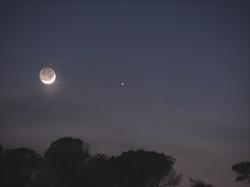
Moon-Mercury-Pleiades Conjunction
Pie de foto: Honourable mention in the 2022 IAU OAE Astrophotography Contest, category Still images of celestial patterns.
This photograph shows the young lunar crescent, some of the nine brightest stars of the Pleiades (with one behind a cloud) on the right, and the planet Mercury, looking slightly red, in the middle of the image.
This picture is rather suggestive of the idea that the Pleiades might possibly consist of seven stars. However, the viewer is misled by the clouds; five of the stars form a tiny chariot, one is next to the handle, and three are at the other end of the quadrilateral. Eight stars would be clearly visible if there were no clouds.
This configuration of the young Moon next to the Pleiades is visible only in the northern hemisphere spring. Thus it was used by the ancient Babylonians to determine the second month of their year and to judge whether or not an intercalary month was necessary. At least as early as the second millennium before the common era, the Babylonians used several asterisms for each month, with another one of them reappearing every five days after invisibility during daylight. To determine the necessity of intercalation in order to synchronise the solar and the lunar year, the Babylonians used several asterisms, not only the Pleiades. For instance, they also made use of the bright stars Arcturus and Sirius, and they observed a configuration with the Moon as well as heliacal phenomena. The modern Jewish and modern Islamic traditions still make use of some of the Babylonian astronomical rules. However, given that the constellations have shifted as a result of precession, and the fact that nowadays we also have computational means to calculate our calendars, this configuration of the small crescent Moon and the Pleiades is less useful, though it remains exceptionally beautiful. Thus the ancient Babylonian and middle Babylonian tradition survives only rudimentarily. Furthermore, it is unlikely that it is depicted in the Nebra Disc from Bronze Age Europe, as has long been claimed.
This image was taken on Elba Island, Italy, in May 2022.
Crédito: Giulio Colombo/ IAU OAE
License: CC-BY-4.0 Creative Commons Reconocimiento 4.0 Internacional (CC BY 4.0) íconos
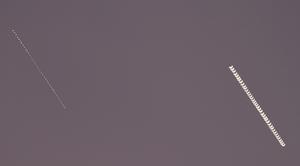
Venus and Mercury Trails
Pie de foto: Honorable mention in the 2023 IAU OAE Astrophotography Contest, category of Still images of phases of Venus.
In this composite image, both Mercury (left) and Venus (right) can be seen heading into the sunset. The phases of each are beautifully captured as they descend. Not all planets or moons in the Solar System show phases as viewed from Earth. This phenomenon occurs because the orbits of Venus and Mercury are positioned between Earth’s orbit and the Sun, sometimes allowing us to see only part of the illuminated portion of each planet. These phases are similar to the phases we see of our own Moon.
Crédito: Marcella Giulia Pace (CC BY 4.0)
License: CC-BY-4.0 Creative Commons Reconocimiento 4.0 Internacional (CC BY 4.0) íconos
Actividades relacionadas

Meet our neighbours: Mercury
astroEDU educational activity (links to astroEDU website) Description: Let's explore Mercury with a tactile, low-cost version!
License: CC-BY-4.0 Creative Commons Reconocimiento 4.0 Internacional (CC BY 4.0) íconos
Rango de edades:
6-8
, 8-10
, 10-12
Nivel educativo:
Primaria
Áreas de aprendizaje:
Actividad lúdica
, Modelización
Duración:
1 hora
Tamaño del grupo:
Grupo
Competencias:
Analizar e interpretar datos
, Desarrollar y utilizar modelos