This page describes an image Pisces Constellation Map
Télécharger le fichier ( image 116.67 kB)
Télécharger le fichier PDF (PDF file 209.48 kB)
Légende du diagramme :
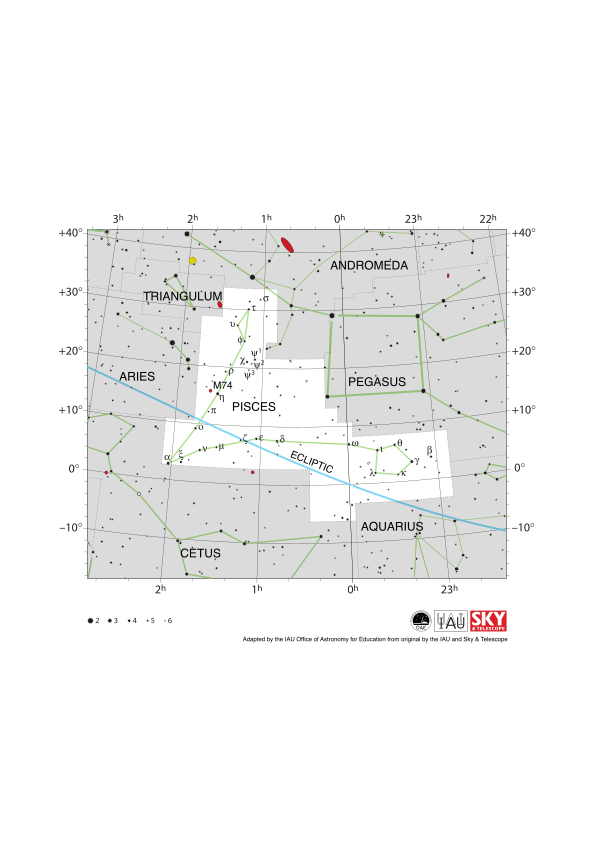
The constellation Pisces along with its bright stars and surrounding constellations. Pisces is surrounded by (going clockwise from the top) Andromeda, Pegasus, Aquarius, Cetus, Aries and Triangulum. Pisces lies on the ecliptic (shown here as a blue line), this is the path the Sun appears to take across the sky over the course of a year. The Sun is in Pisces from mid March to mid April. Thus the Sun is in Pisces at the March equinox. At this point the ecliptic crosses the celestial equator. The Sun’s location at the spring equinox is used to set the zero point of the Right Ascension positional coordinate. The other planets of the Solar System can often be found in Pisces.
Pisces spans the celestial equator and is thus visible at some time in the year from all of planet Earth. In the most arctic or antarctic regions of the world, some parts of the constellation may not be visible. Pisces is most visible in the evenings in the northern hemisphere autumn and southern hemisphere spring
The grand design spiral galaxy M74 is marked on this diagram with a small red circle.
The y-axis of this diagram is in degrees of declination with north as up and the x-axis is in hours of right ascension with east to the left. The sizes of the stars marked here relate to the star's apparent magnitude, a measure of its apparent brightness. The larger dots represent brighter stars. The Greek letters mark the brightest stars in the constellation. These are ranked by brightness with the brightest star being labeled alpha, the second brightest beta, etc., although this ordering is not always followed exactly. The dotted boundary lines mark the IAU's boundaries of the constellations and the solid green lines mark one of the common forms used to represent the figures of the constellations. Neither the constellation boundaries, nor the line marking the ecliptic, nor the lines joining the stars appear on the sky.
Crédit du diagramme : Adapted by the IAU Office of Astronomy for Education from the original by IAU/Sky & Telescope. Lien du crédit
État de la traduction du diagramme: Pas encore approuvé par un·e relecteur(rice)
Licence du diagramme : Creative Commons (CC) Attribution 4.0 International (CC BY 4.0) Creative Commons (CC) Attribution 4.0 International (CC BY 4.0) Icônes
Termes du glossaire en rapport :
Andromède
, Ascension droite (AD)
, Bélier
, Constellation
, Coordonnées célestes
, Déclinaison
, Ecliptique
, Equinoxe
, Magnitude apparente
, Poissons
, Verseau
, Zodiaque
Catégories :
Astronomie à l'œil nu
Want to make your own translation or version of this diagram? Then
download the SVG
version of this diagram in English (691.81 kB). You can edit this using
software like Inkscape (free) or Adobe Illustrator
(proprietary). Just remember to credit the author of the original appropriately.
You can also make your own version or translation of this diagram by adding adding text to a version of
this diagram with no text. Just download one of the following files:
Download Text-Free File ( image 105.59 kB)
Download Text-Free PDF File (PDF file 187.43 kB)
Dans d'autres langues
Anglais: Pisces Constellation MapItalien: Mappa della Costellazione dei Pesci
Espagnol: Mapa de la constelación de Piscis
Chinois traditionnel: 雙魚座星圖
Chinois simplifié: 双鱼座星图
Népalais: मीन राशि तारामण्डलको नक्सा
Allemand: Karte des Sternbilds Fische
Les légendes des diagrammes sur le site de l'OAE ont été écrites, traduites et relues grâce à un effort collectif de l'OAE, les Centres et les Noeuds de l'OAE, les Coordinateurs Nationaux de l'Astronomie pour l'Education de l'OAE(NAECs) et d'autres volontaires. La liste complète des crédits pour ce projet est disponible ici . Toutes les légendes des fichiers média sont déposés sous licence Creative Commons CC BY-4.0 et doivent être créditées au nom de "IAU OAE". Les fichiers média eux-mêmes peuvent avoir des licences différentes (voir plus haut) et et doivent être crédités comme indiqué ci-dessus sous le terme "credit".
Si vous constatez une erreur dans ce diagramme ou sa légende, veuillez nous contacter .








- Ressources
- Moteur de recherche des ressources pédagogiques
- Parcourir les ressources pédagogiques par Sujet
- Parcourir les images
- AstroEdu - Activités en classe
- Grandes Idées - Littéracie en astronomie
- Glossaire
- Rapports de l'OAE
- L'astronomie pour l'Education à travers le monde
- Sélection de ressources externes