Terme du glossaire : La comète de Halley
Description : La comète de Halley est sans doute la plus célèbre des comètes, car c'est la seule comète à cycle court visible à l'œil nu depuis la Terre, avec une période suffisamment courte (environ 75 ans) pour que l'on puisse potentiellement la voir deux fois dans sa vie. La dernière visite de la comète a eu lieu en 1986, et on s'attend à ce qu'elle revienne en 2061. Elle doit son nom à l'astronome anglais Edmond Halley, qui a été le premier à calculer sa périodicité et à prédire sa prochaine visite. Halley a remarqué que les comètes apparues en 1531, 1607 et 1682 avaient toutes des orbites très similaires et qu'il s'agissait donc de visites de la même comète dans le Système solaire interne. Il a correctement prédit le retour de la comète en 1758.
La comète a été visitée par les missions spatiales Vega et Giotto. Celles-ci ont découvert que la poussière de la comète se compose principalement de silicates, de fer et de magnésium, ainsi que de composés carbone-hydrogène-oxygène-azote (CHON). Le noyau de la comète est principalement constitué de glace.
Termes associés :
Voir ce terme dans d'autres langues
Statut du terme et de sa définition : La définition initiale de ce terme en anglais a été aprouvée par un·e spécialiste de la recherche en astronomie et un·e spécialiste de l’éducation La traduction de ce terme et de sa définition n'ont pas encore été aprouvées
Le glossaire multilangue de l'OAE est un projet du Bureau de l'IAU de l'Astronomie pour l'Education (OAE) en collaboration avec le Bureau de l'IAU de diffusion de l'Astronomie (OAO). Les termes et définitions ont été choisis, écrits et relues grâce à un effort collectif de l'OAE, les Centres et les Noeuds de l'OAE, les Coordinateurs Nationaux de l'Astronomie pour l'Education de l'OAE(NAECs) et d'autres volontaires. La liste complète des crédits pour ce projet est disponible ici . Tous les termes du glossaire et leur définition sont déposés sous licence Creative Commons CC BY-4.0 et doivent être créditées au nom de "IAU OAE".
Si vous constatez une erreur dans ce terme ou sa définition, veuillez nous contacter .
Dans d'autres langues
- Arabe: مذنب هالي
- Allemand: Halleyscher Komet
- Anglais: Halley's Comet
- Espagnol: El Cometa Halley
- Italien: La cometa di Halley
- Japonais: ハレー彗星 (Liens externes)
- Portugais brésilien: Cometa Halley
- Chinois simplifié: 哈雷彗星
- Chinois traditionnel: 哈雷彗星
Media associé

Halley's Comet
Légende : Halley’s Comet, is a well-known periodic comet, named after the English astronomer Edmond Halley. It has an orbital period of approximately 75 years and is visible from Earth with the naked eye when it passes through the inner solar system.
The image shows Halley’s Comet, officially designated 1P/Halley, with a tail of gas and dust streaming away from the Sun. It was taken from the La-Silla-Observatory in Chile in 1986 during Halley's Comet's last visit to the inner solar system. The stars in this image appear elongated or as lines of three different colored dots as image was created from three separate observations in different colors of light and the telescope was tracking the comet, which was moving very slightly compared to the background stars. Note that the comets tail does not point in exactly the same direction as the elongation of the stars. This shows us that the comet tail is not always behind the comet, but instead pointing away from the Sun.
The comet passes its perihelion (closest distance to the Sun) at a distance of around 0.59 astronomical units, right between the orbits of Mercury and Venus. Beyond Neptune, it reaches its aphelion (furthest distance from the Sun) at a distance of approximately 35 astronomical units. Halley's Comet reached aphelion in December 2023 and is now moving inwards again. It is expected to be seen with the naked eye from Earth again in mid-2061.
Crédit : ESO
Lien vers les crédits
License: CC-BY-4.0 Creative Commons (CC) Attribution 4.0 International (CC BY 4.0) Icônes
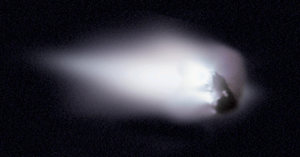
An Encounter With Halley's Comet
Légende : This image shows the solid core, or nucleus, of Halley’s Comet, captured in 1986 by the European Space Agency spacecraft Giotto during its flyby of the comet in the inner Solar System. The nucleus appears irregular and potato-shaped, measuring roughly 15 kilometers (about 9 miles) across, and is composed of a mixture of ice, dust, and rock. Unlike the glowing fuzzy cloud (coma) and long tail that make comets visible from Earth, the nucleus itself is dark and difficult to see until a spacecraft passes close enough to take detailed images.
Halley’s Comet is one of the best-known comets because it returns to the inner Solar System approximately every 76 years, allowing generations of astronomers to observe it repeatedly. The material that is released from the nucleus as the comet warms near the Sun forms a glowing coma and long tails of gas and dust, and over many returns leaves trails of debris that produce meteor showers on Earth, such as the Eta Aquarids in May and the Orionids in October.
Crédit : NASA/ESA/Giotto Project
Lien vers les crédits
License: PD Domaine Public Icônes









- Ressources
- Moteur de recherche des ressources pédagogiques
- Parcourir les ressources pédagogiques par Sujet
- Parcourir les images
- AstroEdu - Activités en classe
- Grandes Idées - Littéracie en astronomie
- Glossaire
- Rapports de l'OAE
- L'astronomie pour l'Education à travers le monde
- Sélection de ressources externes