Terme du glossaire : Fusée
Description : Une fusée est un dispositif couramment utilisé pour lancer des engins spatiaux de la surface de la Terre vers l'espace extra-atmosphérique. Pour ce faire, une fusée se compose de moteurs et de réservoirs de carburant. Les moteurs-fusées sont également utilisés pour contrôler le mouvement des engins spatiaux dans l'espace, en modifiant leur vitesse ou en corrigeant leur trajectoire. Le principe de base d'un moteur-fusée est de produire un flux de particules à grande vitesse, généralement en brûlant du carburant. Lorsqu'un tel flux est dirigé dans une direction spécifique, le moteur-fusée est accéléré dans la direction opposée - une conséquence d'une loi fondamentale de la physique appelée conservation de la quantité de mouvement. Il est à noter que le flux de particules n'a pas besoin d'exercer une pression sur quoi que ce soit pour que cet effet se produise : les fusées fonctionnent parfaitement, même dans le quasi-vide de l'espace.
Termes associés :
Voir ce terme dans d'autres langues
Statut du terme et de sa définition : La définition initiale de ce terme en anglais a été aprouvée par un·e spécialiste de la recherche en astronomie et un·e spécialiste de l’éducation La traduction de ce terme et de sa définition n'ont pas encore été aprouvées
Le glossaire multilangue de l'OAE est un projet du Bureau de l'IAU de l'Astronomie pour l'Education (OAE) en collaboration avec le Bureau de l'IAU de diffusion de l'Astronomie (OAO). Les termes et définitions ont été choisis, écrits et relues grâce à un effort collectif de l'OAE, les Centres et les Noeuds de l'OAE, les Coordinateurs Nationaux de l'Astronomie pour l'Education de l'OAE(NAECs) et d'autres volontaires. La liste complète des crédits pour ce projet est disponible ici . Tous les termes du glossaire et leur définition sont déposés sous licence Creative Commons CC BY-4.0 et doivent être créditées au nom de "IAU OAE".
Si vous constatez une erreur dans ce terme ou sa définition, veuillez nous contacter .
Media associé
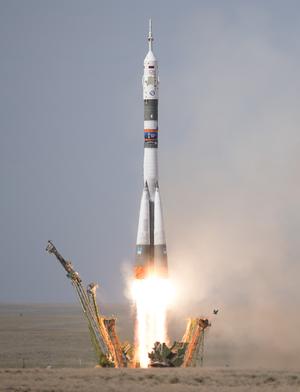
Lancement de la fusée Soyouz
Légende : La fusée Soyouz MS-09 a décollé du cosmodrome de Baïkonour au Kazakhstan le 6 juin 2018, emportant l'équipage de l'expédition 56 vers la Station Spatiale Internationale (ISS). L'équipage était composé du commandant du Soyouz Sergey Prokopyev de Roscosmos, de l'ingénieur de vol Serena Auñón-Chancellor de la NASA et de l'ingénieur de vol Alexander Gerst de l'ESA (Agence Spatiale Européenne).
Crédit : NASA/Joel Kowsky
Lien vers les crédits
License: CC-BY-NC-ND-2.0 Creative Commons (CC) Attribution - Pas d’Utilisation Commerciale - Pas de Modification 2.0 Générique Icônes

The Speed of Spacecraft
Légende : This infographic is part of the "Simplifying Astronomy for Arabic Speakers" project, aiming to present scientific concepts in a simple and accessible way. The design focuses on the speed of spacecraft during the various stages of their launch, illustrating how velocity changes as the spacecraft progresses to reach the desired orbit.
Details of the Stages:
Stage One (Launch):
The spacecraft begins its journey by launching from the launch pad with an increasing speed. The velocity in this stage is influenced by Earth's gravity and atmospheric resistance.
After One Minute:
The spacecraft reaches a speed of approximately 1,600 kilometers per hour (km/h), reflecting a rapid acceleration powered by its engines.
After Two and a Half Minutes:
The rocket boosters are jettisoned, allowing the spacecraft to reach a speed of about 4,800 km/h. At this point, the spacecraft becomes lighter, enabling it to accelerate more efficiently.
Final Stage:
By the end of the ascent phase, the spacecraft achieves its final speed of approximately 28,000 km/h, allowing it to enter the desired orbit around Earth.
Through educational designs like this, the project provides enthusiasts with an opportunity to understand the intricate details of space missions in an engaging and simplified manner.
Crédit : Ali Al-Edhari ; Background image credit - NASA
License: CC-BY-4.0 Creative Commons (CC) Attribution 4.0 International (CC BY 4.0) Icônes
Ceci pourrait vous intéresser également







- Ressources
- Moteur de recherche des ressources pédagogiques
- Parcourir les ressources pédagogiques par Sujet
- Parcourir les images
- AstroEdu - Activités en classe
- Grandes Idées - Littéracie en astronomie
- Glossaire
- Rapports de l'OAE
- L'astronomie pour l'Education à travers le monde
- Sélection de ressources externes