词条 火箭
描述: 火箭是一种常用于将航天器从地球表面发射到外太空的装置。为此,火箭通常由火箭发动机和燃料箱组成。火箭发动机也可用于在太空中控制航天器的运动,改变速度或进行航向修正。火箭发动机的基本原理是产生高速粒子流,通常通过燃烧火箭燃料来实现。当这种粒子流朝特定方向喷出时,火箭发动机就会向相反方向加速,这源于动量守恒这一物理基本定律。需要注意的是,这种粒子流不需要推靠任何物体来产生作用:火箭即使在近乎真空的太空中也能完美运行。
相关词条
用其他语言查看该词条
词条和定义状态: 该术语的英文原始定义已通过天文研究人员和教师的审核 该术语及其定义的译文仍待审核
OAE多语言词汇表是由国际天文学联合会(IAU) 天文教育办公室(OAE) 和 国际天文学联合会(IAU) 天文推广办公室(OAO)合作的项目。. 术语和定义由 OAE中心, OAE 国家天文教育协调员(NAECs) 以及其他志愿者共同选择、撰写和审阅。您可以在 找到完整的致谢列表。所有词汇表术语及其定义均根据 Creative Commons CC BY-4.0许可证发布 且版权归属于 “IAU OAE”。
如果您发现此词汇术语或定义中的事实或翻译错误, 请向 发邮件 联系.
相关媒体
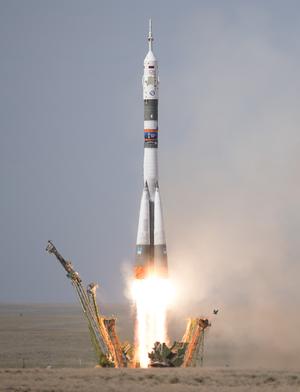
联盟号火箭发射
图注: 2018年6月6日,联盟号MS-09火箭从哈萨克斯坦的拜科努尔航天发射场发射升空,将远征56号机组人员送往国际空间站(ISS)。任务组成员包括俄罗斯航天局的飞船指令长谢尔盖·普罗科皮耶夫、美国国家航空航天局的飞行工程师塞丽娜·奥农-钱斯勒,以及欧洲航天局的飞行工程师亚历山大·格斯特。
来源: 美国国家航空航天局/乔尔-考斯基
来源链接
License: CC-BY-NC-ND-2.0 知识共享许可协议 Attribution-NonCommercial-NoDerivs 2.0 Generic 图标

The Speed of Spacecraft
图注: This infographic is part of the "Simplifying Astronomy for Arabic Speakers" project, aiming to present scientific concepts in a simple and accessible way. The design focuses on the speed of spacecraft during the various stages of their launch, illustrating how velocity changes as the spacecraft progresses to reach the desired orbit.
Details of the Stages:
Stage One (Launch):
The spacecraft begins its journey by launching from the launch pad with an increasing speed. The velocity in this stage is influenced by Earth's gravity and atmospheric resistance.
After One Minute:
The spacecraft reaches a speed of approximately 1,600 kilometers per hour (km/h), reflecting a rapid acceleration powered by its engines.
After Two and a Half Minutes:
The rocket boosters are jettisoned, allowing the spacecraft to reach a speed of about 4,800 km/h. At this point, the spacecraft becomes lighter, enabling it to accelerate more efficiently.
Final Stage:
By the end of the ascent phase, the spacecraft achieves its final speed of approximately 28,000 km/h, allowing it to enter the desired orbit around Earth.
Through educational designs like this, the project provides enthusiasts with an opportunity to understand the intricate details of space missions in an engaging and simplified manner.
来源: Ali Al-Edhari ; Background image credit - NASA