Glossary term: 火箭
Description: 火箭是一種常用於將航天器從地球表面發射到外太空的裝置。為此,火箭通常由火箭發動機和燃料箱組成。火箭發動機也可用於在太空中控制航天器的運動,改變速度或進行航向修正。火箭發動機的基本原理是產生高速粒子流,通常通過燃燒火箭燃料來實現。當這種粒子流朝特定方向噴出時,火箭發動機就會向相反方向加速,這源於動量守恆這一物理基本定律。需要注意的是,這種粒子流不需要推靠任何物體來產生作用:火箭即使在近乎真空的太空中也能完美運行。
Related Terms:
See this term in other languages
Term and definition status: The original definition of this term in English have been approved by a research astronomer and a teacher The translation of this term and its definition is still awaiting approval
This is an automated transliteration of the simplified Chinese translation of this term
The OAE Multilingual Glossary is a project of the IAU Office of Astronomy for Education (OAE) in collaboration with the IAU Office of Astronomy Outreach (OAO). The terms and definitions were chosen, written and reviewed by a collective effort from the OAE, the OAE Centers and Nodes, the OAE National Astronomy Education Coordinators (NAECs) and other volunteers. You can find a full list of credits here. All glossary terms and their definitions are released under a Creative Commons CC BY-4.0 license and should be credited to "IAU OAE".
If you notice a factual or translation error in this glossary term or definition then please get in touch.
Related Media
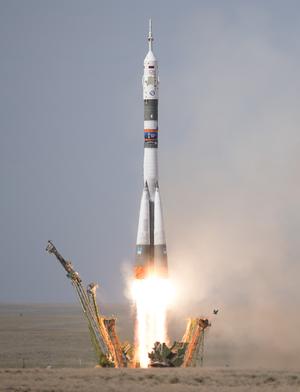
聯盟號火箭發射
Caption: 2018年6月6日,聯盟號MS-09火箭從哈薩克斯坦的拜科努爾航天發射場發射升空,將遠征56號機組人員送往國際空間站(ISS)。任務組成員包括俄羅斯航天局的飛船指令長謝爾蓋·普羅科皮耶夫、美國國家航空航天局的飛行工程師塞麗娜·奧農-錢斯勒,以及歐洲航天局的飛行工程師亞歷山大·格斯特。
Credit: 美國國家航空航天局/喬爾-考斯基
credit link
License: CC-BY-NC-ND-2.0 Creative Commons Attribution-NonCommercial-NoDerivs 2.0 Generic icons

The Speed of Spacecraft
Caption: This infographic is part of the "Simplifying Astronomy for Arabic Speakers" project, aiming to present scientific concepts in a simple and accessible way. The design focuses on the speed of spacecraft during the various stages of their launch, illustrating how velocity changes as the spacecraft progresses to reach the desired orbit.
Details of the Stages:
Stage One (Launch):
The spacecraft begins its journey by launching from the launch pad with an increasing speed. The velocity in this stage is influenced by Earth's gravity and atmospheric resistance.
After One Minute:
The spacecraft reaches a speed of approximately 1,600 kilometers per hour (km/h), reflecting a rapid acceleration powered by its engines.
After Two and a Half Minutes:
The rocket boosters are jettisoned, allowing the spacecraft to reach a speed of about 4,800 km/h. At this point, the spacecraft becomes lighter, enabling it to accelerate more efficiently.
Final Stage:
By the end of the ascent phase, the spacecraft achieves its final speed of approximately 28,000 km/h, allowing it to enter the desired orbit around Earth.
Through educational designs like this, the project provides enthusiasts with an opportunity to understand the intricate details of space missions in an engaging and simplified manner.
Credit: Ali Al-Edhari ; Background image credit - NASA
License: CC-BY-4.0 Creative Commons 姓名標示 4.0 國際 (CC BY 4.0) icons