Terme du glossaire : Saisons
Description : L'axe de la Terre n'est pas perpendiculaire à l'orbite terrestre autour du Soleil, mais incliné d'un angle de 23,4 degrés. Par conséquent, la position apparente du soleil dans le ciel à un moment donné de la journée varie au cours de l'année. Chaque fois que le soleil est, en moyenne, plus haut dans le ciel, une quantité plus importante de lumière du soleil atteint une surface donnée. Au cours de l'année, il en résulte des périodes plus chaudes et plus froides, avec des écarts plus prononcés dans les régions éloignées de l'équateur terrestre, que l'on appelle les saisons. Les saisons de l'hémisphère nord sont opposées à celles de l'hémisphère sud : L'été septentrional, les trois mois centrés sur le 21 juin lorsque l'hémisphère nord est incliné au maximum vers le Soleil, est l'hiver méridional, l'hémisphère sud étant incliné vers l'extérieur, et vice versa pour l'été méridional, qui correspond à la période de trois mois autour du 21 décembre. De nombreuses régions de la Terre proches de l'équateur ont des saisons qui diffèrent du schéma été-hiver observé aux latitudes tempérées et arctiques. Il convient de noter que la durée, le début et la fin de chaque saison peuvent être influencés par les pratiques culturelles et l'époque.
Termes associés :
Voir ce terme dans d'autres langues
Statut du terme et de sa définition : La définition initiale de ce terme en anglais a été aprouvée par un·e spécialiste de la recherche en astronomie et un·e spécialiste de l’éducation La traduction de ce terme et de sa définition n'ont pas encore été aprouvées
Le glossaire multilangue de l'OAE est un projet du Bureau de l'IAU de l'Astronomie pour l'Education (OAE) en collaboration avec le Bureau de l'IAU de diffusion de l'Astronomie (OAO). Les termes et définitions ont été choisis, écrits et relues grâce à un effort collectif de l'OAE, les Centres et les Noeuds de l'OAE, les Coordinateurs Nationaux de l'Astronomie pour l'Education de l'OAE(NAECs) et d'autres volontaires. La liste complète des crédits pour ce projet est disponible ici . Tous les termes du glossaire et leur définition sont déposés sous licence Creative Commons CC BY-4.0 et doivent être créditées au nom de "IAU OAE".
Si vous constatez une erreur dans ce terme ou sa définition, veuillez nous contacter .
Dans d'autres langues
- Arabe: الفصول
- Allemand: Jahreszeiten
- Anglais: Seasons
- Espagnol: Estaciones
- Perse: فصلها
- Italien: Le stagioni
- Japonais: 季節の変化 (Liens externes)
- Portugais brésilien: Estações do ano
- Chinois simplifié: 季节
- Chinois traditionnel: 季節
Diagrammes associés

Solstices and Equinoxes
Légende : This diagram demonstrates the relative positions of the Earth and Sun at the two solstices and two equinoxes. The Earth’s rotation axis is tilted by 23.4° from the axis of its orbit. This means that for half the Earth’s annual orbit around the Sun, the Southern Hemisphere is tilted towards the Sun and the Northern Hemisphere is tilted away from the Sun. During this time the Sun appears to lie below the celestial equator. Due to this at any particular point in the Southern Hemisphere the Sun will appear to be higher above the horizon at a particular time of day and the days will be longer. Conversely during this time, the Sun appears lower in the sky at any particular point in the day in the Northern Hemisphere and the days are shorter.
This effect is most pronounced in late December when the Sun appears at its most southerly point in the sky, corresponding to the longest day of the year in the Southern Hemisphere. This normally occurs on the 21st or 22nd of December (UTC), depending on when the most recent leap year was, but can very occasionally occur on the 20th or 23rd of December. This event is known as the December solstice. As the Sun’s rays hit the Southern Hemisphere at a more perpendicular angle during this time, the Southern Hemisphere is typically warmer in this time of year than at other times of year. This is often referred to as summer in temperate and antarctic regions of the Southern Hemisphere and thus the December solstice is known as the summer solstice. South of the Antarctic Circle at this time the Sun never sets and a Polar Day can last several months. Conversely in the Northern Hemisphere, the Sun’s rays hit the Earth at a more grazing angle than at other times of year so it is colder and this solstice is known as the winter solstice. North of the Arctic Circle the Sun never rises during this time and the Polar Night can last several months.
As the year progresses the Earth moves in its orbit and the tilt of the Earth’s axis moves so it appears more side-on to the Sun. From the perspective of an observer on Earth this means that the Sun moves north in the sky, eventually reaching the celestial equator in late March, This usually occurs on the 20th of March (UTC) but can sometimes occur on the 19th or 21st of March. During this time all places on Earth will experience night and day that is approximately 12 hours long. The Sun’s rays now hit the Southern hemisphere at a more shallow angle than they did in December and hit the Northern Hemisphere at a more perpendicular angle. This means that the Northen Hemisphere will have warmed since December and the Southern Hemisphere cooled. This leads to the March equinox being referred to as the autumn equinox in the Southern Hemisphere and the spring or vernal equinox in the Northern Hemisphere.
As the year progresses further the Sun moves further north on the sky, the Northern Hemisphere days lengthen and the Southern Hemisphere days shorten. By June the Earth’s orbit has progressed to the point where the Northern Hemisphere points towards the Sun and the Southern Hemisphere away from the Sun. At one point between the 20th and 22nd of June (UTC) the Sun reaches its most northerly point in the sky, this is known as June solstice. It is now summer in northern temperate and artic regions so this is known as the summer solstice in the Northern Hemisphere and the winter solstice in the Southern Hemisphere. This is the longest day of the year in the Northern Hemisphere and the shortest day of the year in the Southern Hemisphere. During this time regions north of the Arctic Circle experience a long Polar Day and regions south of the Antarctic Circle experience polar night.
The year progresses further and the Earth moves in its orbit so that the tilt of the Earth’s axis again appears side-on for the Sun. The Sun moves south in the sky and again crosses the celestial equator between the 21st and 24th of September (UTC). At this time all places on the Earth experience equal lengths of day and night. This is known as the September equinox, also called the spring or vernal equinox in the Southern Hemisphere and the autumn equinox in the Northern Hemisphere.
Note the sizes of the Earth, Sun and the Earth’s orbit around the Sun are not to scale in this diagram.
Crédit : Maria Cristina Fortuna/IAU OAE
License: CC-BY-4.0 Creative Commons (CC) Attribution 4.0 International (CC BY 4.0) Icônes
Activités associées
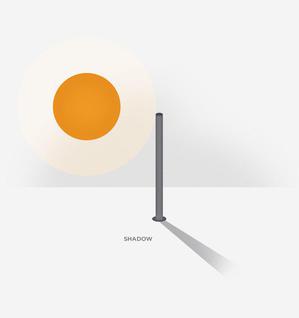
Sun’s Shadow
astroEDU educational activity (links to astroEDU website) Description: Why is the Sun's shadow so important?
License: CC-BY-4.0 Creative Commons (CC) Attribution 4.0 International (CC BY 4.0) Icônes
Mots clés :
Hands-on
, Shadows
Tranches d'âge :
6-8
, 8-10
, 10-12
, 12-14
, 14-16
Niveau scolaire :
Informelle - Médiation
, Collège
, Primaire
, Secondaire
Domaines d'apprentissage :
Basée sur l'observation
, Apprentissage par enquête
Coûts :
Moyen
Durée :
Un jour
Taille du groupe :
Par groupe
Compétences :
Poser des questions
, Communiquer des informations
, Construire des explications
, S'engager dans des arguments fondés sur des preuves
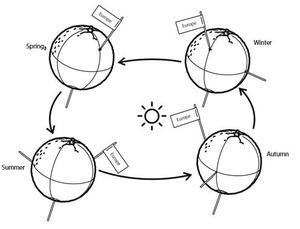
Seasons Around the World
astroEDU educational activity (links to astroEDU website) Description: Demonstrate the seasons on Earth using a model.
License: CC-BY-4.0 Creative Commons (CC) Attribution 4.0 International (CC BY 4.0) Icônes
Mots clés :
Hands-on
, Model
Tranches d'âge :
6-8
, 8-10
, 10-12
Niveau scolaire :
Collège
, Primaire
Domaines d'apprentissage :
Modélisation
, Apprentissage par enquête
Coûts :
Moyen
Durée :
45min
Taille du groupe :
Par groupe
Compétences :
Analyser et interpréter des données
, Poser des questions
, Construire des explications
, Développer et utiliser des modèles
, Planifier et mener des enquêtes
Navigate like a Viking – Use the Sun, not your phone!
astroEDU educational activity (links to astroEDU website) Description: Learn how the Vikings used the sky to navigate at sea with a hands-on activity!
License: CC-BY-4.0 Creative Commons (CC) Attribution 4.0 International (CC BY 4.0) Icônes
Mots clés :
History
, Geography
, Maps
, Coordinates
, Celestial navigation
Tranches d'âge :
12-14
, 14-16
Niveau scolaire :
Collège
Domaines d'apprentissage :
Groupes de discussion
, Modélisation
, Apprentissage par enquête
Coûts :
Moyen
Durée :
1h 30m
Taille du groupe :
Par groupe
Compétences :
Analyser et interpréter des données
, Poser des questions
, Communiquer des informations
, Développer et utiliser des modèles
, Planifier et mener des enquêtes
, Utiliser les mathématiques et la pensée computationnelle
Ceci pourrait vous intéresser également






- Ressources
- Moteur de recherche des ressources pédagogiques
- Parcourir les ressources pédagogiques par Sujet
- Parcourir les images
- AstroEdu - Activités en classe
- Grandes Idées - Littéracie en astronomie
- Glossaire
- Rapports de l'OAE
- L'astronomie pour l'Education à travers le monde
- Sélection de ressources externes