Terme du glossaire : Astérisme
Description : La plupart des étoiles brillantes du ciel nocturne ont été regroupées en configurations appelées constellations. Mais outre les constellations officielles, qui ont été définies par l'Union astronomique internationale, il existe également des groupements d'étoiles qui forment des configurations appelées astérismes. L'astérisme le plus connu est sans doute la Grande Ourse, un groupe d'étoiles qui fait partie de la constellation Ursa Major.
Termes associés :
Voir ce terme dans d'autres langues
Statut du terme et de sa définition : La définition initiale de ce terme en anglais a été aprouvée par un·e spécialiste de la recherche en astronomie et un·e spécialiste de l’éducation La traduction de ce terme et de sa définition n'ont pas encore été aprouvées
Le glossaire multilangue de l'OAE est un projet du Bureau de l'IAU de l'Astronomie pour l'Education (OAE) en collaboration avec le Bureau de l'IAU de diffusion de l'Astronomie (OAO). Les termes et définitions ont été choisis, écrits et relues grâce à un effort collectif de l'OAE, les Centres et les Noeuds de l'OAE, les Coordinateurs Nationaux de l'Astronomie pour l'Education de l'OAE(NAECs) et d'autres volontaires. La liste complète des crédits pour ce projet est disponible ici . Tous les termes du glossaire et leur définition sont déposés sous licence Creative Commons CC BY-4.0 et doivent être créditées au nom de "IAU OAE".
Si vous constatez une erreur dans ce terme ou sa définition, veuillez nous contacter .
Media associé
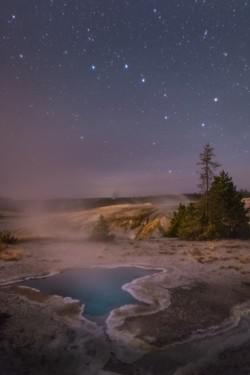
La Grande Ourse à Yellowstone, par Alex Conu, Norvège
Légende : Première place au concours d'astrophotographie 2021 de l'UAI OAE, catégorie Champs d'étoiles étendus.
Cette image montre l'un des astérismes les plus proéminents et les plus connus de l'hémisphère nord - la Grande Ourse ou la Charrue. Cet astérisme fait partie de la constellation de la mythologie grecque - Ursa Major (la Grande Ourse).
La Grande Ourse comprend sept (huit) étoiles qui s'étendent du centre vers la droite de l'image. Les quatre étoiles qui forment la "coupe" de la Grande Ourse ont la forme d'un trapèze juste au-dessus de l'arbre le plus haut, vers la droite de l'image. Ces étoiles sont Dubhe (en haut à droite), Merak (en bas à droite), Megrez (en haut à gauche) et Phecda (en bas à droite). Les trois (quatre) étoiles qui forment l'anse se trouvent à gauche du trapèze (de droite à gauche : Alioth, Mizar et Alkaid). En regardant de près Mizar, il est possible de voir une étoile plus petite en haut à gauche accolée à Mizar. Il s'agit d'Alcor, qui forme avec Mizar un système d'étoiles doubles visible à l'œil nu. Cependant, des mesures très minutieuses ont prouvé que Mizar est en fait un système quadruple et qu'Alcor est un système binaire. Bien que les noms des étoiles soient dérivés des noms arabes des étoiles, différentes cultures ont leurs propres noms pour les étoiles.
Dans diverses cultures du monde, cet astérisme est associé à différents objets et, en outre, certaines cultures indigènes associent des histoires à des étoiles individuelles. Les constellations, en plus d'incarner les histoires et les mythes de diverses cultures, sont d'importants "outils" de navigation. Les étoiles Dubhe et Merak peuvent être utilisées pour trouver l'étoile polaire - Polaris (non visible sur cette image). Compte tenu de sa relation avec l'hémisphère nord et du fait qu'il s'agit d'une constellation circumpolaire (qui ne se couche jamais sous l'horizon), la Grande Ourse et Polaris figurent sur le drapeau de l'Alaska.
Il est important de noter que, bien que les étoiles des constellations (à l'exception des systèmes stellaires multiples de Mizar et Alcor) semblent être "proches" les unes des autres, elles se trouvent en réalité à des distances différentes de la Terre et les unes des autres.
Crédit : Alex Conu/IAU OAE
License: CC-BY-4.0 Creative Commons (CC) Attribution 4.0 International (CC BY 4.0) Icônes
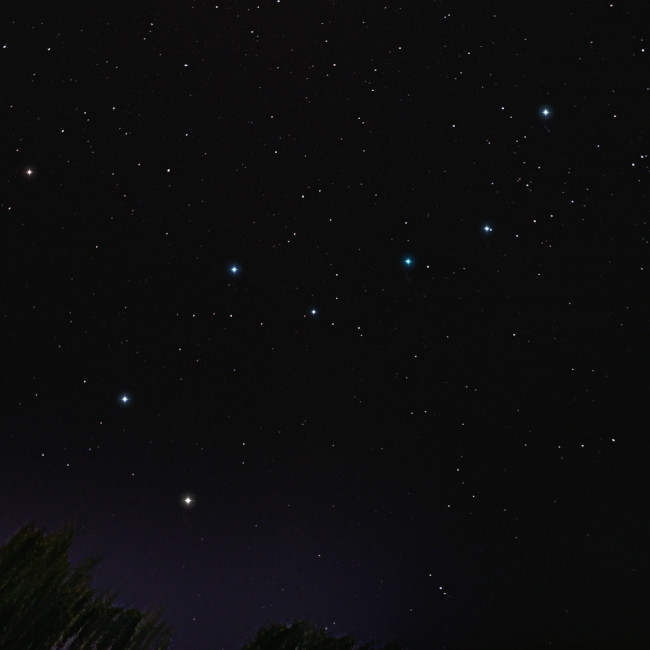
Grande Ourse
Légende : Mention honorable au concours d'astrophotographie 2022 de l'UAI OAE, catégorie Images fixes de motifs célestes.
Cette photographie, prise à Udupi, en Inde, en mai 2021, montre les sept étoiles les plus brillantes de la constellation de la Grande Ourse. Cet astérisme était considéré comme un chariot par les Babyloniens, ce qui a probablement conduit à l'interprétation alternative du Chariot dans le poème didactique du poète grec Aratus. L'interprétation grecque normale est la constellation de la Grande Ourse, qui comprend également de nombreuses étoiles moins lumineuses dans une zone beaucoup plus large du ciel.
Dans l'Égypte ancienne, ces sept étoiles forment la patte avant ou la cuisse du taureau. Elles sont considérées comme une partie de la jambe du dieu Seth, qui était considéré comme le mauvais des deux frères ; le dieu Osiris (qui est parfois considéré comme le premier roi d'Égypte) a été assassiné par son frère Seth. Leur sœur aimante a rassemblé les morceaux éparpillés du cadavre et l'a réanimé. Afin d'empêcher Seth de commettre d'autres méfaits, cette jambe fut attachée à une cheville dans le ciel.
Ces sept étoiles brillantes étaient considérées comme la Grande Ourse du Nord, contenant l'astérisme des Juges par la noblesse de la Chine ancienne. En français et en néerlandais, elle est aussi appelée "casserole", en allemand "char" et en anglais "chariot". Le terme communément connu de "Grande Ourse" vient de l'anglais américain. Elle est considérée comme la figure masculine qui est le père de toutes les étoiles et de tous les humains dans la saga navajo nord-américaine, où l'on dit qu'elle est l'époux d'une déesse mère vue dans Cassiopée. De même, il est désigné comme le chariot de l'homme dans la mythologie nordique et le chariot de la femme dans la Petite Ourse. Dans d'autres cultures nordiques, le groupe est interprété comme un élan, par exemple chez les Inuits et les Sibériens, tandis que les Samis y voient l'arc et la flèche de Favdna. En revanche, toutes les cultures de l'hémisphère sud ne le nomment pas, car il est toujours soit proche de l'horizon, soit invisible. Par exemple, les Tucano brésiliens l'appellent le grand anus du serpent et, à Samoa, il fait partie du Heirloom Warclub.
Les Hawaïens utilisaient également l'astérisme pour la navigation et l'appelaient Les Sept, tandis que la tradition macédonienne l'interprétait comme les Sept Voleurs. Dans la tradition italienne, l'astérisme est appelé "Les sept bœufs" (Rome) ou "Les sept frères" (Sardaigne). De même, les traditions mongoles parlent de sept bouddhas, tandis que les Indiens l'appellent les sept sages.
Crédit : Arya Anthony/IAU OAE
License: CC-BY-4.0 Creative Commons (CC) Attribution 4.0 International (CC BY 4.0) Icônes

Forgoing the Summer Triangle as it sets in the early winter evening
Légende : Winner in the 2022 IAU OAE Astrophotography Contest, category Still images of celestial patterns.
This image was taken from Nagano, Japan, in December 2018, and shows three prominent constellations: Aquila (towards the lower-left of the image), Cygnus (in the upper part of the image) and Lyra (bottom-right). The brightest stars within these constellations (Altair, Deneb and Vega) form the three vertices of the asterism known as the Summer Triangle. The star Altair is the brightest star towards the bottom-left of the image, Deneb is the brightest star towards the top-right of the image, and Vega is the brightest star towards the bottom-right of the image.
In Asian cultures the stars Vega and Altair represent a love story between the weaver girl and the herdsman, who are separated by the faint band of the Milky Way, but in July are allowed to cross the heavenly river (the Milky Way) to be together.
The Boorong people of Northeast Victoria, Australia, associate the reappearance of Vega — after its yearly disappearance from view — with the time when the Mallee fowls build nests. The Boorong also associate their indigenous constellation Neilloan with the goddess Mallee-hen (Vega), mother of Totyarguil (Altair), the hero who created the Murray River. In Wardaman traditions, the star Vega acts as a gateway to the Milky Way for spirits of the deceased.
The star name Altair is abbreviated from the Arabic “Al-Nasr Al-Ta’ir” (meaning “The Flying Eagle”) proving that the constellation of the Eagle (Aquila) is one of the most stable ones in history. Originating from the Babylonian epoch (carrying a king towards the sky), it was taken over by the Greeks, Romans, and Arabs. The star name Deneb comes from the Arabic word “dhanab”, meaning “tail”, and refers to the Greek constellation of The Bird that is interpreted in the Roman tradition as a Swan (Cygnus), and as a Hen in the Arabic world. The third star name, Vega, comes from the Arabic “Al-Nasr Al-Waqi”, meaning “The Swooping Eagle'', because the indigenous (pre-Islamic) Arabic culture had a second eagle in the area of the Greek constellation Lyra. In the Early Modern Age, some Christian astronomers, inspired by the Arabic tradition, depicted this constellation as an eagle or vulture holding a lyre.
The image also shows a range of other constellations, including Delphinus, Sagitta, and Vulpecula. According to Greek mythology, Sagitta, The Arrow, carried the god of light and the goddess of fertility. In winter they set in the evening but in spring they rise again in the east, and are present for longer and longer in order to make the land fruitful and agriculture successful.
Crédit : Kouij Ohnishi/IAU OAO
License: CC-BY-4.0 Creative Commons (CC) Attribution 4.0 International (CC BY 4.0) Icônes
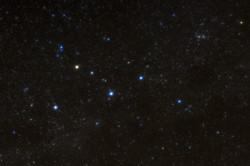
Portrait of a Bat
Légende : Honourable mention in the 2022 IAU OAE Astrophotography Contest, category Still images of celestial patterns.
Taken in November 2019 from the Doi Inthanon National Park, Chiang Mai, Thailand, this image captures the notable northern constellation Cassiopeia, in the shape of the letter M. Although the official constellation name is the Latinised version of the name of queen “Kasseipeia” from Greek mythology, these five bright stars were considered a constellation in many cultures around the world and they are associated with diverse stories. In Thailand, for example, the constellation represents a Bat, while in Hawaiian culture it is called 'Iwa Keli'i, the chief frigate bird.
For the Navajo in North America, the bright stars are the central part of the celestial mother (of all stars and humans) revolving around the celestial pole together with her husband, the celestial father (of all stars and humans) seen in the constellation of Ursa Major. For the Maya it was part of the huge constellation of the Hole-Backed Caiman, and for the Inuit a Lamp Stand and a Blubber Container.
In ancient China, the bottom-left star was associated with the mythological general Wangliang who drove four horses, represented by the two bright and two fainter stars of the M’s next stroke (from upper-left to lower-middle). The remaining two bright stars and a couple of the other fainter ones are considered a Flying Corridor, a sort of highway, next to the Emperor’s Forbidden Palace that is located at the northern polar region.
On the island of Tonga in the South Pacific, this asterism is considered the Wing of Tafahi and it is not clear if this refers to the shape of the island of Tafahi, or if it is based on an error and originally referred to a wing of the Polynesian hero Tafaki.
The various colours of the stars indicate their temperatures, with redder stars being relatively cooler on their surface than blue and white stars.
Crédit : Thanakrit Santikunaporn/IAU OAE
License: CC-BY-4.0 Creative Commons (CC) Attribution 4.0 International (CC BY 4.0) Icônes

To guard the Stars and the Sea Together
Légende : Winner in the 2022 IAU OAE Astrophotography Contest, category Still images of celestial patterns.
This image composition is amazing. In the far background of the landscape we see a chain of mountains that seems to mirror the structure of the Milky Way in the sky above. The strong daylight-like colours of the landscape are caused by the Moon, the bright light at the top of the image.
Taken in Kinabalu, Malaysia, in February 2019, this image shows the alignment of planets and the Moon, conveying the idea of the ecliptic as the central line of the Zodiac, the plane within which all planets orbit the Sun. The ecliptic is the central line of the Zodiac, so the region of about five to 10 degrees either side of the ecliptic is where the constellations of the Zodiac are located. Starting from the horizon towards the bottom left of the image we can see the planets Venus, Saturn and Jupiter. The planets have different cultural significance for people around the world, and are deeply embedded in social, religious and practical aspects of life. For example, Wardaman traditions of Indigenous Australians associate the planets with ancestor spirits who traverse the Celestial Road (ecliptic). The appearance and disappearance of planets in the sky are associated with various ceremonies. For example, when Venus starts being the “Morning star” after having been the “Evening star”, this marks the Banumbirr ceremony for the Yolnu people of Arnhem Land, in Australia.
The image also shows the constellations Scorpius, Aquila, Lupus and Triangulum Australe, the asterism of the Teapot, and the two pointer stars Alpha and Beta Centauri. The constellations, asterisms and individual stars within them have significance in many different cultures.
Malaysia, being close to the equator, has had connections to the north as well as to the south and almost the whole sky is visible over the course of the year. The star Antares is seen by the Kokatha people of the Western Desert as Kogolongo, the red tailed black cockatoo, while the Boorong refer to it as Djuit, the red-rumped parrot. The two stars which form the stinger of Scorpius (Shaula and Lesath), are called Karik Karik, the Australian Kestrel.
Crédit : Likai Lin/IAU OAE
License: CC-BY-4.0 Creative Commons (CC) Attribution 4.0 International (CC BY 4.0) Icônes
Diagrammes associés
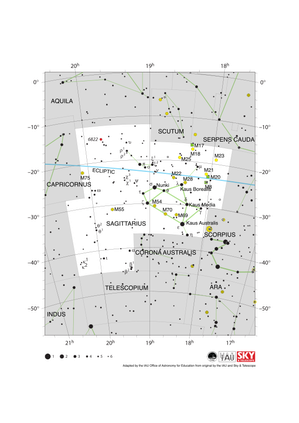
Sagittarius Constellation Map
Légende : The constellation Sagittarius along with its bright stars and surrounding constellations. Sagittarius is surrounded by (going clockwise from the top) Aquila, Scutum, Serpens Cauda, Ophiuchus, Scorpius, Corona Australis, Telescopium, Microscopium and Capricornus. The brighter stars in Sagittarius form a distinctive teapot shape. Sagittarius lies on the ecliptic (shown here as a blue line), this is the path the Sun appears to take across the sky over the course of a year. The Sun is in Sagittarius from mid December to mid January. The other planets of the Solar System can often be found in Sagittarius.
Sagittarius lies south of the celestial equator. The famous teapot asterism is visible for all but the most arctic regions of the world but the most southerly parts of the constellation are not visible in northern parts of Asia, Europe and North America. Sagittarius is most visible in the evenings in the northern hemisphere summer and southern hemisphere winter.
The supermassive black hole Sagittarius A* which lies at the center of our Milky Way Galaxy is sits on the western (here right-hand) edge of Sagittarius. Due to it covering an area at the center of our Galaxy, Sagittarius is home to many star clusters including open clusters (marked here with yellow circles) and globular clusters (marked here with yellow circles with + signs superimposed on them). Three nebulae are also marked here with green squares.
The y-axis of this diagram is in degrees of declination with north as up and the x-axis is in hours of right ascension with east to the left. The sizes of the stars marked here relate to the star's apparent magnitude, a measure of its apparent brightness. The larger dots represent brighter stars. The Greek letters mark the brightest stars in the constellation. These are ranked by brightness with the brightest star being labeled alpha, the second brightest beta, etc., although this ordering is not always followed exactly. The dotted boundary lines mark the IAU's boundaries of the constellations and the solid green lines mark one of the common forms used to represent the figures of the constellations. Neither the constellation boundaries, nor the line marking the ecliptic, nor the lines joining the stars appear on the sky.
Crédit : Adapted by the IAU Office of Astronomy for Education from the original by IAU/Sky & Telescope
License: CC-BY-4.0 Creative Commons (CC) Attribution 4.0 International (CC BY 4.0) Icônes

Carte de la constellation LA GRANDE OURSE
Légende : La constellation de la Grande Ourse avec ses étoiles brillantes et les constellations qui l'entourent. La Grande Ourse ou Ursa Major est entourée de (dans le sens des aiguilles d'une montre à partir du haut) : Dragon, Caméléon, Lynx, Petit Lion, Lion, Chevelure de Bérénice, Chiens de Chasse et Bouvier. La Grande Ourse est célèbre pour son astérisme proéminent, souvent connu en anglais sous le nom de Big Dipper ou the Plough (la Grande Ourse ou la Charrue). Cet astérisme nordique proéminent porte une grande variété de noms dans les cultures du monde entier. Alors que la plupart des constellations et des astérismes sont constitués d'étoiles sans rapport les unes avec les autres qui apparaissent au hasard dans le ciel, cinq des étoiles de la Grande Ourse font partie du groupe mobile de la Grande Ourse, un groupe d'étoiles qui se déplacent ensemble dans l'espace et qui se sont probablement formées au même endroit il y a 300 millions d'années. Les deux étoiles situées à l'extrémité droite de la Grande Ourse sur ce diagramme forment une paire d'étoiles indicatrices qui peuvent être utilisées pour localiser Polaris, l'étoile du pôle nord qui se trouve dans la constellation de la Petite Ourse.
La Grande Ourse est une constellation septentrionale, visible depuis les régions septentrionales et équatoriales. Certaines parties de la constellation sont visibles depuis toutes les régions de l'hémisphère sud, à l'exception des régions les plus antarctiques, mais toutes les régions tempérées de l'hémisphère sud ne peuvent pas voir l'intégralité de la Grande Ourse. Inversement, la Grande Ourse et une grande partie du reste de la constellation sont circumpolaires dans les régions arctiques et dans de nombreuses régions tempérées de l'hémisphère nord. La Grande Ourse est surtout visible le soir au printemps dans l'hémisphère nord et en automne dans l'hémisphère sud.
Deux galaxies importantes apparaissent dans la partie nord de cette constellation, la galaxie spirale M81 et M82, une galaxie spirale possible dont la structure est difficile à observer depuis la Terre car elle apparaît sur le bord. Ces deux galaxies sont représentées ici par des ellipses rouges. La nébuleuse planétaire M97 (la nébuleuse du Hibou) se trouve au milieu de la constellation et est marquée par un cercle vert superposé à un symbole plus.
L'axe des y de ce diagramme est en degrés de déclinaison avec le nord en haut et l'axe des x est en heures d'ascension droite avec l'est à gauche. La taille des étoiles marquées ici correspond à la magnitude apparente de l'étoile, une mesure de sa luminosité apparente. Les points les plus gros représentent les étoiles les plus brillantes. Les lettres grecques indiquent les étoiles les plus brillantes de la constellation. Elles sont classées par ordre de luminosité, l'étoile la plus brillante étant étiquetée alpha, la deuxième plus brillante bêta, etc., bien que cet ordre ne soit pas toujours respecté à la lettre. Les lignes pointillées marquent les limites des constellations selon l'UAI et les lignes vertes pleines marquent l'une des formes couramment utilisées pour représenter les figures des constellations. Ni les limites des constellations, ni les lignes reliant les étoiles n'apparaissent sur le ciel.
Crédit : Adapté par le Bureau de l'astronomie pour l'éducation de l'AIU à partir de l'original de l'AIU/Sky & Telescope
License: CC-BY-4.0 Creative Commons (CC) Attribution 4.0 International (CC BY 4.0) Icônes
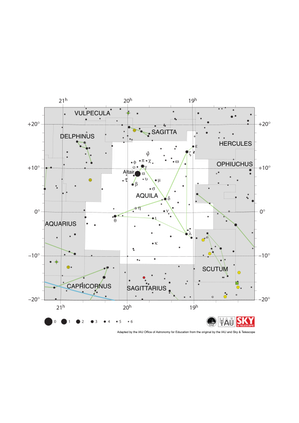
Aquila Constellation Map
Légende : The constellation Aquila with its bright stars and surrounding constellations. Aquila is surrounded by (going clockwise from the top): Sagitta, Hercules, Ophiuchus, Serpens Cauda, Scutum, Sagittarius, Capricornus, Aquarius and Delphinus. Aquila is most notable for its brightest star Altair. This forms one vertex of the prominent Summer Triangle asterism that is visible in northern hemisphere summer evenings.
Aquila spans the celestial equator and thus some part of it is visible from all of the Earth at some point in the year. It is most visible in the evenings in the late northern hemisphere summer and late southern hemisphere winter.
The y-axis of this diagram is in degrees of declination with north as up and the x-axis is in hours of right ascension with east to the left. The sizes of the stars marked here relate to the star's apparent magnitude, a measure of its apparent brightness. The larger dots represent brighter stars. The Greek letters mark the brightest stars in the constellation. These are ranked by brightness with the brightest star being labeled alpha, the second brightest beta, etc., although this ordering is not always followed exactly. The dotted boundary lines mark the IAU's boundaries of the constellations and the solid green lines mark one of the common forms used to represent the figures of the constellations. The blue line in the lower right of the diagram is the ecliptic. Neither the constellation boundaries, nor the line marking the ecliptic, nor the lines joining the stars appear on the sky.
Crédit : Adapted by the IAU Office of Astronomy for Education from the original by IAU/Sky & Telescope
License: CC-BY-4.0 Creative Commons (CC) Attribution 4.0 International (CC BY 4.0) Icônes
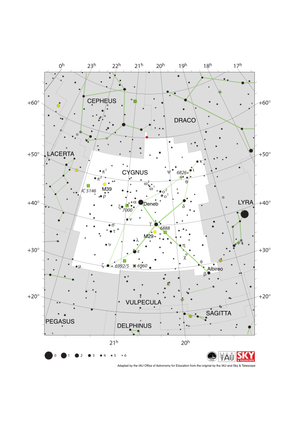
Cygnus Constellation Map
Légende : The constellation Cygnus with its bright stars and surrounding constellations. Cygnus is surrounded by (going clockwise from the top): Cepheus, Draco, Lyra, Vulpecula, Pegasus and Lacerta. Cygnus is notable for its brightest star Deneb. This forms one vertex of the prominent Summer Triangle asterism that is visible in northern hemisphere summer evenings.
Cygnus is a northern constellation and thus the whole of the constellation is visible at some point in the year in the whole northern hemisphere. The whole constellation is also visible from equatorial regions of the southern hemisphere with parts of the constellation visible from temperate southern regions.
The plane of the Milky Way runs through Cygnus and thus the constellation is rich in nebulae and star clusters. These include the North America Nebula (NGC 7000) and the Crescent Nebula (NGC 6888). The Veil Nebula is a huge supernova remnant, parts of which are marked here as NGC 6960 and NGC 6992/5. All of the previously-mentioned nebulae are marked with green squares. The planetary nebula NGC 6826 is marked here with a green circle superimposed on a plus sign. The open star clusters M29 and M39 are marked here with yellow circles.
The y-axis of this diagram is in degrees of declination with north as up and the x-axis is in hours of right ascension with east to the left. The sizes of the stars marked here relate to the star's apparent magnitude, a measure of its apparent brightness. The larger dots represent brighter stars. The Greek letters mark the brightest stars in the constellation. These are ranked by brightness with the brightest star being labeled alpha, the second brightest beta, etc., although this ordering is not always followed exactly. The dotted boundary lines mark the IAU's boundaries of the constellations and the solid green lines mark one of the common forms used to represent the figures of the constellations. Neither the constellation boundaries, nor the lines joining the stars appear on the sky.
Crédit : Adapted by the IAU Office of Astronomy for Education from the original by the IAU and Sky & Telescope
License: CC-BY-4.0 Creative Commons (CC) Attribution 4.0 International (CC BY 4.0) Icônes
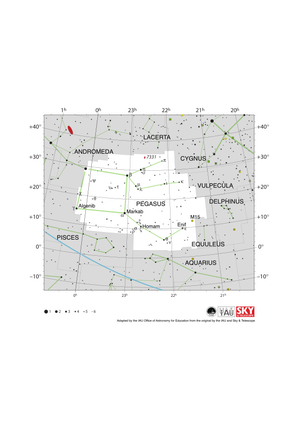
Pegasus Constellation Map
Légende : The constellation Pegasus with its bright stars and surrounding constellations. Pegasus is surrounded by (going clockwise from the top): Lacerta, Cygnus, Vulpecula, Delphinus, Equuleus, Aquarius, Pisces and Andromeda. Pegasus is known for the prominent asterism the “Square of Pegasus” which consists of its three brightest stars plus the brightest star in Andromeda.
Pegasus is a northern constellation and thus the whole constellation is visible at some point in the year throughout the northern hemisphere. The whole constellation is also visible to southern hemisphere equatorial and temperate zones with parts of the constellation visible from all but the most antarctic regions. Pegasus is best viewed in the evening in the northern hemisphere autumn and southern hemisphere spring.
The globular cluster M15 lies in Pegasus and is marked here with a yellow circle with a plus sign superimposed on it. The spiral galaxy NGC 7331 also lies in Pegasus and is marked here with a red ellipse.
The y-axis of this diagram is in degrees of declination with north as up and the x-axis is in hours of right ascension with east to the left. The sizes of the stars marked here relate to the star's apparent magnitude, a measure of its apparent brightness. The larger dots represent brighter stars. The Greek letters mark the brightest stars in the constellation. These are ranked by brightness with the brightest star being labeled alpha, the second brightest beta, etc., although this ordering is not always followed exactly. The dotted boundary lines mark the IAU's boundaries of the constellations and the solid green lines mark one of the common forms used to represent the figures of the constellations. The blue line at the bottom of the diagram marks the ecliptic. Neither the constellation boundaries, nor the lines joining the stars, nor the ecliptic, appear on the sky.
Crédit : Adapted by the IAU Office of Astronomy for Education from the original by the IAU and Sky & Telescope
License: CC-BY-4.0 Creative Commons (CC) Attribution 4.0 International (CC BY 4.0) Icônes
Ceci pourrait vous intéresser également








- Ressources
- Moteur de recherche des ressources pédagogiques
- Parcourir les ressources pédagogiques par Sujet
- Parcourir les images
- AstroEdu - Activités en classe
- Grandes Idées - Littéracie en astronomie
- Glossaire
- Rapports de l'OAE
- L'astronomie pour l'Education à travers le monde
- Sélection de ressources externes