Terme du glossaire : Noyau actif de galaxie
Description : Un noyau actif de galaxie (AGN) est une région très lumineuse située au centre d'une galaxie. On pense qu'il est alimenté par un trou noir supermassif qui accrète la matière environnante, formant autour de lui un disque d'accrétion extrêmement chaud. Les AGN ont des structures assez complexes, avec de nombreuses régions différentes qui émettent de la lumière avec des caractéristiques différentes, et sont souvent entourés d'un tore de matière poussiéreuse en forme de beignet. Un AGN émet parfois des jets de matière dans des directions opposées. Si de nombreuses galaxies ont un trou noir supermassif en leur centre, tous les centres de galaxie ne sont pas en train d'accréter de la matière et ne sont donc pas des AGN (une galaxie est active lorsqu'elle abrite un noyau actif, AGN).
Le terme AGN est un terme général qui englobe des objets tels que les quasars, les blazars, les galaxies de Seyfert et les radiogalaxies. On pense que les différentes propriétés d'observation de ces types d'objets résultent en partie du fait que les AGN sont observés sous des angles différents.
Termes associés :
Voir ce terme dans d'autres langues
Statut du terme et de sa définition : La définition initiale de ce terme en anglais a été aprouvée par un·e spécialiste de la recherche en astronomie et un·e spécialiste de l’éducation La traduction de ce terme et de sa définition n'ont pas encore été aprouvées
Le glossaire multilangue de l'OAE est un projet du Bureau de l'IAU de l'Astronomie pour l'Education (OAE) en collaboration avec le Bureau de l'IAU de diffusion de l'Astronomie (OAO). Les termes et définitions ont été choisis, écrits et relues grâce à un effort collectif de l'OAE, les Centres et les Noeuds de l'OAE, les Coordinateurs Nationaux de l'Astronomie pour l'Education de l'OAE(NAECs) et d'autres volontaires. La liste complète des crédits pour ce projet est disponible ici . Tous les termes du glossaire et leur définition sont déposés sous licence Creative Commons CC BY-4.0 et doivent être créditées au nom de "IAU OAE".
Si vous constatez une erreur dans ce terme ou sa définition, veuillez nous contacter .
Dans d'autres langues
- Arabe: النواة المجرية النشطة
- Bengali: সক্রিয় ছায়াপথ কেন্দ্রীণ
- Allemand: Aktiver Galaktischer Kern
- Anglais: Active Galactic Nucleus
- Espagnol: Núcleo Galáctico Activo
- Hindi: सक्रिय गैलेक्टिक नाभिक (ऍक्टिव्ह गॅलेक्टिक न्युक्लीअस)
- Italien: Nucleo galattico attivo
- Japonais: 活動銀河核 (Liens externes)
- Coréen: 활동은하핵
- Marathi: सक्रिय गॅलेक्टिक केंद्रक (ऍक्टिव्ह गॅलेक्टिक न्युक्लीअस)
- Portugais brésilien: Núcleo Galáctico Ativo
- Chinois simplifié: 活动星系核
- Chinois traditionnel: 活動星系核
Media associé

Jet Ejected from the Active Galaxy M87
Légende : A 3000-light-year-long jet streaming from the core of galaxy M87, as captured by the Hubble Space Telescope. The center of this image shows the core of the elliptical galaxy M87 (in the constellation Virgo) which hosts an active galactic nucleus (AGN).
An AGN is a very luminous region around a supermassive black hole. It is powered by matter falling towards the black hole and forming a hot accretion disk. Many galaxies host a supermassive black hole, but not all of them are accreting enough matter to appear as an AGN.
The strong gravity of the supermassive black hole in the heart of M87 has caused a huge jet of charges particles to be flung out from the accretion disk. This extends far out into the galaxy itself, beyond the core region. Here we see the jet as a whitish-blue line which gets wider the further it goes from the core. The light emission we see here is caused by the energetic electrons in the jet interacting with magnetic fields.
Crédit : NASA, ESA, A. Lessing (Stanford University), E. Baltz (Stanford University), M. Shara (AMNH), J. DePasquale (STScI)
Lien vers les crédits
License: CC-BY-4.0 Creative Commons (CC) Attribution 4.0 International (CC BY 4.0) Icônes
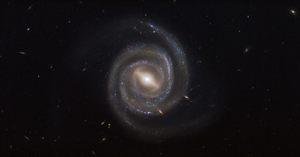
Hubble Image of Barred Spiral Galaxy UGC 6093
Légende : This image from the Hubble Space Telescope shows the barred spiral galaxy UGC 6093. This galaxy has two spiral arms in its outer regions but the inner edge of each arm joins with the outer edge of a straight bar feature that goes across the galaxy's center.
This galaxy has been classified as an active galaxy due to the emissions of certain lines in its spectrum. This indicates that the supermassive black hole that lies in the center of the galaxy is accreting gas from its surroundings. Unlike some active galactic nuclei (AGN), the center of this galaxy does not shine especially brightly in the visible light so its status as an AGN is not immediately visible from this image.
Crédit : ESA/Hubble & NASA
Lien vers les crédits
License: CC-BY-4.0 Creative Commons (CC) Attribution 4.0 International (CC BY 4.0) Icônes









- Ressources
- Moteur de recherche des ressources pédagogiques
- Parcourir les ressources pédagogiques par Sujet
- Parcourir les images
- AstroEdu - Activités en classe
- Grandes Idées - Littéracie en astronomie
- Glossaire
- Rapports de l'OAE
- L'astronomie pour l'Education à travers le monde
- Sélection de ressources externes