Termine del Glossario Diametro angolare
Descrizione Il diametro angolare di un oggetto è il suo diametro visibile da una posizione specifica, misurato come un angolo. Il diametro angolare è utilizzato in astronomia come una modalità per esprimere le dimensioni degli oggetti celesti nel cielo. Il diametro angolare aumenta con l'aumentare delle dimensioni fisiche di un oggetto e diminuisce quando un oggetto è più lontano. Ad esempio, la Luna e il Sole hanno entrambi un diametro angolare di circa mezzo grado se visti dalla Terra. La Luna è circa 400 volte più piccola del Sole, ma appare delle stesse dimensioni (circa mezzo grado di diametro), poiché il Sole è circa 400 volte più lontano.
Vedi questo termine in altre linguestatus del termine e della definizione La definizione originale di questo termine in inglese é stata approvata da un ricercatore astronomo e da un docente La traduzione di questo termine e della sua definizione sono state approvate da un ricercatore astronomo e da un docente
Il Glossario Multilingue OAE é un progetto dell'Ufficio IAU per la didatticadell'astronomia (OAE) in collaborazione con l'ufficio IAU OAO per la DivulgazioneAstronomica (OAO). I termini e le definizioni sono stater scelte, scritte eriviste da un impegno collettivo da parte di OAE, i Centri e i Nodi OAE e iCoordinatori Nazionali per la Didattica dell'Astronomia e da altri volontari.Potete trovare una lista completa dei crediti, Tutti i termini del glossarioE le definizioni sono pubblicate su Creative Commons CC BY-4.0 licenza e dovrebbero essere accreditate ad IAU OAE.
Se noti un errore di fatto o di traduzione in questo termine del glossario, per favore contattaci.
In Altre Lingue
- Arabo: القطر الزاوي
- Bengalese: কৌণিক ব্যাস
- Tedesco: Winkelausdehnung
- Inglese: Angular Diameter
- Spagnolo: Diámetro Angular
- Persiano: قطر زاویهای
- Francese: Diamètre angulaire
- Giapponese: 角直径 (external link)
- Coreano: 각지름
- Brasiliano Portoghese: Diâmetro angular
- Cinese semplificato: 角直径
- Cinese tradizionale: 角直徑
File multimediali correlati

Eclissi solare anulare
Didascalia: Questa immagine ritrae un'eclissi anulare, un tipo particolare di eclissi solare che si verifica quando la Luna passa direttamente davanti al Sole senza coprirlo completamente. Poiché la Luna si trova vicino al punto più lontano della sua orbita, ha una dimensione angolare inferiore al normale e appare quindi leggermente più piccola del Sole nel cielo. Se in questa situazione si verifica un'eclissi, la Luna blocca solo la parte centrale del disco solare, lasciando visibile un anello luminoso, spesso chiamato "anello di fuoco", attorno alla sagoma della Luna. Un'eclissi anulare è diversa da un'eclissi solare totale in quanto gli osservatori vedono questo anello luminoso anziché il Sole completamente oscurato.
Crediti: Utente di Wikipedia - Dpickd1
link ai crediti
License: CC-BY-4.0 Creative Commons Attribuzione 4.0 Internazionale (CC BY 4.0) icone
Diagrami correlati
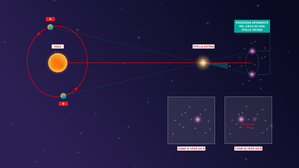
Parallasse annuale
Didascalia: La determinazione delle distanze ha rappresentato storicamente una sfida per l'astronomia. Uno dei metodi principali per misurare le distanze consiste nell'utilizzare la parallasse annuale. La Terra orbita attorno al Sole nel corso di un anno, il che significa che si sposta da un lato del Sole (qui indicato come posizione A) all'altro (posizione B) nell'arco di sei mesi. Nei sei mesi restanti, torna poi alla sua posizione iniziale. Questo movimento modifica leggermente la prospettiva da cui un osservatore sulla Terra vede il cielo notturno. È simile al cambiamento di prospettiva che si nota quando si osserva una scena prima con l'occhio sinistro e poi con il destro. Il cambiamento di prospettiva fa sì che gli oggetti vicini cambino posizione nella propria visione. Il moto annuale della Terra attorno al Sole modifica la prospettiva dell'osservatore in misura sufficiente da spostare le posizioni osservate degli oggetti celesti. L'entità di questo effetto dipende dalla distanza dall'oggetto celeste. Le stelle vicine avranno spostamenti di posizione osservati maggiori rispetto alle stelle più lontane.
Lo spostamento di posizione è noto come parallasse trigonometrica o annuale (che chiameremo qui α) ed è definito come lo spostamento di posizione di una stella rispetto a ciò che vedrebbe un osservatore al centro del Sistema Solare (il Sole). In questo diagramma vediamo la stella vista da due prospettive distanti sei mesi l'una dall'altra (posizioni A e B). Se osservata dalla posizione A, lo spostamento della stella sarà α, mentre se osservata dalla posizione B sarà –α. Pertanto, la differenza relativa nella posizione della stella tra l'osservazione dalla posizione A e quella dalla posizione B sarà 2α.
La grandezza della parallasse trigonometrica o annuale in secondi d'arco è approssimativamente pari a 1 diviso per la distanza in parsec. Un secondo d'arco (spesso rappresentato dal simbolo ″) è il diametro angolare che avrebbe un bastone lungo un metro se osservato da una distanza di 206 km. Un parsec (spesso abbreviato in pc) è pari a 3,26 anni luce o 30,86 trilioni di chilometri. Si tratta di 206.265 unità astronomiche (la distanza tipica tra la Terra e il Sole). Nessun'altra stella è più vicina di 1 pc al Sole, quindi tutte le stelle nel cielo hanno parallassi trigonometriche inferiori a un secondo d'arco.
Sebbene le parallassi trigonometriche siano state a lungo utilizzate per misurare le distanze dagli oggetti nel nostro Sistema Solare o dalle stelle vicine, i recenti progressi hanno ampliato ulteriormente i confini di queste misure di distanza. Il satellite Gaia ha esteso i confini delle misurazioni della parallasse a oltre mille parsec. Anche gli array di radiotelescopi possono misurare con estrema precisione le posizioni di oggetti molto distanti e quindi la loro parallasse trigonometrica.
Si noti che la Terra e il Sole non sono in scala in questa immagine, e che l'inclinazione dell'asse terrestre non è rappresentata con precisione.
Crediti: Aneta Margraf/IAU OAE
License: CC-BY-4.0 Creative Commons Attribuzione 4.0 Internazionale (CC BY 4.0) icone
Attività correlate
The sky at your fingertips
astroEDU educational activity (links to astroEDU website) Description: Build a simple cross-staff and measure the stars!
License: CC-BY-4.0 Creative Commons Attribuzione 4.0 Internazionale (CC BY 4.0) icone
Fasce d'età
10-12
, 12-14
Livello di istruzione
Middle School
, Primary
Aree di apprendimento
Informal/Field Trip Related
, Observation based
, Project-based learning
Costi:
Low Cost
Durata:
2 hours
Abilità:
Analysing and interpreting data
, Developing and using models