Terme du glossaire : Diamètre angulaire
Description : Le diamètre angulaire d'un objet est son diamètre visible à partir d'un endroit spécifique, mesuré sous forme d'angle. Le diamètre angulaire est utilisé en astronomie comme l'un des moyens d'exprimer la taille des objets célestes dans le ciel. Le diamètre angulaire augmente avec la taille physique de l'objet et diminue lorsque l'objet est plus éloigné. Par exemple, la Lune et le Soleil ont tous deux un diamètre angulaire d'environ un demi-degré lorsqu'ils sont vus de la Terre. La Lune est environ 400 fois plus petite que le Soleil, mais nous apparait avec la même taille (environ un demi-degré de diamètre), car le Soleil est environ 400 fois plus éloigné.
Voir ce terme dans d'autres languesStatut du terme et de sa définition : La définition initiale de ce terme en anglais a été aprouvée par un·e spécialiste de la recherche en astronomie et un·e spécialiste de l’éducation La traduction de ce terme et de sa définition n'ont pas encore été aprouvées
Le glossaire multilangue de l'OAE est un projet du Bureau de l'IAU de l'Astronomie pour l'Education (OAE) en collaboration avec le Bureau de l'IAU de diffusion de l'Astronomie (OAO). Les termes et définitions ont été choisis, écrits et relues grâce à un effort collectif de l'OAE, les Centres et les Noeuds de l'OAE, les Coordinateurs Nationaux de l'Astronomie pour l'Education de l'OAE(NAECs) et d'autres volontaires. La liste complète des crédits pour ce projet est disponible ici . Tous les termes du glossaire et leur définition sont déposés sous licence Creative Commons CC BY-4.0 et doivent être créditées au nom de "IAU OAE".
Si vous constatez une erreur dans ce terme ou sa définition, veuillez nous contacter .
Dans d'autres langues
- Arabe: القطر الزاوي
- Bengali: কৌণিক ব্যাস
- Allemand: Winkelausdehnung
- Anglais: Angular Diameter
- Espagnol: Diámetro Angular
- Perse: قطر زاویهای
- Italien: Diametro angolare
- Japonais: 角直径 (Liens externes)
- Coréen: 각지름
- Portugais brésilien: Diâmetro angular
- Chinois simplifié: 角直径
- Chinois traditionnel: 角直徑
Media associé

Annular Solar Eclipse
Légende : This image captures an annular eclipse, a special type of solar eclipse that occurs when the Moon passes directly in front of the Sun but does not completely cover it. Because the Moon is near the farthest point in its orbit it has a smaller angular size than normal and is thus slightly smaller in the sky than the Sun. If an eclipse occurs in this situation, the Moon only blocks the central portion of the Sun's disk but leaves a bright ring, often called the “ring of fire”, visible around the Moon’s silhouette. An annular eclipse is different from a total solar eclipse in that observers see this luminous ring rather than the Sun being fully obscured.
Crédit : Wikipedia user - Dpickd1
Lien vers les crédits
License: CC-BY-4.0 Creative Commons (CC) Attribution 4.0 International (CC BY 4.0) Icônes
Diagrammes associés

Annual Parallax
Légende : Distance determination has historically been a challenge for astronomy. One of the primary ways to measure distance is to use annual parallax. The Earth orbits around the Sun over the course of a year meaning that it moves from one side of the Sun (shown here as position A) to the other side of the Sun (position B) over the course of six months. It then moves back to its original position over the remaining six months. This movement subtly changes the perspective an observer on Earth sees the night sky from. This is similar to the change in viewing perspective you may get when viewing a scene from your left eye and then your right eye. The change of viewing perspective causes nearby objects to shift in position in your vision. The annual motion of the Earth around the Sun changes the perspective of the observer enough to shift the observed positions of celestial objects. How big this effect is depends on the distance to the celestial object. Nearby stars will have bigger shifts in observed position than more distant stars.
The positional shift is known as the trigonometric or annual parallax (which we will call α here) and is defined as the shift in position of a star compared to what an observer at the center of the Solar System (the Sun) would see. In this diagram we see the star viewed from perspectives six months apart (positions A and B). When observed from position A the star’s shift in position will be α while when observed at position B it will be –α. Thus the relative difference in the stars position between being observed at position A and position B will be 2α.
The size of the trigonometric or annual parallax in arcseconds is approximately 1 divided by the distance in parsecs. An arcsecond (often represented by a ″ symbol) is the angular diameter a one-metre-long stick would have when viewed from 206 km away. A parsec (often abbreviated to pc) is 3.26 light years or 30.86 trillion kilometres. This is 206,265 astronomical units (the typical distance between the Earth and the Sun). No other star is closer than 1 pc to the Sun so all stars in the sky have trigonometric parallaxes less than one arcsecond.
While trigonometric parallaxes have long been used to measure the distances to objects in our Solar System or nearby stars, recent advances have pushed the boundaries of these distance measures further. The Gaia satellite has pushed the boundaries of parallax measurements to over a thousand parsecs. Arrays of radio telescopes can also very accurately measure the positions of very distant objects and thus their trigonometric parallax.
Note the Earth and Sun are not to scale here and the Earth’s axial tilt is not accurately represented.
Crédit : Aneta Margraf/IAU OAE
License: CC-BY-4.0 Creative Commons (CC) Attribution 4.0 International (CC BY 4.0) Icônes
Activités associées
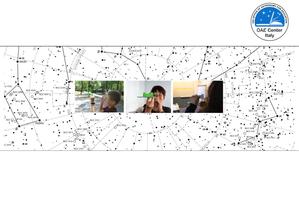
The sky at your fingertips
astroEDU educational activity (links to astroEDU website) Description: Build a simple cross-staff and measure the stars!
License: CC-BY-4.0 Creative Commons (CC) Attribution 4.0 International (CC BY 4.0) Icônes
Tranches d'âge :
10-12
, 12-14
Niveau scolaire :
Collège
, Primaire
Domaines d'apprentissage :
Informel/lié à une sortie scolaire
, Basée sur l'observation
, Apprentissage par projet
Coûts :
Faible
Durée :
2h
Compétences :
Analyser et interpréter des données
, Développer et utiliser des modèles
Ceci pourrait vous intéresser également










- Ressources
- Moteur de recherche des ressources pédagogiques
- Parcourir les ressources pédagogiques par Sujet
- Parcourir les images
- AstroEdu - Activités en classe
- Grandes Idées - Littéracie en astronomie
- Glossaire
- Rapports de l'OAE
- L'astronomie pour l'Education à travers le monde
- Sélection de ressources externes